
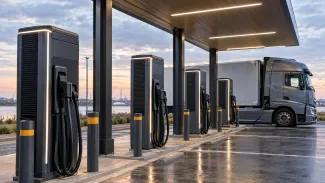
Eight bays between Antwerp and Ghent
Temse sits in Belgium's largest port and logistics region, on the TEN-T corridor running from the North Sea to the Mediterranean. Milence describes the site as a node on that route. Four of the eight charging spots carry both MCS and CCS connectors, the remaining four are CCS only at up to 400 kW.
Drivers get sanitary facilities, vending machines and outdoor seating. Those are small things in a car article. On a truck stop that can run past 40 minutes, they are the difference between a usable hub and a fence with cables behind it.
First Milence site with four megawatt posts
Three earlier Milence locations have MCS: Antwerp, Zwolle and Landvetter. Each of those has a single megawatt charger rated up to 1.2 MW. Temse has four, rated up to 1.5 MW. The hardware comes from Power Electronics, and Milence also has a megawatt charging partnership with Alpitronic.
Temse is part of the MACBETH project, a group of industry partners working on the technical and economic problems of deploying megawatt charging at scale. The Belgian hub will feed data into that work.
Megawatt charging is not a European-only story. Chery's Volt-Dragon charger in China is rated at 1.44 MW, with a claimed 10–97% in 6:50 for a passenger car. Cars and trucks are chasing the same power figures with very different batteries behind the connector.
Charging time at 1.5 MW
The 1.5 MW rating is a ceiling per post. Take a tractor unit with a 500 kWh usable pack, charging from 20 to 80%. That is 300 kWh. If the truck held an average of 1 MW across the whole window, the stop would take 18 minutes.
Real packs taper, and Milence has not published charging curves from Temse, so the average will be lower than the peak. A 40-tonne truck also arrives with a pack that has been cycling all day, not a pre-conditioned one from a home charger.
For scale: the fastest passenger cars are now in the 400–500 kW class. The BMW iX5 is quoted at 460 kW. One MCS post at Temse is rated at more than three of those at once.
€0.379 per kWh and the cost per 100 km
Ad-hoc charging in Belgium starts at €0.379/kWh excluding VAT, for CCS and MCS alike. Belgian VAT is 21%, so a driver paying it in full hands over roughly €0.459/kWh.
Put that into a per-100-km figure. A loaded 40-tonne tractor unit on the motorway uses somewhere around 1.0 to 1.3 kWh/km. At 1.2 kWh/km, 100 km needs 120 kWh, which comes to €45.48 excluding VAT. A diesel truck at 30 l/100 km and roughly €1.55 a litre lands near €46.50 for the same distance. At 1.0 kWh/km the electric figure drops to €37.90; at 1.3 kWh/km it climbs to €49.27.
At the ad-hoc rate the two are close, and consumption decides which one wins. That is why volume agreements matter in this segment. Milence offers lower rates to customers who commit to volume, and a fleet charging at its own depot will usually beat both numbers.
The same rate looks very different in a car. At 20 kWh/100 km, €0.379/kWh works out to €7.58 per 100 km. You can run your own consumption figures through our charging cost calculator.
Where our charging data stops
Our supercharger database covers 483 locations across Europe with prices for each. Temse is not in it, and that is not an oversight. Those 483 sites are built around cars: shorter bays, lower power, payment by card or app. Truck hubs run on contracts, reserved bays and a different grid connection.
The cheapest locations in our database show what a car driver pays per kWh. They say nothing about what a haulier pays in Temse.
39 hubs, eleven under construction
Milence now lists 39 operational hubs in Europe and eleven more under construction. Temse is the fifth in Belgium. The company frames the site as a step toward a reliable European truck charging network, and the EU's AFIR rules push the same way: member states have to build truck charging pools along the TEN-T core network, with minimum capacity thresholds that rise by 2030.
What stays open is the part a press release cannot answer. Four 1.5 MW posts only help if the trucks arrive with packs and cooling that accept the power, and if the local grid can feed them. The MACBETH measurements from Temse should produce the first real numbers on that.