
What the US recall covers
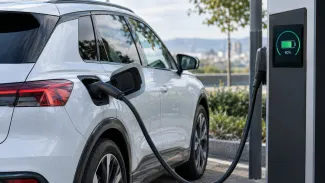
The recall documents filed with the National Highway Traffic Safety Administration (NHTSA) carry campaign number 26V698; Audi's own reference is 93SK. Audi says it is not aware of any claims, crashes, fires, injuries or deaths connected to the Q4 e-tron battery issue, and that the root cause has not been determined.
Interim owner letters are due to be mailed on 18 December 2026. Until a remedy exists, owners are advised to keep the state of charge at or below 80%. An authorised dealer will run a diagnostic check on the battery and, if needed, apply a temporary charge limit. US owners can call Audi on 1-800-253-2834.
The Q4 recall follows the 8 October recall of 22,524 Volkswagen ID.4 SUVs (model years 2023 to 2026). In that filing VW wrote that "certain charging profiles combined with a state of charge over 80% may trigger thermal propagation" – the spread of heat from one failing cell to its neighbours. ID.4 owners received an email saying VW intended to apply a remote setting limiting charging to 80% unless they opted out by 21 October.
The European recall is larger
The US paperwork is not the whole story. Last week Volkswagen Group filed three separate recalls with Germany's Federal Motor Transport Authority (KBA) covering 72,668 electric vehicles worldwide, including 9,881 in Germany. Those campaigns cover certain batches of the ID. Buzz, ID.3, ID.4 and ID.7 built between 2022 and 2025, plus Cupra Born models from 2022 to 2024.
If you drive one of those cars in Europe, the practical route is your dealer or the KBA recall database, not the NHTSA site. The documents cited here cover US vehicles, and Audi states that the majority of the affected Q4 e-tron production was built for the North American market. Whether European-built Q4 cars share the same battery batches is not stated in the filings.
What 80% means in kilometres
An Audi Q4 e-tron with the large pack has about 77 kWh of usable capacity. Cap it at 80% and you can draw on 61.6 kWh. The remaining 15.4 kWh sits in the battery and does nothing for you.
Put that against consumption. At 18 kWh/100 km, 61.6 kWh gives roughly 342 km; the full 77 kWh would give about 428 km. At a winter figure of 24 kWh/100 km, the capped pack is good for around 257 km. You can run your own numbers in our range calculator.
For most families the daily routine barely changes, because 80% is a sensible default for nickel-based cells anyway. The pinch comes on long holiday drives, where you would normally leave a fast charger at 90% or more to reach the next stop. That last slice is now gone, and it will usually be worth one extra charging stop per long day.
What the extra stops cost
Home electricity and public DC charging are not the same money. Take an illustrative household price of €0.25/kWh and a motorway charger at €0.69/kWh. Every 15.4 kWh you now buy on the road instead of at home costs about €6.80 more. One long trip a week, and you are looking at roughly €27 a month. Our charging cost calculator lets you plug in your own tariff and your own car.
Planning matters more than usual. Our Supercharger database currently lists 483 locations, and the cheapest-charging list shows where a stop costs least. Pack size is also creeping up across the market: Ford now fits an 88 kWh pack as standard to the Select and Premium Mach-E trims, which makes an 80% cap less painful than it would have been on a smaller battery.
What to do if your car is affected
- Check your VIN. US owners can search nhtsa.gov/recalls with campaign 26V698. European owners of the ID.3, ID.4, ID.7, ID. Buzz or Cupra Born should ask their dealer whether their car falls under the KBA campaigns.
- Do not opt out of the software limit. It is there because a full battery under certain charging profiles is the condition linked to the problem.
- Book the diagnostic. The dealer check is free under the recall and takes the place of guessing whether your pack is affected.
- Ask about the remedy in writing. Interim letters go out in December; a permanent fix and a date for it are not in the documents yet.
- Plan long drives around 80%. Fewer, shorter top-ups in the 10–60% band are quicker than chasing a full battery you cannot reach.
The root cause is still open
Audi's Product Safety Committee was told about battery thermal events in other Volkswagen Group EVs that use the same cells as the Q4 e-tron. An internal investigation then found the same battery and production characteristics as in the affected VW Group cars. That is why the recall was filed before anyone knew what actually failed.
Cell supply is shifting in the background. Svolt has started series production of a 100 kWh semi-solid battery pack, one of several attempts to move away from the chemistry used in most packs on the road today. It does nothing for a Q4 e-tron sitting on a dealer forecourt this winter.
As of 28 October 2026, neither Audi nor Volkswagen has published a root cause, and no date for the permanent repair has been given. Owners get a diagnostic check, an 80% limit and a letter in December.
Source: https://electrek.co/2026/10/27/vws-ev-recall-spreads-to-audi-owners-told-stop-at-80-charge/