
The version ladder
| Version | Price | Battery | WLTP | DC peak | 0–100 km/h |
|---|---|---|---|---|---|
| Standard Range | €35,600 | 58.3 kWh | 445 km | 193 kW | — |
| RWD, 71.2 kWh | — | 71.2 kWh | 520 km | — | — |
| AWD, 71.2 kWh | — | 71.2 kWh | 440 km | — | — |
| Tested by electrive (Ultra) | — | 71.2 kWh | — | — | 4.5 s |
DC peak: for the larger 71.2 kWh pack, 236 kW; the source quotes this for the pack, not per drivetrain.
Only the Standard Range price is documented in the source. The 4.5 s 0–100 km/h figure comes from the L03 electrive tested, which had the 18-speaker Ultra equipment; it is not a base-model acceleration figure.
Charging: the same C-rate in both batteries
Xpeng stayed on 400 volts and pushed the cells hard. A 236 kW peak on a 71.2 kWh pack works out to 3.3C. The smaller 58.3 kWh pack peaks at 193 kW, which is also 3.3C. Identical stress on the cells, same under-20-minute window from 10 to 80 per cent.
The peak is not the useful figure. Even allowing the full 20 minutes, the 71.2 kWh pack moves 49.8 kWh in that 10–80 per cent window, an average of 149 kW, or 63 per cent of its peak. The 58.3 kWh pack moves 40.8 kWh over the same time, an average of 122 kW. That is a flat curve by current standards, and it matters more than the headline number on a motorway stop. On AC the car takes 11 kW: about 6.2 hours from 5 to 100 per cent on the 71.2 kWh pack and about 5.0 hours on the 58.3 kWh pack, slightly more with charging losses. Vehicle-to-load is standard.
What 520 km WLTP means on the road
The 71.2 kWh RWD version claims 13.7 kWh/100 km on the WLTP cycle – 71.2 kWh divided by 520 km. That is a lab figure. Add the usual 20 to 30 per cent for motorway speeds, heating and a family on board and you land near 17–18 kWh/100 km, which is roughly 400–420 km of real range. For the Standard Range, the same arithmetic gives 13.1 kWh/100 km from 58.3 kWh and 445 km.
No independent winter test exists yet. When it does, our range calculator is where to check it against the WLTP claim.
Cost per 100 km
Take 17 kWh/100 km and two prices. At €0.25/kWh from a home wallbox that is €4.25 per 100 km. At €0.45/kWh on public DC, realistic for Central Europe, it is €7.65. A petrol car at 6.5 l/100 km and €1.55/l costs about €10.08. Over 15,000 km a year the gap is roughly €875 against home charging, or €365 if you rely on public DC. Our charging cost calculator takes your own tariff; the list of the cheapest DC locations in our database is the place to check public charging prices.
What the documented price buys
On the only documented German price, the Standard Range costs €611 per kWh of battery capacity (€35,600 / 58.3 kWh) and €80 per kilometre of WLTP range (€35,600 / 445 km). Because the upper-trim prices are not in the source, a battery-step premium cannot be calculated from documented figures.
Space for people, little for luggage
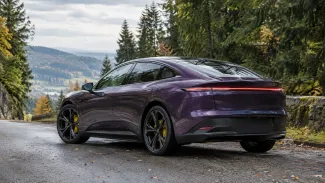
The boot holds 367 litres, a modest figure for a 4.65-metre family car. The frunk adds 89 litres in rear-wheel drive and 44 litres with all-wheel drive. Rear passengers get reclined backrests and decent headroom despite the sloping roof, and the front seats have massage, ventilation and heating – unusual below €40,000. Only the front seats, though.
On the road the body rolls more than the chassis deserves and the steering stays soft even in its firmest setting, according to electrive's notes from the Black Forest and Alsace. The assistance system holds lane and distance up to 150 km/h with capacitive hand detection, and automatic parking is too slow for street-side use. On the motorway, electrive reports brisk acceleration up to the electronically limited 193 km/h, and recorded 4.5 s to 100 km/h in its Ultra-equipped test car.
European deliveries and what stays open
Xpeng says European deliveries start before the end of 2026. No independent consumption or charging test of the L03 has been published; the WLTP figures and the under-20-minute 10–80 per cent claim remain the key numbers until then. Full specifications for the models already in our database are in the EV catalog.