
What Yangwang has actually confirmed
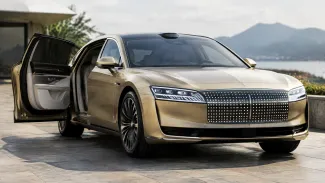
Yangwang general manager Hu Xiaoqing said on Friday that the Altior will be the first BYD model with rear-hinged rear doors. He put the opening angle at nearly 90 degrees, which matters in a car this long: the rear door aperture, not the wheelbase, is what decides whether an adult can get out at a kerb without unfolding themselves in stages.
Hu also showed the front end. There is a dot-matrix grille that BYD calls Gemstone and headlights with a crystal-style internal pattern. That is the sum of the official information. Everything else, including the door handles, the roof line and the interior, is still covered by the camouflage that appeared in September.
Size puts it next to the Maybach
At roughly 5,500 mm the Altior sits within a few centimetres of the Mercedes-Maybach S-Class (about 5,470 mm) and a little under the Rolls-Royce Phantom (about 5,760 mm). For scale inside BYD's own range: the Ocean MPV we reported on earlier measures 5,145 mm, so the Altior adds another 355 mm on top of an already large seven-seater.
Yangwang sits above the main BYD brand and above Denza, in the same way that Maybach sits above Mercedes. The brand's current line-up is the U7 sedan, the U8 off-roader and the U9 supercar, all of which debuted with hardware from BYD's newest shelf: the quad-motor e4 platform, the second-generation Blade battery and the DiSus-X body control system.
The five-minute charging claim in kilowatts
One of the preview images shows the car plugged into a BYD Flash Charge post. That gives us something to calculate with. Take a generous 20 kWh/100 km for a 5.5-metre limousine and a 400 km top-up: that is 80 kWh. Delivered in five minutes, 80 kWh works out to 960 kW average power across the whole session. A real charging curve needs a peak above that average, so the Altior would have to sit in the 1 MW class.
BYD's own Super e-Platform, shown in 2025, quotes up to 1 MW at 1,000 V and a 10C battery. The arithmetic and the marketing line up. Whether a production car holds anywhere near that average for five minutes is a different question, and there is no independent measurement yet. Our real-world range tool is built on Bjørn Nyland's test data, and it holds no Yangwang entries at all, because no Yangwang has been through that test cycle.
Infrastructure is the other half. The fastest public chargers in Europe today top out around 400 kW, with 500 kW hardware only starting to appear. A 1 MW car would spend most of its life well below its own ceiling. Grid connections are the bottleneck further upstream: our earlier piece on Irish depots offering 500 kW of grid flexibility shows the scale of connection that sites of this kind need before a megawatt column makes sense.
Solid state is still a rumour
Several outlets expect the Altior to be BYD's first car with a solid-state battery. BYD executive vice president Stella Li said in September that the company's first solid-state vehicle will debut in 2027. She did not name it. The Altior's launch timing, which is reportedly days away, and the 2027 date do not obviously fit together, and BYD has confirmed nothing on chemistry. Treat the solid-state line as unverified.
Price against Yangwang's own range
The rumoured 2 million yuan starting price converts to about $300,000 and, at roughly 7.75 yuan per euro, about €260,000. Yangwang's existing electric sedan, the U7, starts at 658,000 yuan (about €85,000). The U8L SUV, the brand's most expensive series-production model, starts at 1.45 million yuan (about €187,000). The Altior would therefore cost about three times the U7 and still sit clearly above the U8L.
Charging cost does not scale with the price tag. Public charging in Europe is billed per kWh, so a megawatt peak shortens the stop but not the invoice. Our database of 483 European charging locations is where to check what a session actually costs; the charging cost calculator converts that into euros per 100 km.
Dubai first, Europe unconfirmed
Hu said the global launch will take place in the United Arab Emirates rather than in China, which is unusual for a Chinese flagship. CarNewsChina, citing unnamed sources, puts the date around 5 November. BYD has published no date, no output figures, no battery capacity, no range and no European pricing. The doors and the grille are confirmed. The rest arrives, or does not, in Dubai.
Source: https://electrek.co/2026/10/30/byd-reveals-flashy-new-feature-upcoming-luxury-ev/