
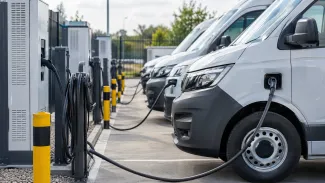
Four depots in Cork, Galway and Dublin
An Post operates three of the sites, in Cork and Galway. DHL Express Ireland operates the fourth, in Dublin. Together the locations hold 211 electric vehicles and 181 charging points, with up to 500 kW of flexible demand between them. That 500 kW is the project's own figure for how much charging load can be shifted or curtailed when the electricity system asks for it.
The arithmetic behind 500 kW
Split across the fleet, 500 kW works out at about 2.4 kW per vehicle, 2.8 kW per charge point, and roughly 125 kW per depot. These are small blocks. The point of the project is aggregation, not size at any single site.
For scale, 500 kW is about the peak output of one high-power DC charger.
A second calculation shows the share of daily energy that could move. Take a delivery van covering 100 km a day at 25 kWh/100 km. That is 25 kWh per van, or about 5.3 MWh across 211 vehicles. Shifting the full 500 kW for two hours moves 1 MWh, close to a fifth of the fleet's daily energy. The pilot has not published consumption data for these vans, so read that as a ratio, not a measurement.
Who does what
eStation and The Mobility House Solutions supply and install the charging and energy management hardware and software. VIOTAS provides the route into EirGrid's flexibility markets, so the depots can offer their load the way a generator or a large industrial consumer does. Mitsui Ireland and ESB Smart Energy Services are also partners in the project.
Vehicles still have to leave on time
The control system sits between two sets of signals. One is the depot's timetable. The other is the state of the electricity system, where demand is high or where wind generation is abundant. Charging is scheduled around both, with the operating requirement taking precedence.
Shane Mullarkey, business development at Mitsui Ireland, described the fleets as "a powerful distributed battery resource" and said smart charging and vehicle-to-grid technology let operators shift load towards periods of abundant renewable generation. The project announcement refers to vehicle-to-grid as a capability of the wider concept; the pilot's hardware description covers charging and energy management, not bidirectional discharge.
The cost side
A depot buys electricity on a commercial tariff, not at the per-kWh prices a passing driver sees in our supercharger database of 483 locations. Illustrative arithmetic: 25 kWh/100 km at €0.20/kWh comes to €5.00 per 100 km in energy cost, before any revenue from flexibility. Our charging cost calculator lets you substitute your own tariff and consumption for those round numbers.
Revenue from grid services is the part the announcement leaves open. No expected income per site, per vehicle or per MWh is published.
Related work in Europe
Ireland is not the only European market pushing money into the electricity side of charging. The UK has committed £100 million to support cheaper low-powered AC charging from spring 2027, which addresses the same problem from the infrastructure end rather than the market end.
Commercial fleets are also being shaped by weight rules. Truck makers have asked the EU to keep the four-tonne battery allowance in the rules for heavy vehicles, a decision that sets how much payload an electric hauler gives up. Depot charging and vehicle weight are two different constraints on the same business case.
What is not in the announcement
The partners have given no revenue estimate for the flexibility sold, no duration for the pilot and no expected number of grid calls per month. The 500 kW ceiling and the 181 charge points are the only capacity figures released. Whether the model scales depends on those missing numbers: a depot that is rarely called earns little, and one that is called during its busiest shift has to buy back the schedule elsewhere.