
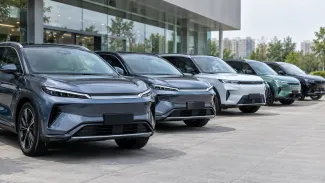
BYD: 483,125 cars, at least 62% of them electric
The four sub-brands add up exactly to the reported total. Dynasty and Ocean sold 423,843 vehicles, Fang Cheng Bao 43,872, Denza 15,152 and Yangwang 258. That is 2.25 times Geely's figure – first place is no longer a close fight.
More than 300,000 of those cars were battery-electric, according to our report on BYD's October BEV volume. That works out to at least 62% of the total, with plug-in hybrids covering the remainder. For a company that built its volume on DM-i hybrids, the split has quietly flipped.
Geely: 214,996, and 10,607 cars without a label
Geely Galaxy accounted for 153,385 vehicles, Zeekr for 32,483 and Lynk & Co for 18,521. Those three sum to 204,389. The remaining 10,607 units in the 214,996 total are not broken out by brand in the release, so the sub-brand table does not fully reconcile with the headline number.
Against BYD, Geely's NEV volume is 44.5%. Zeekr alone at 32,483 is now roughly the size of Nio's whole group, which delivered 34,246.
Leapmotor: four months above 100,000
Leapmotor delivered 106,127 vehicles, up 50.99% year on year. Running that growth rate backwards puts October 2025 at roughly 70,300 units – the brand added about 36,000 cars a month in twelve months. October was the fourth consecutive month above the 100,000 mark, and the company says it will hand over its two-millionth vehicle in November.
Leapmotor is also the one brand in this list with a direct European retail channel, through its Stellantis joint venture. If you want to compare what is actually on sale here, our EV catalog lists 67 models with full specifications.
Xpeng: 50,237, a quarter of them abroad
Xpeng handed over 50,237 cars globally, up 21.8% month on month and 19.6% year on year – a monthly record. Overseas deliveries hit 13,326 units, up 166% year on year. That is 26.5% of the month's volume leaving China, a share that would have looked unrealistic for the brand two years ago.
HIMA halves, Li Auto slips under 30,000
Huawei's HIMA network delivered 33,537 units, down 50.8% year on year and 10.5% month on month. The figure covers Aito, Luxeed, Stelato, Maextro and Shangjie. A halving of volume in twelve months is the largest decline in the whole set.
Li Auto delivered 29,025 cars, down 8.6% year on year and 8.8% month on month. October was the first month in which the company built cars with no CATL batteries at all. Battery supply in China is shifting in parallel – sodium-ion packs were exempted from consumption tax through 2028.
Nio delivered 34,246 vehicles: 18,125 under the Nio brand, 8,383 Onvo and 7,738 Firefly. January–October came to 334,547, up 38.5% year on year, which implies about 241,500 cars in the same period of 2025.
The rest of the table
Changan Nevo delivered 63,648 units, up 36.9% month on month and 75% year on year; its Deepal brand added 32,602. Great Wall Motor sold 49,499 NEVs, including 12,187 Ora and 8,648 Wey. GAC Aion reached 42,357, up 56.8% year on year. BAIC NEV sold 32,502, of which ArcFox supplied 26,325 – four fifths of the total. Voyah delivered 13,030.
Xiaomi reported more than 50,000 units. Its full-year target is 550,000, and the company says it has reached about 60% of it – roughly 330,000 cars after ten months.
What the numbers say about the fourth quarter
Two things are measurable. First, the record months at Leapmotor and Xpeng are coming from volume outside the premium segment and, for Xpeng, increasingly from exports. Second, the decline at HIMA and Li Auto shows that a strong brand name does not protect a monthly number in a market this crowded.
Xiaomi's arithmetic is the tightest constraint in the table. To reach 550,000 from roughly 330,000, it needs about 220,000 cars in November and December combined – roughly 110,000 a month, more than double its October volume in each of the two months. Leapmotor's two-millionth delivery is scheduled for November.