
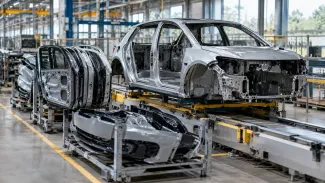
Eight stages, 100 workers, 4,100 cars a year
The line takes pre-production vehicles first and is meant to handle end-of-life cars later. Construction and approvals took nine months and finished three months ahead of schedule; VW says it can reuse existing manufacturing equipment to keep costs down. Zwickau already builds six MEB-based models for Volkswagen, Audi and Cupra. The last combustion car left the plant in June 2020, and the conversion closed in January 2022 with the ID.5.
The arithmetic behind 4,100 vehicles
Spread over a typical 250-working-day year, 4,100 cars means about 16 vehicles per working day, or roughly one car per hour per shift during two-shift operation. Divided by the 100 retrained employees, that is 41 vehicles per worker per year. With the announced envelope of €90 million, the investment works out to about €21,950 per unit of annual capacity – a figure that only makes sense once the line runs reliably, which is why the 2027 ramp-up matters more than the opening ceremony.
The scale is tiny next to production. Zwickau was laid out for more than 300,000 cars a year, so 4,100 is roughly 1.4% of that. Volkswagen Group has built over a million MEB cars; at 4,100 a year, dismantling a million vehicles would take about 244 years. This is not a solution to the end-of-life question. It is a pilot with a business plan attached.
Parts first, plastic second
The revenue line that VW talks about most is used original parts. Doors, bumpers, motors and transmission components are reportedly in highest demand, sold through dealer and service networks, independent workshops and parts retailers. The logic is straightforward: a cheaper motor or door can keep a seven-year-old ID.3 on the road instead of turning it into a write-off.
Material recovery comes next. VW says plastic separated from one vehicle could contribute recycled material to three new cars, though not all of the plastic in those cars. That sentence is worth reading twice. It is a contribution, not a closed loop, and the company gives no tonnage.
Brussels sets the recycled-content targets
European rules are pulling in the same direction. The EU Battery Regulation (2023/1542) requires documented recycled content in EV batteries from 18 August 2031: 16% cobalt, 85% lead, 6% lithium and 6% nickel, rising to 26% cobalt, 12% lithium and 15% nickel from 18 August 2036. The Commission's 2023 proposal for an End-of-Life Vehicles Regulation targets 25% recycled plastic in new vehicles, a quarter of it from scrapped cars. The existing ELV directive already demands 85% reuse and recycling and 95% reuse and recovery by weight.
Those numbers explain why a carmaker would rather control dismantling than leave it to scrapyards. The material has to come from somewhere, and the paper trail has to hold.
Renault and Stellantis sell used parts too
VW is not first here. Renault has run its Flins site near Paris as a Re-Factory since 2020, covering refurbishment, parts remanufacturing and recycling, and Stellantis sells remanufactured components under its SUSTAINera brand. What is different at Zwickau is the location: a plant that builds new EVs now also takes them apart, using the same roof and some of the same equipment.
What an owner can do with this
If you drive an MEB car, the practical question is whether a recovered original motor or door is worth buying over a new part or a scrapyard unit. Ask for the provenance and the warranty in writing, because VW has published neither. For running costs on a car you intend to keep, our EV savings calculator and the charging cost calculator give you the per-100-km figure you can compare with a repair bill. Specifications for current models are in our EV catalog.
No product planned after 2031
Zwickau has no vehicle production planned beyond 2031, so the recycling line does not secure the plant's long term on its own. VW says the business could eventually support 1,000 jobs; that is a projection, not a schedule. Pressure from Chinese brands keeps rising in the meantime, including models aimed squarely at European families such as the BYD Ocean MPV, 5,145 mm long with seven seats.
What remains open is the part that decides whether this works commercially: VW has not disclosed part prices, sales volumes, warranty terms, or how it inspects a motor or a door before resale. Until those numbers exist, 4,100 cars a year is a capacity figure, not a business case.
Source: https://insideevs.com/news/813972/vw-zwickau-dismantling-ev-line/