
What the tax change says
Announcement No. 20 (2026) came from the Ministry of Finance, the General Administration of Customs and the State Taxation Administration on 16 July. From 1 September 2026, specified lithium-ion batteries carry a 2% consumption tax. That rises to 4% on 1 September 2027. Sodium-ion, solid-state and fuel-cell batteries stay exempt through the end of 2028, provided they meet the relevant national standards. The full text is on the Chinese tax administration site. There is no equivalent chemistry-based consumption tax in the EU.
The tax gap in euros and yuan
Percentages hide the size of the thing, so let's put numbers on it. On 22 October, square LFP cells for EVs averaged 0.41 yuan per Wh. A 60 kWh pack holds roughly 60,000 Wh of cells, so at that price the bare cells cost about €3,000 (24,600 yuan at the late-October rate of 8.20 yuan to the euro). A 2% consumption tax on that value comes to about €60 (492 yuan); at 4% it doubles to about €120 (984 yuan). For reference, the source's dollar conversions put the cell cost at about $3,420, the 2% tax at roughly $68 and the 4% tax at about $137.
That 2% is applied to the bare cell cost derived from the source's 0.41 yuan/Wh square-LFP cell price, with pack assembly, housing and electronics excluded, so the tax on a complete pack would be somewhat higher. That is the whole advantage on a mid-size family car: tens of euros, not thousands. It only becomes a real advantage if sodium cells cost the same as LFP to begin with. On 28 October, battery-grade lithium carbonate sat at about 97,000 yuan ($13,500) per tonne. Cheaper lithium narrows the gap sodium was supposed to exploit.
Hina's 10 GWh plant in Wuhan
Hina Battery signed an agreement with Wuhan's Jiangxia District on 14 October for a sodium-ion production base with planned annual capacity of 10 GWh. The first phase is 3 GWh. Construction is due to start in early 2027, with initial output before the end of that year. A separate deal with Chengli Special Automobile covers sodium-ion sanitation vehicles: refuse collection, hook-lift, dust suppression and food-waste trucks. The chassis approval application is planned for early 2027, followed by prototypes, demonstration vehicles and small-volume orders.
Those vehicles make sense as a first market. The chassis has room for a big pack, and the routes are fixed, so performance can be measured under known conditions. A passenger car offers neither advantage.
A 339 kWh truck at minus 40 °C
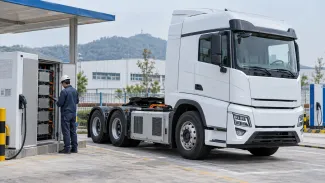
Hina's published specifications list at least 145 Wh/kg and an operating range of minus 40 to 80 °C. A FAW Jiefang J6P tractor with a 339 kWh Hina pack ran nearly seven months and more than 15,000 km. FAW Jiefang reported that the battery held above 90% of usable capacity at minus 40 °C. In August, Hina and Tonly delivered a mining truck with a 676 kWh system to the Tangshan Sanyou mine in Hebei Province.
At 145 Wh/kg, a 339 kWh pack weighs at least 2,338 kg. The 676 kWh version comes to roughly 4,662 kg. Scale that down to a 60 kWh family car and you are looking at about 414 kg of cells before the housing, cooling and wiring go in. Weight is one reason sodium is not heading for your driveway yet. If you want to see which chemistries the cars sold in Europe actually use, our EV catalog lists the models and their packs.
Hard carbon is where the cost sits
Sodium is spread more evenly around the world than lithium, which is the supply argument you hear most often. Cheap raw material does not make a cheap cell. Commercial sodium-ion batteries use hard-carbon anodes made from coal, biomass and other carbon-rich feedstock, and producing the right structure takes controlled processing. That adds cost and manufacturing complexity. Sodium-ion has not yet shown a consistent cost advantage over LFP.
The downstream chain is also concentrated in China, including cell, cathode and hard-carbon production. A tax exemption does not change that.
Standards cover storage, not traction
China published GB/T 48072-2026 on 28 August, setting safety requirements for sodium-ion cells and batteries used in electrical energy storage. It takes effect on 1 March 2027 and is not an electric vehicle approval standard. Stationary storage is where sodium has a clearer case, because weight matters far less on a concrete pad than under a truck floor. The same stationary/grid-side logic, rather than traction batteries, is at work closer to home, where An Post and DHL depots in Ireland offer up to 500 kW of grid flexibility from their charging installations.
Where it stands
The tax exemption has an end date: 31 December 2028. Hina's 3 GWh first phase is due to produce before the end of 2027. Hina's own specification sheet still lists 145 Wh/kg, and the cells still need hard carbon.