
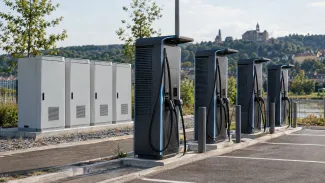
From four charging points to six
The site sits between an A3 exit, a McDonald's and the Wertheim Village outlet centre. It used to have four charging points. Six are now in operation, all Alpitronic HYC400, and two more ABB units with 350 kW peak power are due shortly. The extra power does not come from the grid. It comes from four Sungrow battery modules in switchgear cabinets on site: 1,028 kWh of capacity, 500 kW of maximum output, coordinated by an energy management system that divides available power between the grid connection, the battery and the cars.
A grid connection upgrade can take three years
Ionity told electrive that upgrading a medium-voltage connection in Germany can take up to three years. Storage bridges that wait, which lets the operator open more charging points now instead of in 2029. During busy periods the battery also covers peaks, so the park can deliver more power than its grid connection alone would allow.
Fifty charging parks, but smaller buffers than Wertheim
The 2027 plan is bigger, though not uniformly so. Fifty systems and more than 20 MWh works out at roughly 400 kWh per site on average, less than half of what Wertheim has. The typical installation will therefore be sized for peak shaving and for opening new locations, not for running a whole park off-grid.
Some throughput arithmetic of our own: if each of those 50 systems completes one full cycle a day, that is about 20 MWh a day, or 7.3 GWh a year. A family EV going from 10 to 80 percent on a 77 kWh pack takes roughly 54 kWh, so the Wertheim buffer holds about 19 such sessions before it is flat. The grid refills it continuously, which is the whole point.
Hemsbach adds a solar roof
A second project in Hemsbach is a new build: twelve fast-charging points under a photovoltaic canopy rated above 223 kWp, plus storage above 2 MWh. Unlike Wertheim, the solar power will be stored and used later at the same site. A canopy of that size will not carry twelve cars at full power on its own. The grid and the battery do the heavy lifting while the panels reduce how much electricity has to be bought in.
What it costs at the plug
Battery storage changes the site, not the tariff. Using the rates Ionity applies in most EU markets and a 77 kWh car charged from 10 to 80 percent, our charging cost calculator gives this picture at 22 kWh/100 km:
- Ad-hoc rate around €0.79/kWh: €42.70 per session, about €17.40 per 100 km.
- Contract rate around €0.49/kWh: €26.50 per session, about €10.80 per 100 km.
- Diesel at 6.5 l/100 km and €1.55/l: roughly €10.10 per 100 km.
Those are list prices and vary by country and contract, so check your own numbers. The point stands: on ad-hoc pricing, fast charging on a German motorway is still more expensive per kilometre than an efficient diesel. Our list of the cheapest charging locations shows how wide the spread across Europe already is.
External cabinets, not integrated batteries
Ionity buys external systems rather than chargers with integrated batteries, arguing that one cabinet can serve several posts regardless of the charging hardware brand. The storage system is supplied by Sungrow, a Chinese manufacturer. So far Ionity has used only external battery storage, though it says it remains open to charging stations with integrated batteries and is evaluating their use. The company has not said how it will source the remaining installations.
Stationary systems are usually run in a partial state-of-charge window to slow degradation.
What Ionity has not said
The company is working on using the batteries for grid services and energy trading later on, which would need its management system to handle far more than charging sessions. Cost of the Wertheim installation, the split of the 50 systems between countries and the number of sites that will get solar have not been published. Our supercharger database gives a sense of how many sites a charging network has to keep supplied: Ionity alone operates hundreds of sites across Europe, so 50 battery-buffered parks is a fraction of its network.
Source: https://www.electrive.com/2026/10/27/ionity-plans-battery-storage-systems-at-50-charging-parks/