
What the Q3 numbers say
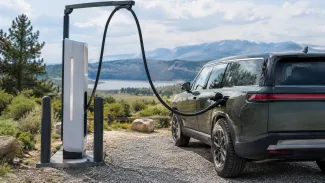
Every RAN stall is built to deliver up to 300 kW. The network is US-only for now, which matters for the size of the claim: 1,185 ports is a national figure, not a global one. The station count of 165 tells us more than the port count on its own, because it explains how Rivian is building.
Divide the two and you get 7.2 ports per location. A year ago the network had roughly 852 ports (1,185 divided by 1.39) across about 131 sites, so Rivian added something like 330 DC ports in twelve months. That is the number I would put next to any "39% growth" headline.
Seven ports per site is a deliberate choice
Tesla's US Supercharger network, by the source's own comparison, runs over 40,000 fast-charging ports at nearly 3,300 locations. That is about 12 ports per site, against Rivian's 7.2. Both models have costs attached. A larger site spreads the fixed bill for a grid connection, a transformer and a permit over more stalls, so the cost per usable port falls. A smaller site is quicker to permit and cheaper to walk away from if the location underperforms.
Rivian is placing chargers where its owners actually drive: trailheads, national park gateways, rural corridors. Traffic at those spots is seasonal and thin. Seven stalls with 300 kW each is already more than most of them will need on a Tuesday in February.
The Waypoint network added ten chargers this year
The contrast inside Rivian's own portfolio is sharper than the contrast with Tesla. Roughly 330 new DC ports in a year, and ten new 11 kW Waypoint chargers. The last pair went live in October. Waypoints are the destination chargers that make a national park hotel or a ski lodge practical for an overnight stop, and they are cheap per unit compared with a 300 kW cabinet.
They also did not get a single mention in the company's most recent documents. That is where the investment priority sits.
On the 100% renewable claim
Rivian says every kilowatt-hour delivered through a RAN charger is matched with renewable generation. Matched is the accurate word. The electrons coming out of the cable are not traceable to a particular wind farm, and the renewable source can sit in another state entirely. That is standard practice for corporate power purchase agreements, and it is how most European charging operators account for green tariffs too. It is a paper transaction, not a physical one.
What a fast-charging kWh costs per 100 km
Port counts are the easy part. The number that decides whether a family charges on the road or at home is cost per kWh, and that is what our charging cost calculator is built around. Our own supercharger price database, which currently covers 483 European locations, lists the cheapest ones separately at /superchargers/cheapest.
Take a mid-size electric SUV that uses 20 kWh/100 km. At €0.55/kWh on a European DC fast charger, 100 km costs €11. On a home tariff at €0.25/kWh the same distance costs €5. Over 15,000 km a year that gap is about €900. This is an illustrative calculation, not a market average, but the ratio holds across almost every European tariff structure I have worked through. Public DC charging in Europe typically costs two to three times what home charging does.
For a US network the arithmetic is different, because American DC pricing is often per minute rather than per kWh in states that restrict electricity resale. Rivian's own rate structure does not show up in the quarterly report at all, so there is nothing to compare directly with our European data yet.
A US network for now — and why the ratio still travels
Rivian does not sell cars in Europe and RAN has no European sites — not yet. The company has publicly confirmed Europe as its next market, naming the UK as the entry point and the mid-size R2 SUV as the intended product, with a direct-to-consumer sales model planned and no launch date confirmed; industry expectations point to roughly 2028–2029. The consequence for European readers is that RAN's ports-per-site and power-per-stall pattern is the template Rivian would most likely bring to a European network, so the ratio is worth tracking now.
Those three numbers — ports per site, average power per stall, and the split between en-route DC and destination AC — determine whether a network is pleasant or painful, whatever the badge on the cabinet.
Europe's problem looks different. The 483 locations in our own database are spread across countries with different plug standards, different payment rules and different price transparency requirements, and the binding constraint is often the grid connection queue rather than the charger supply.
If you want to check what a given consumption figure does to your own costs before a long trip, the range calculator and the real-world range tool built on Bjørn Nyland's measurements are the two I use most.
The number to watch next quarter
The 39% is measured against Q3 2025, which was itself a small base. Rivian's Waypoint network ended the period with 540 chargers at 208 locations, ten of them installed during 2026 and the most recent pair switched on in October.
Source: https://insideevs.com/news/813896/rivian-adventure-networks-dc-fast-chargers-growth-q3-2026/