
What the money covers
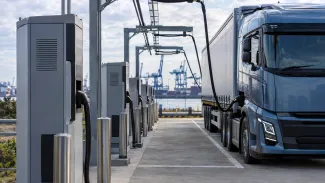
The grant pays a share of the charge points, the installation work and the civil engineering around them. Foundations, ducting, trenching: groundworks that often cost more than the hardware itself. The funding is for depots serving electric vans and HGVs.
The £1 million ceiling counts per applicant, not per site. A haulier with three depots can spread the money across all three but cannot go above £1 million in total.
The rate cut in numbers
Round one put £28 million into projects delivered during 2026/27 and covered 70% of eligible costs. Divide the two and you get £40 million of eligible works. The new round puts in £38 million at 60%, which covers roughly £63.3 million. More public money, considerably more total project value, less support per pound spent.
For a fleet working near the ceiling the change is easy to see. At 70%, £1.43 million of eligible costs was enough to reach the £1 million maximum grant. At 60% it takes £1.67 million, about 17% more capital for the same money.
Smaller depots feel it in absolute terms. A site with £100,000 of eligible costs now gets £60,000 instead of £70,000. If every applicant hit the cap, the £38 million would stretch to 38 projects. Most will be smaller than that, so the real count should run higher.
Purchase grants run alongside
The infrastructure funding sits inside a £1 billion government commitment to zero-emission commercial vehicles. The Zero Emission Truck and Van grants cover up to 40% of an electric HGV's price, capped at £81,000, so a truck listed at £202,500 or more reaches the ceiling. Vans get up to £5,000. That purchase budget is ringfenced at £170 million until 2030.
Aymeric Larcher, managing director of Renault Trucks UK & Ireland, called depot charging a substantial investment and said it remains one of the main barriers for operators making the switch. The scheme was reopened on 11 November; the first window closed in June 2026 and had been due to reopen on 28 October, according to Fleet News.
Depot charging and the grid
A charger in the yard usually delivers the cheapest kilowatt-hour a fleet buys, because the site pays a commercial electricity tariff rather than a public charging price with a margin on top. Our supercharger database tracks 483 locations across Europe with the price per kWh at each, and prices vary between them. Public charging still matters on longer runs, and route tools keep improving – PlugShare 8.0 added dark mode and stop distances, with the Android version still missing.
The constraint is the connection. A depot asking for several hundred kilowatts of DC charging may need a new supply or an upgrade, and the groundworks that follow are exactly what the eligible-cost definition is written for. The UK mechanism is a grant programme, not a mandate. EU member states work to AFIR, which sets charging requirements along the TEN-T network; the UK sits outside that framework and funds depots directly instead.
What to do before 26 February
Start with the supply. Ask the network operator what the site can take today, what an upgrade would cost and how long it would take to deliver. A grant does not shorten a connection queue.
Then price the whole project rather than the boxes. The scheme covers 60% of eligible costs, which leaves 40% on the fleet's books, plus anything the rules exclude.
Run the depot tariff against what the fleet pays now. Our charging cost calculator turns consumption and price per kWh into cost per 100 km; put the depot rate in one column and a public high-power rate in the other. The gap is the annual saving the investment has to earn back.
Check utilisation honestly. Sixty per cent off a charger that runs two hours a week is still an expensive charger, and the £1 million cap means large fleets cannot fund a whole network from one application.
The window closes at midday on 26 February 2027. The previous round closed in June 2026 with £28 million committed at the higher rate.
Source: https://www.electrive.com/2026/11/12/uk-depot-charging-scheme-reopens-with-reduced-funding-rate/