
What the deal covers
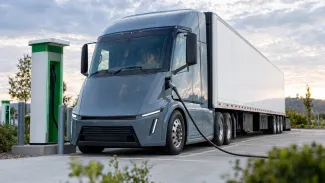
Nevoya will deploy 25 Class 8 battery-electric trucks on the I-10 corridor. The charging for those trucks is matched 100% with renewable energy certificates. Meta buys environmental attribute certificates (EACs) that represent the environmental attributes of the electric freight service, and it does not use the trucks itself.
This is the second agreement between the two companies. In Texas, Nevoya started with 25 electric semi-trucks and grew to a 63-truck deployment on the Houston–Dallas corridor, backed by a buyers' alliance organised with Google and the Center for Green Market Activation. Meta was one of several buyers in that alliance. The I-10 deal is standalone.
The trucks Nevoya has shown from the Texas project are branded Class 8 vehicles from Windrose and Tesla, charged at sites run by Terrawatt and Greenlane. Nevoya has not said which of the two models will run on the I-10 route.
Why a data centre company buys truck certificates
Freight is part of a data centre's carbon footprint, and most of that freight sits in Scope 3, the emissions of suppliers and logistics rather than of the company's own buildings. Devon Lake, Meta's head of net zero strategy, said freight is part of the footprint of building and operating data centres, and that multi-year commitments help make electric trucking available on the routes serving the regions where the company builds.
An EAC is a certificate that carries the environmental benefit of a service, sold separately from the service itself. The buyer can count lower emissions in its supply chain accounting. The carrier gets revenue it can plan around for several years, which is exactly what a bank or a leasing company wants to see before financing a truck.
One honest caveat: a certificate is an accounting instrument. It does not remove a tonne of cargo or a kilometre of driving. Emissions fall only if the truck actually on the road is electric rather than diesel.
The corridor matters more than the truck
I-10 runs east from the ports of Los Angeles and Long Beach through Phoenix, El Paso and Houston to the Gulf. Los Angeles is the busiest US port by container tonnage, and Long Beach is the main transpacific gateway. San Bernardino to Phoenix is roughly 590 km on I-10, about 370 miles, and that single leg already sits beyond what a loaded Class 8 battery-electric truck covers on one charge. The trucks therefore need en-route charging along the I-10 itself, and that is precisely why the announcement names the charging partners, Greenlane and Terrawatt, while the truck models themselves stay out of the headline.
What 100 km costs: our calculation
We ran the energy numbers with European pump and charger prices, not California ones. The ratio is what travels. The figure of 130 kWh/100 km is our own assumption for a loaded long-haul artic, so treat it as an input you can plug your own consumption into, not as a manufacturer claim.
- Diesel: a long-haul artic at 33 l/100 km and €1.50 per litre costs about €49.50 per 100 km.
- Electric, depot charging: 130 kWh/100 km at €0.20/kWh costs about €26 per 100 km.
- Electric, public high-power charging: the same 130 kWh at €0.40/kWh costs about €52 per 100 km.
The crossover sits near €0.38/kWh. Above that price, the electric truck spends more on energy than the diesel one. Purchase price, servicing, tolls and driver wages are excluded, and electric drivelines usually cost less to service. You can run your own figures in our charging cost calculator.
This is the part corporate announcements tend to skip. A route with a depot charger and a night tariff saves money. A route that depends on public fast charging at motorway prices may not save anything at all.
What European fleets can copy
Two conditions make the Nevoya model work: demand contracted for years, and charging the operator controls. The first is a sales problem. The second is a construction problem, and in Europe it is often the harder one.
Support for depot charging exists, though it moves. In the UK, the depot charging grant scheme reopened with £38 million and a lower grant rate, which changes the payback arithmetic for anyone who budgeted on the old rate. Public charging locations across Europe are mapped in our charging station map.
What to check before copying it
- Contract length against asset life. A three-year freight contract does not cover a truck financed over seven.
- Who owns the charger. If the site belongs to someone else, ask what you pay per kWh and for how long that price holds.
- Payload. Battery weight comes out of the cargo, and on dense loads that changes the number of trips.
- Temperature. Winter consumption on a battery truck rises faster than on a diesel one, which moves the €0.38/kWh crossover down.
- Who keeps the certificate revenue. If it sits with the shipper rather than the carrier, it does not help your business case.
Nevoya has not disclosed the value of the Meta agreement, the length of the multi-year term, or the price per kWh it pays at the Greenlane and Terrawatt sites. Those three numbers decide whether the model leaves the two corridors where it has now been signed.