
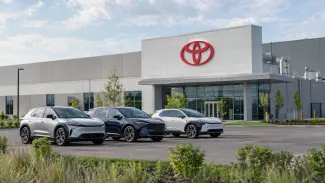
What the Saline site covers
Toyota says the centre spans the full battery development cycle, from raw material procurement through customer applications to recycling. The company calls it a "central hub" for its North American production network. That network includes the North Carolina battery plant near Liberty, Toyota's first battery plant outside Japan and its twelfth manufacturing site in the United States. Toyota puts the investment at €14bn and the planned job count at 5,100.
The argument for the site is distance. "For Toyota customers, this facility means Toyota engineers can detect and resolve field concerns faster and closer to the source," said Jordan Choby, group vice president of powertrain. He added that the centre will let the company develop longer-lasting batteries for the conditions American drivers meet every day.
Most of the batteries are small
Toyota's sales mix explains the priorities. Hybrids still carry its volumes, and a hybrid pack is a fraction of an electric car's battery. Current Toyota full hybrids use packs in the region of 1 kWh. The bZ4X carries 73.1 kWh gross. That is a difference of roughly 70 times, and the two are evaluated for different things: hybrid packs for cycle life under constant charge and discharge, EV packs for fast-charging behaviour and thermal management at 150 kW and above.
The bZ4X also shows the range side. Toyota quotes up to 573 km WLTP for the front-wheel-drive version with the 73.1 kWh pack. Measured figures are lower, particularly in winter. Our real-world range calculator uses Bjørn Nyland's test data instead of WLTP, so you can see how much of that 573 km survives at 0 °C.
Charging cost, an example
Take a 73 kWh electric SUV at 19 kWh/100 km and run it through our charging cost calculator. On a home tariff of €0.25/kWh, 100 km costs €4.75. On DC fast charging at €0.39/kWh it costs €7.41. A hybrid at 5 l/100 km and €1.60/l of petrol comes to €8.00 per 100 km. The electric car is clearly cheaper at home and roughly level with the hybrid on public charging. Our supercharger database tracks 483 locations across Europe with prices; the cheapest sites list shows how much that answer depends on where you plug in.
US rules, European pressure
The Michigan site also has a regulatory purpose. US consumer incentives for electric cars depend on where battery components and critical minerals are sourced, so testing and developing packs on American soil supports the output of the North Carolina plant. Europe and the UK are moving in a similar direction. Our report on the UK weighing 35% tariffs on Chinese EVs covers the trade side of that shift.
For European buyers, nothing changes yet. Toyota's European EVs are supplied from Japan, and the EU battery regulation requires a carbon footprint declaration for EV batteries, with a battery passport following in 2027. Work done in Saline does not shorten that paperwork. Competitive pressure is arriving from elsewhere: Kia is Europe's fastest-growing top-10 brand, with EV sales up 58% and the EV2 starting at €26,600, as we reported.
What changes for buyers
Nothing in this announcement alters a specification sheet or a price list in Europe. If you are weighing a Toyota hybrid against a European electric rival, use the EV catalog for consumption and battery data, then put your own tariff into the charging cost calculator to get a 100 km figure that matches your driving. The battery in the car you buy this year was developed somewhere else.
Toyota has not said how many engineers will work in Saline, which chemistries will be tested there first, or when work done at the site will reach European models. The only confirmed date in the announcement is the North Carolina plant's 2025 production start.
Source: https://www.electrive.com/2026/10/05/toyota-battery-center-in-north-america-opens-in-michigan/