
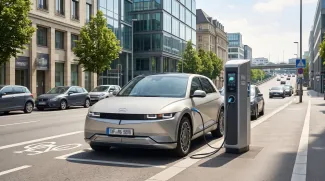
What the app will do
Smart charging functions will appear in myHyundai and Kia Access. Drivers enrol in the programme their local electricity provider runs, and the software moves charging to hours with lower prices and lighter grid load, based on the schedule the driver sets. Utilities get standardised battery and charging data across different models. WeaveGrid says the exchange does not compromise data privacy or vehicle security.
Reach matters here. WeaveGrid says its utility network now covers providers serving more than 50% of US EVs, up from over 40% when Hyundai and Kia invested in the company in January 2025, as electrive reported at the time.
V2G is not switched on
Most Hyundai and Kia EVs sold in North America sit on the E-GMP platform, which already supports two-way power transfer. The Ioniq 5 and EV6 can run external devices through vehicle-to-load. The EV9, listed with a 99.8 kWh pack, can back up a house. Discharging into the public grid for payment is a different job. It needs bidirectional hardware at the wall, connection rules from the grid operator and a tariff that pays for the export. Hyundai says phase two begins once those three exist. No date has been given.
"We see our vehicles as part of a larger energy ecosystem, and our customers should benefit from that every day," said Woong Tae Hwang, Vice President and head of Hyundai Motor Group's EV Energy Strategy Group. Apoorv Bhargava, co-founder and CEO of WeaveGrid, framed the deal around load growth at US utilities and EVs as one of the largest flexible resources available to meet it.
What a shifted charge is worth
Our own arithmetic with European tariffs shows the size of the prize in phase one. A 60 kWh session at €0.35/kWh costs €21. The same energy at €0.20/kWh costs €12. Moving it off-peak saves €9.
Put that on the road. At 18 kWh/100 km, 60 kWh covers roughly 333 km, so timing alone is worth about €2.70 per 100 km. A petrol car at 6.5 l/100 km and €1.55/l burns €10.08 per 100 km. Home charging at €0.20 already lands near €3.60 per 100 km, which is why the gap between peak and off-peak rates decides whether smart charging pays anything at all. US residential rates are lower and differ by state, so the dollar figure will be smaller there. The charging cost calculator runs the same comparison with your own tariff.
Ford and GM sell the hardware already
Hyundai and Kia are not first to the home. Ford offers Intelligent Backup Power with the F-150 Lightning, and GM sells Ultium Home hardware for vehicle-to-home use. Both are purchases tied to a specific charger and installation. What is different here is the software layer across two brands and dozens of utilities, with V2G named as the next step rather than sold as a feature today.
Our EV catalog lists the E-GMP models with pack sizes and charging curves if you want to compare them directly.
The European version is a price question
Europe has the same problem in a different form: tariffs move, and most drivers never check them. Our supercharger database tracks 483 locations with per-kWh prices, and the cheapest list shows how far apart rates sit inside one country. A car that can choose when to charge, and later when to discharge, turns that spread into money. Home storage follows the same logic, as we noted when Huawei launched the Luterra S2 with 20 kW three-phase output and still no price. Depot charging shows the industrial end: Vilnius airport's electric buses now run three days per charge where diesel buses managed 12 hours.
What an owner should do now
If you drive an E-GMP car in Europe, ask your supplier for the off-peak window in writing and set the car's departure timer to match it. Vehicle-to-load needs an adapter and works today; house backup needs approved hardware and, in most countries, a conversation with the grid operator before anything is connected. In the US, the app update is the part you will see first. The payment for discharging is not scheduled.