
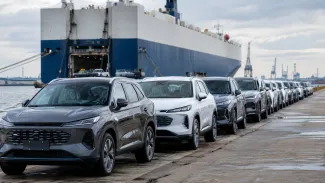
What London is reportedly preparing
According to The Times, Economic Secretary to the Treasury Jonathan Reynolds is developing a set of tariffs on Chinese vehicle imports. Reuters, citing the same reporting, says the concern is subsidised vehicles arriving in the UK at dumping prices. No duty has been introduced so far.
A government spokesperson gave Reuters this line: "We continue to engage closely with industry so that our approach reflects the sector's and UK's national interests." No timetable was offered.
The EU duties already in force
The European Union has had anti-subsidy duties on battery-electric passenger cars from China since the end of October 2024. They sit on top of the standard 10% import duty, and the rate depends on the manufacturer: between 7.8% and 35.3%. The lowest rate went to Tesla's China-built cars. SAIC, which owns MG, got the highest.
So European buyers have been living with this for two years. A Chinese-built electric car that competes on price in Prague or Berlin already carries the extra cost. Britain does not, which is precisely the gap the EU wants closed.
Chinese brands at 16 per cent of UK registrations
At the end of September, electrive reported that Chinese manufacturers hold a 16% share of new car registrations in the UK, across all powertrains and not only electric ones. That figure explains the political weight behind the discussion. It also explains why British dealers are nervous about a sudden change in the rules.
Why the EU link matters
The EU is working on its Industrial Accelerator Act, which would favour European-made products in funding programmes, public procurement and other industrial policy tools. The mechanism rests on local content and on the labels "Made in Europe" and "Made in EU".
The UK car industry is tied to the European one. The British trade body SMMT has just published an analysis by Oxford Economics estimating that UK car production supports €24 billion of economic activity, 250,000 jobs and €1.6 billion in tax revenues inside the EU every year. Being treated as a partner country under the new rules matters more to that industry than a tariff line does.
Efforts to build that European supply base are already visible. BMW recently opened a €1 billion plant in Bavaria to build 108.7 kWh battery packs for the new i3. That is the kind of local content the Made in Europe criteria are meant to reward.
What a tariff would do to a sticker price
Take a Chinese-built electric car with a pre-duty value of £25,000. Today it pays the standard 10%, which is £2,500. If the UK adopted the EU's top rate, the combined duty would be 45.3%, or £11,325. The difference is £8,825 per car before VAT.
UK VAT at 20% is charged on the duty-inclusive value, so the retail gap would be wider again, roughly £10,600 if the whole amount were passed through. This is arithmetic on published rates, not a forecast for a specific model. The EU sets its rates per manufacturer, and a British scheme could be structured differently.
The price gap tariffs are meant to address is real. We reported earlier that VW's Jetta brand prices its first electric sedan at €10,600 in China. No European-built car reaches that number.
What to check if you are buying
Nothing has changed for UK buyers today. If you are shopping for a Chinese-brand EV there, two details are worth confirming before you sign. First, where the car is actually built. Check the country of manufacture on the certificate of conformity rather than assuming from the badge, because a plant in Hungary or Spain takes a car out of the Chinese-origin category. Second, the delivery date. A duty introduced between order and delivery usually lands on the invoice.
Our EV catalogue lists the models on sale in Europe with their prices and specifications, and the EV savings calculator shows what a car costs to run once you know the purchase price.
The UK government has imposed nothing yet, and its spokesperson gave Reuters no date for a decision.
Do the EU duties apply to every Chinese brand at the same rate?
No. The EU sets a rate per manufacturer, from 7.8% to 35.3% on top of the 10% standard duty. Tesla's China-built cars received the lowest rate, SAIC the highest. A UK scheme could follow the same logic or use a flat figure.
Does a Chinese brand building cars in Europe still pay the tariff?
Not on those cars. The EU duties cover vehicles produced in China. A car assembled in a European plant falls outside them, which is exactly the reason the Made in Europe rules focus on where production happens rather than who owns the brand.
Source: https://www.electrive.com/2026/10/05/uk-apparently-considering-special-tariffs-on-chinese-evs/