
From referendum to two-shift production
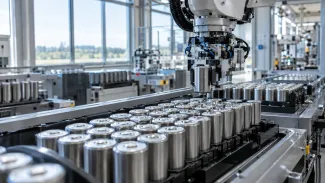
Construction started in April 2024. The first pre-series batteries came off the line in March 2026, and series production began this week, in the presence of Bavarian minister-president Markus Söder. The site covers roughly 60 hectares and holds about 50,000 square metres of production space. BMW says 500 robots work there and that more than 3,500 data points are recorded for every battery built, monitored in real time with AI-based assistance systems. At full capacity around 1,600 people will work at the plant, producing several hundred high-voltage batteries per day on two lines.
Getting there took a vote. Residents of Straßkirchen backed the project in a referendum in September 2023, which cleared the way for construction. High demand for the Neue Klasse models is why BMW is ramping up faster than planned and has gone to two shifts immediately.
800 volts and 46 mm round cells
This is the first BMW series application of an 800-volt architecture combined with large-format cylindrical cells of 46 millimetres diameter. BMW puts the energy density of these cells around 20 per cent above the prismatic cells used in Gen5. Cells go straight into the pack using the cell-to-pack principle, and the housing becomes a load-bearing part of the body through pack-to-open-body. BMW quotes faster charging and longer ranges than Gen5 as a result.
The cells arrive at the plant from outside suppliers. Irlbach-Straßkirchen inspects them, assembles cell clusters, connects coolers, welds, foams the assembly for mechanical stability and puts every finished pack through an end-of-line check. Sister plants are being built or have opened in Debrecen, Shenyang, Woodruff and San Luis Potosí under a local-for-local approach. Assembly capacity is not cell capacity, a distinction that matters in the European supply debate. Our earlier report on T&E's analysis of EU cell capacity covers that gap in detail.
What the i3 numbers mean
The new i3 50 xDrive takes a 108.7 kWh battery from Lower Bavaria. BMW quotes up to 906 km WLTP. Divide the pack by that range and the official consumption comes out at 12.0 kWh/100 km, a figure that would be remarkable for a car of this size and weight. Motorway consumption in this class usually lands between 18 and 20 kWh/100 km. With roughly 105 kWh usable and 19 kWh/100 km, the real range is nearer 550 km. Our real-world range tool works on Bjørn Nyland's measurements for other cars; we do not have i3 test data in the database yet.
Charging is where the 800-volt system shows. BMW says DC power peaks at 400 kW and that 423 km of range can be added in ten minutes. At the official 12.0 kWh/100 km, those 423 km represent about 50.8 kWh, so the average power over that window is around 305 kW. That is roughly 47 per cent of the pack in ten minutes.
Competitors quote similar peaks. The Mercedes CLA with its 85 kWh battery claims 792 km WLTP, and 800-volt hardware is now common across Hyundai, Kia, Porsche and Lucid. The i3's range figure is ahead of most of them on paper.
Cost per 100 km
Numbers on paper need a price attached. At a home tariff of €0.25/kWh, the official 12.0 kWh/100 km costs €3.00 per 100 km; a realistic 19 kWh/100 km costs €4.75. On DC fast charging at €0.60/kWh, the same two figures become €7.20 and €11.40. A petrol car at 6.5 l/100 km and €1.75/l sits at €11.38, so fast-charging a large electric sedan and fuelling a combustion car land in the same place. Charging at home is about two and a half times cheaper.
Put your own tariff and consumption into our charging cost calculator. For route planning, the cheapest charging locations page lists the lowest prices we track across the 483 sites in our supercharger database.
Recycling, CO2 and EU rules
BMW uses secondary cobalt, lithium and nickel in the Gen6 cells and says renewable electricity covers anode and cathode material production as well as cell manufacturing. The company puts the CO2 saving at around 33 per cent per watt-hour against Gen5 cells. Under the EU Battery Regulation, EV batteries placed on the market from 2027 need a carbon footprint declaration and a battery passport, which turns those figures into a compliance document rather than a marketing line. Since the end of 2025 BMW has run a direct recycling competence centre with Encory in Salching, near the new plant, handling cells and production scrap.
Price pressure from the other direction
A €1 billion plant and a premium sedan sit at one end of the market. Chinese manufacturers keep pushing the other end: VW's Jetta brand opened orders for its first electric sedan at €10,600 in China, and Chinese NEV sales hit record levels in September, with BYD at 456,713 units. Both ends depend on the same number, the cost of a kilowatt-hour of cells, and Irlbach-Straßkirchen assembles packs rather than producing cells.
For now the plant supplies Munich, where the i3 is built. BMW says the site will become a hub for other German vehicle plants. Which one receives Gen6 packs next has not been specified.
Source: https://www.electrive.com/2026/10/02/bmw-begins-gen6-battery-production-in-irlbach-straskirchen/