
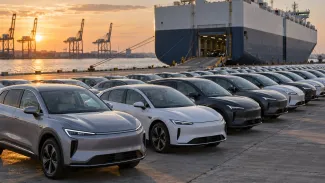
BYD: 273,143 BEVs, 183,570 PHEVs
BYD's September total splits into 273,143 battery-electric cars and 183,570 plug-in hybrids. Battery cars take 59.8% of the mix. Exports reached 180,700 units, or 39.6% of the month's volume, so roughly two in five BYD passenger cars now leave China.
Cumulative sales for January to September stand at 3,078,490 cars. Divide by nine and you get 342,054 a month. Hold that pace through December and BYD finishes 2026 near 4.1 million units.
Geely Galaxy second, Leapmotor up 59%
Geely Galaxy delivered 130,479 units, about a quarter more than Leapmotor, which reported 105,656 deliveries for a 59% year-on-year gain. Leapmotor says 27,000 of those cars went abroad, 25.6% of its monthly volume and the highest export share of the EV-only brands in this table.
Cumulative deliveries are 665,539, which the company puts at 66.7% of its one-million target for 2026. Reaching that million requires 334,461 cars in the fourth quarter. That is 111,487 a month, roughly 5.5% above September's record. Tight, but arithmetically plausible.
Three brands separated by 274 cars
HIMA (37,490), Nio (37,408) and Zeekr (37,216) finished within 274 units of each other. Xpeng is ahead of all three on 41,256, up 5% year on year, and Changan Nevo on 45,607. Xiaomi sold about 40,000 cars, including more than 10,000 Skynomad SUVs, for 269,000 in nine months.
Zeekr is the fastest grower here: plus 103.85% in September and plus 100.84% cumulative at 288,404 units. Nio's group total of 300,301 splits into Nio 181,988, Onvo 70,191 and Firefly 48,122, up 49.2% overall. GAC Aion added 21.91% to reach 35,494. Deepal managed 30,185, BAIC NEV 24,080, and Voyah 13,025 with cumulative sales up 19%.
Which targets are still reachable
The gap between September's run rate and the full-year goals decides who hits their number. Xiaomi has 48.9% of 550,000, so it needs 281,000 cars in the fourth quarter, or 93,667 a month. That is 2.3 times September's volume. Xpeng sits at 51.7% of the same 550,000 target and would need 88,544 a month.
Zeekr has 57.7% of 500,000 and needs 70,532 a month. Li Auto is at 59.8% of its 490,000 minimum and needs 65,521. Nio has 65.9% of 456,000, which means 51,900 a month, about 39% above September. Leapmotor's required rate is the smallest stretch of the group.
What lands in Europe
These are global figures, not European ones. BYD's export number covers every market outside China, and Leapmotor's 27,000 overseas cars are spread across Asia, Latin America and Europe. Still, both brands are expanding on this continent, and Leapmotor's European sales run through its joint venture with Stellantis.
That partner has its own problems with battery supply. We reported earlier that Stellantis paused output at Sochaux and Rennes after ACC deliveries came in short of plan. Buyers comparing a Chinese model with a European one can check specifications and prices in our EV catalog, and the savings calculator converts consumption into euros per 100 km against a petrol or diesel equivalent.
One line in the table points the other way. Lynk & Co delivered 18,493 cars in September and its cumulative sales for the year are down 19%, the only brand in this ranking losing volume.