
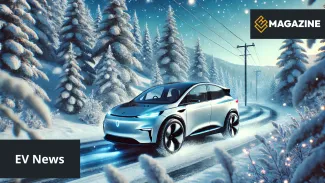
New EU rules cover brake dust from 2026
An electric car has no exhaust pipe, so the particle debate moves to what the tyres and brakes leave behind. Tyre, brake and road wear happen on every vehicle, electric or not. Weight makes it worse. Many EVs carry several hundred kilograms more than a comparable petrol model, and instant torque puts extra stress on the front tyres.
Regulation (EU) 2024/1257, the Euro 7 rules agreed in 2024, sets the first brake particle limits for cars and vans. They apply to new type approvals from 29 November 2026 and to all new cars a year later. Tyre abrasion limits are to be developed through UNECE rules. The student team points to that November 2026 date when explaining why the project exists.
The wheel that collects particles
A conventional filter would clog with road dust within days. VENTRA takes a different route. The system charges the particles electrically and pulls them onto a grounded collection surface, where they stick. The team says the surface can then be cleaned with a vacuum cleaner or rinsed with water.
The published capture rates come from simulation only: about 24% of generated particles at 50 to 80 km/h, and up to 42% at lower speeds. VENTRA is a research and demonstration vehicle built by students, not a production model.
Roughly 100 kg lighter
Less mass means less tyre wear, so the chassis uses carbon-fibre reinforced thermoplastic panels and sheds nearly 100 kg compared with a conventional build, according to the team. A display-based Clean-Drive system watches driving style and suggests gentler acceleration, less abrupt braking and fewer unnecessary steering inputs.
Collected particles can be recycled, and some are already used in the car's interior components. Similar thinking about material recovery appears elsewhere in the supply chain, as in Vianode and FAAM's work on anode production scrap. Mass varies widely across the market, and the Range Rover Sport EV, listed at £110,000 in the UK with a 608 km WLTP range, sits at the large end of the electric segment.
What tyre wear adds up to
A rough calculation shows the scale. Take a common 205/55 R16 tyre. Tread depth is about 8 mm when new and 1.6 mm at the legal limit, so roughly 6.4 mm of rubber is meant to be worn away. The rolling circumference is about 1.93 m and the tread is 20.5 cm wide. That is around 2,530 cm³ of rubber, or 2.9 kg per tyre at a density near 1.15 g/cm³.
Over a 40,000 km life, four tyres lose about 11.6 kg of rubber, which works out at 0.29 g per kilometre. A household driving 15,000 km a year wears off roughly 4 kg annually, if the tyres are run close to the legal limit. Real numbers differ with compound, road surface and driving style. Most of that mass stays on the road as larger particles and gets washed into drains. A smaller share becomes airborne, and that is the part VENTRA is after.
Brake dust follows a different pattern. Regenerative braking does most of the slowing in an electric car, so friction pads are used less and last longer. Tyres get no such benefit.
What drivers can do
Checking tyre pressure once a month, accelerating gently and lifting off earlier before junctions all reduce wear, and none of it costs anything. Abrasion is still missing from the EU tyre label, which shows rolling resistance, wet grip and noise, so buyers cannot compare tyres on wear today.
Fine particles that do become airborne end up in the air around the car and inside it. Cabin filters catch part of them. Replacing the filter at the interval the manufacturer specifies is a cheap measure for families who sit in traffic every day. Our EV catalog lists kerb weights if you want to see how much car four tyres are being asked to carry.
No production plans
TU/ecomotive builds a new concept car each year with a different focus. The 2025 model, Aria, looked at repairability. VENTRA is the tyre and brake wear project, and the team has announced no series production, no manufacturer partnership and no road-test date. Brake particle limits under Euro 7 reach new type approvals on 29 November 2026, and the simulation figures remain the only published results for VENTRA.
Do electric cars wear tyres faster than petrol cars?
Often yes, because of extra weight and strong acceleration from a standstill. Regenerative braking works the other way for friction pads, which are used far less and typically last longer. Driving style and tyre pressure decide how large the difference gets in daily use.
Does Euro 7 mean my current car needs a retrofit?
No. The brake particle limits apply to new vehicle types and then to newly sold cars. Vehicles already on the road are not covered, and retrofitting a particle collector is not part of the regulation.