
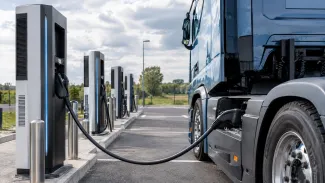
Where the site sits
Vierzon is where the A20 between Paris and Toulouse crosses the A71 towards Clermont-Ferrand, with the A85 linking to Tours and the Atlantic coast nearby. A truck on that corridor stops for 45 minutes anyway: EU driving rules require a 45-minute break after 4.5 hours at the wheel.
Voltix says the four points deliver enough energy in 30 to 45 minutes for a truck to continue its journey. Each point carries CCS and MCS connectors, so a 400 kW truck and a megawatt-capable one can use the same bay. At the opening, Renault Trucks, Volvo Trucks, Daimler Truck, Scania and MAN showed current heavy-duty electric trucks with MCS capability.
1.5 MW is ahead of the trucks
No series-production truck on European roads today draws 1.5 MW. The Mercedes-Benz eActros 600 has a 621 kWh battery and a CCS ceiling around 400 kW. Going from 20 to 80 per cent means roughly 373 kWh, which takes about 56 minutes at a flat 400 kW and close to 15 minutes at 1.5 MW. Real charging curves are not flat, so the practical figure sits between those two numbers.
That is why the site is built this way now. The Megawatt Charging System standard is specified well above what current trucks accept, and cable and connector design at those currents gets as much attention as the cells. We covered a BYD patent filing that keeps connectors dry earlier this year.
One thing the announcement does not address is the grid connection. Four points at 1.5 MW each would pull 6 MW if all four ran flat out at once; eight would need 12 MW. Whether the site can do that simultaneously or shares power between bays is not stated. Voltix has also not published its price per kWh at Vierzon.
What a kilowatt-hour costs a truck
Heavy electric trucks use roughly 1.1 kWh per kilometre in good conditions, so about 110 kWh per 100 km. Add charging losses and the energy drawn from the grid is nearer 120 kWh. At €0.50/kWh that is €60 per 100 km. A diesel tractor at 30 l/100 km and €1.70 per litre comes to about €51. Our charging cost calculator works the same way for cars.
Energy is not the whole bill. Tolls, maintenance and the CO2 class of the vehicle matter, and Germany exempts zero-emission trucks from its HGV toll. Our cheapest superchargers page tracks the spread between networks across the 483 charging locations we have logged in Europe, and that spread is wide for cars as well. Move the truck tariff from €0.60 to €0.40 per kWh and the 100 km figure drops from €72 to €48, which is more than the gap to diesel.
The money behind the network
Vierzon is the first site of a programme announced in September 2026, when Vinci Concessions, Épopée Gestion and ADEME Investissement committed nearly €90 million to a fast-charging network for electric trucks. The first phase covers around 20 sites, mostly in France, with Germany and Spain to follow and a target of 50 sites by 2028.
In Germany, Voltix and Eliso won the contract as a bidding consortium for 25 sites in the state-initiated truck fast-charging network at unmanaged motorway rest areas. The Vierzon site is part of the DRIVE-FR project and is co-financed through the European CEF-AFIF funding line.
Freight emissions
Voltix places the station in the context of French road freight. According to the company, 89 per cent of domestic land freight in France moves by road, and road freight accounts for 7.4 per cent of national greenhouse gas emissions. "An electric truck without charging infrastructure is just a promise," said Nicolas Notebaert, Director General of Concessions at Vinci.
Route planning belongs to that promise too. We noted in our Leapmotor B03X article that some passenger EVs still ship without a charging route planner. For a 40-tonne tractor on a fixed corridor, the planner is the difference between a schedule and a guess.
Voltix has not said where the next stations will go. The target it has published is 50 sites by 2028, against the one site now open in Vierzon.
Source: https://www.electrive.com/2026/10/08/voltix-opens-frances-most-powerful-truck-charging-station/