
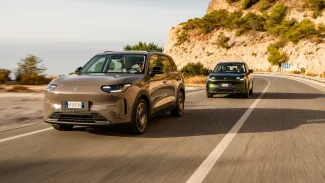
How Leapmotor got to 1,020 showrooms
The brand has been in Europe for two years. It now has more than 1,020 retail locations in 36 countries, mostly inside Fiat, Opel and Peugeot showrooms run by Stellantis partners. The range runs from the T03 city car through the C10 and B10 SUVs to the B05 fastback, and the B03X sits between the T03 and the larger B models. Pre-sales began in July. The wider market is moving the same way: EU electric car sales rose 45% to 1.64 million, with cheaper models leading.
Two battery sizes, 292 and 382 km WLTP
Both versions use a 200 Nm front motor and LFP cells built into the body structure, a layout Leapmotor calls CTC 2.0 Plus. The Pro has 39.8 kWh and 130 kW, the ProMax 53 kWh and 145 kW. Both reach 100 km/h in 8.6 seconds and are limited to 160 km/h. The Pro weighs 1,525 kg, the ProMax 1,625 kg. Leapmotor is not alone in integrating cells this way; BYD has patented a different design with cells sitting in a dielectric fluid.
Range against the small European EVs
The Pro is rated at up to 292 km WLTP, the ProMax at up to 382 km. That trails most direct rivals. A Škoda Epiq with 52 kWh is quoted at up to 441 km, about 15% more from a slightly smaller pack. The VW ID. Cross reaches 427 km with 52 kWh, the Ford Puma Gen-E 417 km with 46.8 kWh, the Peugeot e-2008 405 km with 51 kWh.
The comparison is awkward because makers count differently. VW, Škoda, Ford and Peugeot quote usable energy; Leapmotor and Kia quote gross. Leapmotor does not say how much of the 53 kWh in the ProMax a driver can use. Our EV range calculator shows what a consumption figure means on your own routes.
Charging: fast on paper, manual in practice
The Pro accepts up to 100 kW, the ProMax up to 133 kW, and both are quoted at 10 to 80% in 21 minutes. By manufacturer figures that beats the VW ID. Cross (24 minutes) and the Ford Puma Gen-E (26 minutes); the Peugeot e-2008 needs 35 minutes from 20 to 80%. AC charging is three-phase 11 kW, about two and a half hours from 30 to 80% with the small battery and a little over three hours with the large one. A heat pump and V2L output are standard.
Route planning is the weak part. The navigation lists stations along the way and can filter for CCS points above 100 kW, but the filter resets with every new route, and arrival is shown only as remaining range in kilometres, not as a state of charge. The car will not precondition the battery automatically before a stop selected in the navigation, so the driver has to start it in the app first. On a family trip that means CarPlay or Android Auto, both wireless, plus an app that does not know the current charge level. Our Supercharger database covers 483 locations, and the cheapest Superchargers list helps with price.
Space in the back
At 4,270 mm the B03X is 12 cm longer than a VW ID. Cross, with an almost identical wheelbase of 2,605 mm against 2,601 mm. It is taller and slightly wider than the ID. Cross and the Peugeot e-2008. A 1.90 m tester still had knee and head room in the back and could put his feet under the front seats. Three belts are fitted, though in practice the bench suits two adults and a child. The rear seat bases fold upwards to free floor space. A 10 metre turning circle and the standard 360-degree camera on the ProMax help in car parks. The test report gave no boot figures, so take the pram and the holiday luggage to the dealer before deciding.
What it costs per 100 km
Consumption was 13 kWh/100 km on city and country roads and about 17 kWh/100 km on mostly motorway routes. At a home tariff of €0.25/kWh that is €3.25 and €4.25 per 100 km. At a DC price of €0.69/kWh it becomes €8.97 and €11.73. Our charging cost calculator uses your own tariff.
The rules behind the price
EU fleet limits for new cars stand at 93.6 g CO2/km for 2025 to 2029, which pushes makers towards small electric models. Since 2024 the EU has also charged countervailing duties on electric cars built in China; cooperating manufacturers outside the sampled groups pay 20.7% on top of the standard 10% import duty. Leapmotor's response has been distribution rather than local assembly, using Stellantis showrooms instead of building its own network.
The consumption figures come from sunny test drives at around 21°C, and no winter motorway run has been done. Leapmotor also does not publish the usable capacity of the 53 kWh ProMax, so efficiency comparisons with the 52 kWh Škoda Epiq remain approximate.