
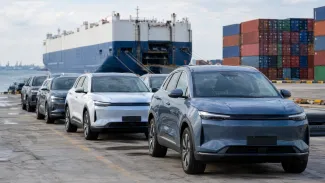
7,900 used cars, a 280% jump and a 44% new-car decline
CEVM lists more than 2,600 used Chinese EVs on its marketplace right now, with inventory refreshed almost daily. The brands on offer include Xiaomi, BYD, iCar, Denza, Lynk&Co, Avatr and others, the company says. Its Shanghai team regularly finds cars with around 6,000 km on the clock priced 40% below their original Chinese list price.
The contrast with the new-car channel is stark. According to CEVM's own figures, pre-owned sales to EU customers grew 280% year on year to 7,900 units in the first nine months of 2026, while new-vehicle sales to EU customers fell 44% over the same January–September period.
“Tariffs have already weakened demand for new Chinese BEVs among our European customers,” CEVM chief operating officer Jakub Geršl told CarNewsChina. “Pre-owned cars are exempt from the additional BEV tariffs and from the new hybrid (PHEV) quota. That is why we are making pre-owned vehicles the main focus of our European business.”
How the tariff gap works
The two mechanisms are separate, and mixing them is where most of the confusion starts. New Chinese battery-electric cars have carried additional countervailing duties of up to 45.3% since 2024. Plug-in hybrids were not hit by those duties — which is exactly why European buyers shifted toward them over the last two years — but they now fall under a new EU cap of 350,000 units on hybrid imports from China. Pre-owned cars are exempt from both the countervailing duties and the hybrid quota.
That is why a 6,000 km car can undercut a new one by more than depreciation alone would suggest. The used car avoids both barriers entirely, while a new BEV carries the duty from the moment it lands and a new PHEV has to fit inside a capped quota.
The math on a 40% discount
Take an illustrative car with a Chinese list price of €30,000. These are clean numbers for the calculation, not a quote for a specific model.
A new import at the full 45.3% duty comes to €43,590 before shipping, homologation and VAT. The same car at 40% below list is €18,000 on the Chinese side. The gap is €25,590, which makes the used car 58.7% cheaper than the tariffed new one.
The €18,000 is not a delivered European price. Transport, customs clearance, any conversion work and individual approval still come on top. The comparison also ignores VAT, which applies to both routes. Even with those costs added, the duty difference is large enough to absorb a lot.
Depreciation on a new car is a different animal, though. According to CADA/Jingzhengu data for September 2026, a Tesla Model 3 retains 61.4% of its value after three years in China, a Tesla Model Y 53.9%, a BYD Seagull 50.5% and a Porsche Taycan 48.5%. A 40% discount on a nearly new car is therefore not the same thing as the three-year loss a new-car buyer absorbs — the used import simply starts from a price that has already taken the hit.
Running costs
Purchase price is only half of the family budget. At 18 kWh/100 km and a public tariff of €0.45/kWh, the energy cost is €8.10 per 100 km. Our charging cost calculator lets you plug in your own home tariff, which changes the result more than the car does.
Our supercharger database holds 483 locations across Europe with prices. The cheapest locations page is the place to start if you plan long trips, and the full map shows what is available on your route.
Prague pickup: 20 cars and no three-month wait
CEVM has also opened a delivery centre in Prague, its first such facility for European customers. The initial batch there is 20 EVs, available for buyers who want to collect a car immediately. The alternative is a direct import from China, which typically means waiting roughly three months. For Czech and Central European buyers, that turns a long-distance import decision into something closer to a normal dealership visit.
What to check before you buy
The charging inlet is the first item. Many domestic-market Chinese models use GB/T connectors for AC and DC, not the CCS2 plug used across Europe. Adapters exist, but they are not accepted everywhere and add failure points. Confirm the inlet before you pay.
Type approval is the second. A car built for the Chinese market may not carry an EU certificate of conformity, which means individual approval in your country. Check the rules where you register the car, not where you buy it.
Then come the practical items: whether the warranty transfers, whether spare parts are stocked in Europe, whether the infotainment and navigation work outside China, and whether over-the-air updates still reach the car. A battery state-of-health report matters more than the odometer. At 6,000 km, degradation should be small, but a report confirms it.
What it does to the new-car market
The used channel grows while the new one is constrained. CEVM is explicit that pre-owned vehicles are now the main focus of its European business. European manufacturers, meanwhile, are pressing Brussels on local content. An ACEA-backed study argued that Europe's battery capacity falls short of the EU's localisation plans, which is the argument behind keeping duties in place.
The technology gap is not standing still either. Our report on the Denza N8 five-minute charging claim showed an average of 937 kW over the charging window, a reminder that the used cars arriving now are not old technology. Our EV catalog currently covers 67 models with full specifications for comparison.
CEVM's 7,900 figure covers sales to EU customers through September and comes from the company itself. No independent registration data was published with it, so the total size of the used-import channel across all traders remains unmeasured.
Source: CarNewsChina — Europeans discovered used EVs from China, price 40% under MSRP, CEVM says