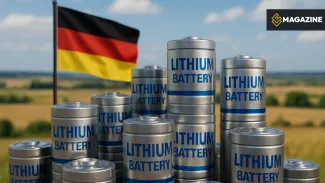
Finland digs first — but modestly
After years of planning, Finland has officially opened the first lithium mine in Europe dedicated to battery production. Located in the Kaustinen region and operated by Sibanye-Stillwater's Keliber project, the facility represents a €783 million investment and is expected to produce 15,000 tonnes of lithium hydroxide per year once it reaches full capacity by 2028.
To put that in context: 15,000 tonnes covers roughly 10 percent of Europe's current lithium demand. It is a meaningful first step, not a solution. Commercial production of battery-grade hydroxide is scheduled to begin in late 2026, with approximately 300 permanent jobs created.
What makes the Finnish project notable is its unusually tight integration. The entire supply chain — from spodumene ore mining to chemical refining — is compressed into a corridor of just 43 kilometres. That proximity matters. Most of the world's lithium currently travels thousands of kilometres: mined in Australia or Chile, refined in China, then shipped again to European cell factories in Hungary, Poland, or Germany.
Meanwhile, across the Atlantic
On the very same week, the US Geological Survey published a study estimating that the Appalachian mountain range contains 2.3 million metric tons of economically recoverable lithium. At 2025 import levels, that volume equals 328 years of US lithium consumption.
The resource is split between two belts. The southern Appalachians — primarily North and South Carolina — hold roughly 1.43 million metric tons of lithium oxide locked in coarse-grained pegmatite rocks. The northern belt, stretching through Maine and New Hampshire, adds another 900,000 metric tons.
The USGS notes this is enough material to produce batteries for 130 million EVs and 1.6 million grid-scale storage installations. The geological twist? These same pegmatite formations once bordered what is now Ireland and Portugal before the breakup of the supercontinent Pangea. In other words, the rocks under the eastern United States are geologically related to European crust — a reminder that Europe, too, likely harbours unexplored lithium potential.
Why Europe still imports almost everything
Europe's lithium dependency is not a secret. The EU currently sources the vast majority of its lithium from Australia and Chile, but the real chokepoint is refining. China controls roughly 60 to 65 percent of global lithium chemical processing, turning raw ore into the battery-grade carbonate and hydroxide that cell manufacturers actually need.
The EU Critical Raw Materials Act, adopted in 2024, set a target: by 2030, at least 10 percent of the EU's annual consumption of strategic raw materials should come from domestic extraction, and no more than 65 percent from any single third country. Finland's output will help, but 10 percent of demand from one mine barely moves the needle.
Other European projects are moving slowly. Portugal has known spodumene deposits in the north but faces environmental licensing delays. Spain's Extremadura region holds significant lithium reserves, yet commercial extraction remains years away. Serbia, with one of Europe's largest known deposits at the Jadar site, saw its Rio Tinto project blocked in 2022 after mass protests — a reminder that geology alone does not guarantee supply.
What this means for EV buyers
For now, nothing changes on the dealership floor. The lithium market remains oversupplied after the investment boom of 2021–2023, and prices have collapsed from their peaks. But supply gluts are temporary. As European battery factories — Northvolt, CATL in Hungary, Samsung SDI — scale up, demand will tighten again by the late 2020s.
The Finnish mine will primarily supply European cathode manufacturers. Its hydroxide output is suited to high-nickel battery chemistries used in premium EVs with longer WLTP ranges — the kind of cars European buyers increasingly prefer over entry-level models.
The broader lesson is geopolitical. Both the US and the EU have now placed lithium on their official lists of critical minerals. The US is using the discovery to push for faster permitting and domestic refining investment. Europe, with its stricter environmental rules and denser population near potential mining sites, will find that harder to replicate. But without more mines, Europe's EV industry remains vulnerable to supply disruptions and price spikes originating on the other side of the world.
The next frontiers
Beyond hard-rock mining, Europe is also exploring alternatives. Direct lithium extraction from geothermal brines in the Upper Rhine Valley (Germany and France) and in Cornwall, UK, could produce battery-grade lithium with a far smaller surface footprint. These projects are still pilot-scale, but if they prove economical, they could complement Finnish hard-rock output without the open-pit controversy.
Recycling will play a role too. By the early 2030s, end-of-life EV batteries from the first wave of European mass-market electrics — the Renault Zoe, Nissan Leaf, VW e-Golf generation — will create a secondary lithium stream. Finnish miner Keliber has already signalled interest in integrating recycling into its 43-kilometre loop.
Can Europe really become self-sufficient in lithium?
Not in the next decade. Even with Finland's new mine, Portugal's potential projects, and direct extraction pilots, Europe will likely cover only 15–20 percent of its own lithium demand by 2030. The rest will still come from Australia, Chile, and — via refining — China.
Does more lithium mining mean cheaper EVs?
Not directly. Lithium prices have already collapsed since 2022, yet EV prices have not fallen proportionally because batteries represent only part of the total cost. What domestic supply does provide is price stability and protection against geopolitical shocks that could suddenly raise costs.
What is the environmental impact of the Finnish mine?
Hard-rock lithium mining is more energy- and water-intensive than brine extraction. However, the Keliber project uses Finland's near-zero-emission electricity grid (dominated by nuclear and renewables) for refining, and the 43-kilometre integrated chain minimises transport emissions. Full lifecycle assessments are still pending as production ramps up.
Source: https://interestingengineering.com/energy/us-lithium-deposit-discovered