
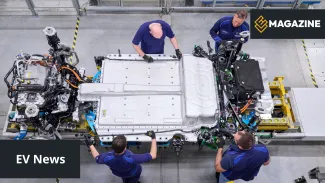
The deal, announced alongside LGES's first-quarter 2026 financial results, pushes the South Korean battery giant's total order backlog to more than 440 GWh. While LGES maintained the customary supplier secrecy by not naming the customer directly, the cell format itself tells a compelling story. The orders cover 46-millimetre-diameter cylindrical cells—the same format BMW adopted for its Neue Klasse electric platform. Specifically, BMW's iX3, i3, and the recently updated i7 all utilise 4695 cells (46 mm diameter, 95 mm height), while the upcoming iX5 is expected to employ the taller 46120 variant designed for larger vehicles with higher ground clearance.
This alignment is no coincidence. BMW manufactures its X5 SUV at its sprawling plant in Spartanburg, South Carolina, making the LGES factory in Arizona a geographically logical source for battery supply. South Korean outlets Chosun and MK report that the contract spans ten years and is worth approximately ten trillion won. If confirmed, this would represent the first time LG Energy Solution has supplied battery cells for BMW's fully electric vehicles, though the two companies have previously collaborated on hybrid applications.
The contract also reveals how BMW has pivoted its US battery strategy. The Munich-based carmaker originally intended to source cells for its American-built EVs from a new AESC plant, but that project encountered construction delays. Speculation had mounted that BMW might resort to importing Chinese cells or scrambling for alternative North American suppliers. The LGES agreement appears to resolve that uncertainty, ensuring a domestic US supply chain for BMW's most important electric models at a time when regional content requirements are tightening on both sides of the Atlantic.
For LG Energy Solution, the BMW deal arrives at a critical juncture. Despite the headline-grabbing contract, the company reported an operating loss of 207.8 billion won in Q1 2026, even as revenue edged up 1.2 percent to 6.555 trillion won. LGES attributed the red ink partly to inventory adjustments from a major North American pouch-battery customer—widely understood to be General Motors—while noting that cylindrical EV cells and energy storage systems helped offset the decline. The BMW contract not only diversifies LGES's customer base but also validates its bet on large cylindrical formats, where it already counts Rivian, Chery, and possibly Mercedes-Benz as clients.
What does this mean for European EV buyers? While the cells themselves will be manufactured in Arizona for American-built models, the technological ripple effects will reach European showrooms. The Neue Klasse platform is BMW's global electric backbone, and the 46-series cell format is central to its packaging efficiency, charging performance, and cost structure. If LGES can deliver at scale in Arizona, it strengthens the business case for bringing similar cylindrical-cell production to Europe—something analysts have long urged as the continent races to build a resilient, locally anchored battery industry. For now, European-built BMW EVs will likely continue to rely on existing suppliers such as CATL and Samsung SDI, but the LGES contract sets a new benchmark for long-term partnerships in the premium EV segment.
The agreement also underscores a broader industry trend: cylindrical cells are regaining favour among premium automakers after years of pouch and prismatic dominance. Tesla's 4680 format paved the way, and now BMW's adoption of 4695 and 46120 cells signals that the industry sees the cylindrical design as the optimal compromise between energy density, thermal management, and manufacturing scalability. As LGES ramps production in Arizona by year-end and its Ochang plant in South Korea already manufactures 4695 cells, the supply pipeline for BMW's electric offensive is beginning to look decidedly more robust.
What are 46-series cylindrical cells and why is BMW using them?
46-series cells are lithium-ion batteries with a 46-millimetre diameter. BMW's Neue Klasse platform uses the 4695 variant (95 mm tall) for sedans and crossovers, and will use the taller 46120 (120 mm) for larger SUVs. The format offers better energy density and thermal stability compared with older pouch designs, while allowing faster assembly through simplified pack architecture.
Will this LGES deal affect BMW electric cars built in Europe?
Directly, no—the Arizona factory will primarily supply BMW's Spartanburg plant in the US. However, the deal validates the 46-series cylindrical technology that underpins BMW's global Neue Klasse platform. If production scales successfully in Arizona, it increases the likelihood of similar cylindrical-cell investments in Europe to supply German and Hungarian BMW factories.
How does this contract compare to other recent battery supply deals?
At roughly 100 GWh over ten years, the LGES-BMW agreement is comparable in volume to major contracts struck by Rivian and Mercedes-Benz with LGES. It is smaller than Tesla's internal 4680 programme or CATL's multi-hundred-gigawatt-hour deals with Chinese automakers, but it stands out as one of the largest premium European OEM commitments to cylindrical cells to date.
Source: https://www.electrive.net/2026/04/30/lges-erhaelt-grossauftrag-fuer-rundzellen-womoeglich-von-bmw/