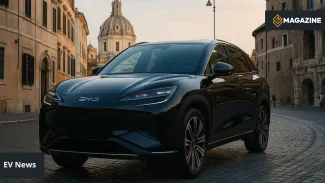
From Phaeton prestige to Chinese EV production
The Gläserne Manufaktur — or Transparent Factory — was once Volkswagen's showcase of automotive pride. Opened in 2002 in the baroque city centre of Dresden, its glass walls and Canadian maple floors were designed to assemble the flagship VW Phaeton in full public view. The plant later built Bentley models, the electric e-Golf and, most recently, the Volkswagen ID.3. But in December 2025, it became the first German production site VW closed in its 88-year history, ending an era with just 6,000 ID.3 units produced annually and roughly 205 employees left.
Now, according to sources familiar with the matter cited by CarNewsChina, BYD wants to breathe new life into at least half of the facility. The Chinese automaker would invest in the site and use it for EV manufacturing, while the remaining portion is reportedly planned as an innovation hub in cooperation with the state of Saxony and the local technical university TU Dresden.
Why Dresden matters for BYD
For BYD, a German production site is not just about capacity — it is about brand credibility. Despite selling more EVs globally than any other company in 2025, BYD remains a challenger brand in Europe. A Dresden address offers something no marketing campaign can easily buy: a "Made in Germany" label on European-sold vehicles.
The company is already investing heavily in building its European image. BYD signed British actor Daniel Craig to promote its premium Denza brand and has been expanding its dealer network rapidly across the continent. The numbers back up the ambition: in Germany alone, BYD sold 3,438 cars in March 2026, a staggering 327% year-over-year increase.
Currently, every passenger car BYD sells in Europe is imported from China, subject to a 10% standard EU import duty plus an additional 17% anti-subsidy tariff. Local production would erase the latter entirely and send a powerful signal to European buyers sceptical of Chinese-built cars.
Volkswagen's pragmatic U-turn
The irony is hard to miss. VW, Europe's biggest car maker and the very symbol of German automotive engineering, is now effectively inviting its biggest Chinese rival into one of its most iconic factories. Yet Volkswagen CEO Oliver Blume called sharing unused European factory capacity with Chinese automakers a "clever solution" as recently as 30 April 2026. VW has already cut its global production capacity from 12 million to 9 million vehicles and reduced European capacity by 1 million units. The Dresden plant, with its tiny output, was always more of a prestige project than a profitable factory.
Beyond BYD, Xpeng and SAIC's MG brand are also exploring opportunities to use Volkswagen plants in Europe, according to the same sources. Xpeng already manufactures vehicles in Europe through Magna Steyr in Austria and is a technical partner to VW in China, supplying E/E architecture and assisted-driving software for VW-branded EVs.
The geopolitical chessboard
The Dresden talks cannot be separated from the broader EU-China trade war over electric vehicles. In 2024, the European Union imposed additional tariffs on China-made EVs, prompting Beijing to reportedly tell Chinese automakers to pause major investments in EU countries that backed the tariffs. Germany, which voted against the extra duties, has since been viewed favourably in Beijing.
The pattern is already visible. Poland, which supported the tariffs, lost Leapmotor production at Stellantis' Tychy plant. Spain, which abstained, secured Leapmotor B10 production at Stellantis' Zaragoza facility. China is effectively rewarding compliance and punishing opposition — and the EU has offered little visible counterweight, leaving member states to compete individually for Chinese investment.
In January 2026, Brussels and Beijing were reported to be in talks to replace the anti-subsidy tariffs with a "minimum price" mechanism for Chinese BEV exports. If agreed, local production inside the EU would become even more strategically valuable for Chinese brands.
Labour shadows hang over the deal
Any BYD expansion in Europe comes with baggage. In April 2026, the European Parliament raised allegations of labour abuses at BYD's construction site in Szeged, Hungary. A watchdog report claimed thousands of workers were kept on-site for seven-day weeks with shifts exceeding 12 hours, allegedly violating Hungary's labour code. The same contractor group, Jinjiang Construction, was previously linked to conditions "analogous to slavery" at BYD's Brazil factory.
These allegations will not go unnoticed in Germany, where works councils and unions hold significant power. Dresden may be in the former East, but German labour standards are uniform — and any attempt to replicate Hungarian or Brazilian working conditions inside the Gläserne Manufaktur would trigger immediate and fierce opposition from IG Metall and local politicians.
What happens next
Neither BYD nor Volkswagen has officially commented on the Dresden talks. Sources caution that no final decision has been made. BYD had previously considered Spain as a preferred location for a second European plant, attracted by lower manufacturing costs and cheap renewable electricity. The company is already building factories in Hungary and Turkey, though Reuters reported last year that BYD had slowed the Hungary ramp-up while accelerating Turkish production. BYD denied the report.
If the Dresden deal goes through, it will mark a watershed moment: a Chinese company producing EVs inside the factory that once symbolised the pinnacle of German automotive ambition. For Volkswagen, it is a pragmatic way to monetise idle real estate. For BYD, it is a chance to tell European buyers that its cars are built not just competitively, but locally — in the very heart of the continent that invented the automobile.
Would BYD cars made in Dresden avoid EU tariffs on Chinese EVs?
Yes. The EU's additional 17% anti-subsidy tariff applies only to electric vehicles imported from China. Cars manufactured inside the European Union, even by a Chinese-owned company, are treated as EU-made and face only the standard rules of origin and local content requirements.
Why did Volkswagen close the Dresden factory in the first place?
The Transparent Factory was a low-volume prestige site producing just 6,000 ID.3 units per year. As part of its broader cost-cutting programme, Volkswagen reduced global capacity by 3 million vehicles and shuttered its first German plant in 88 years to lower fixed costs.
Are other Chinese brands also looking at European factory partnerships?
Yes. According to industry sources, Xpeng and SAIC's MG brand are exploring similar arrangements with Volkswagen and other European manufacturers. Xpeng already produces vehicles in Austria through Magna Steyr and is a technical partner to VW in China.