Listen to this article:
What the RDW Actually Approved
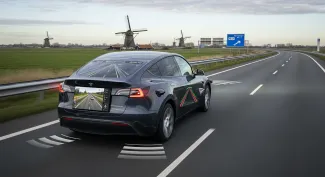
On April 10, the Dutch vehicle authority RDW granted Tesla "a European type approval with provisional validity in the Netherlands" for its Full Self-Driving (Supervised) system. The key word is provisional — and the key limitation is that it applies exclusively to Dutch roads.
The approval was issued under EU Regulation 2018/858, Article 39, which exists precisely for technologies that are developing faster than the regulatory framework. FSD Supervised is classified under UN R-171 as a Driver Control Assistance System (DCAS) — a Level 2 system where the driver remains fully responsible at all times. Hands can be off the wheel, but eyes must remain on the road, and the driver must be ready to intervene immediately.
The RDW's testing was extensive: over 1.6 million kilometres of EU road testing, more than 4,500 closed-track test scenarios, and more than 13,000 customer ride-alongs. Tesla submitted documentation covering over 400 compliance requirements. But critically, the RDW has not publicly released its testing data, citing commercially sensitive information. RDW General Manager Bernd van Nieuwenhoven told Reuters: "We say: Trust us on this, we tested it extensively."
No, Other Countries Do Not Have to "Automatically Accept" It
This is where the story gets interesting — and where the Czech Ministry of Transport stepped in to clear up widespread confusion among Tesla owners. On May 7, the ministry published a detailed press release explaining that EU law does not impose an obligation to "automatically adopt" another member state's provisional approval without further assessment.
The ministry's position is worth reading in full because it captures the dilemma facing every EU transport authority right now. The RDW is one of the most respected approval bodies in Europe. Its procedures are transparent and technically rigorous. And the technology itself does not change driver responsibility or fundamentally alter traffic rules. Yet each country must still verify that:
- The approved function does not contain operational conditions specific only to the Netherlands
- It complies with that country's own road traffic regulations
- Its use cannot lead to confusion about the driver's role or weaken legal certainty in accident investigations
"This is not about questioning the technology," the Czech ministry stated. "It is about protecting the legal framework in which drivers and public authorities operate."
Belgium's Split Personality: Flanders Races Ahead
Belgium represents both the most promising and most complicated case in Europe right now. Under Belgium's federal structure, vehicle type approval falls to the regional level — meaning Flanders, Wallonia, and Brussels each make their own decision.
Flemish Minister of Mobility Annick De Ridder publicly announced on May 5 that she had already instructed her administration to provide "clarity by the end of the week on a possible rapid homologation." She framed the move as keeping Flanders "at the forefront as a forward-looking region."
Wallonia and Brussels have not issued public statements, and the federal FPS Mobility has stayed silent. If Flanders proceeds alone, Belgian Tesla owners could face a surreal situation where FSD is legal north of the language border but not south of it — a regulatory patchwork that would test the limits of EU mutual recognition in practice.
The TCMV Meeting: Presentation, Not a Vote
The most anticipated event in this saga took place on May 5 in Brussels: the 117th meeting of the EU's Technical Committee on Motor Vehicles (TCMV). The Dutch RDW presented its Article 39 file to representatives from all 27 member states in what was originally a 20-minute slot, later extended to a dedicated one-hour afternoon session.
No vote was held. This was purely informational. For an EU-wide approval, committee members representing 55% of member states and 65% of the bloc's population must vote in favour. The next TCMV meetings are expected in June or July, with another session in October.
Tesla had told regulators in a confidential presentation that it expected "EU-wide" approval in the second or third quarter of 2026. That timeline is now looking ambitious.
The Nordic Wall of Skepticism
Emails obtained by Reuters from European regulators reveal significant pushback from the very countries that often set the pace on road safety standards.
Swedish Transport Agency investigator Hans Nordin wrote that he was "quite surprised" to learn that FSD permits speeding and said it should not be allowed. Finnish official Jukka Juhola questioned whether the system was safe on icy roads at 80 km/h and how it would handle moose — a genuinely life-threatening hazard on Nordic roads. Regulators in Denmark and Norway raised similar concerns, alongside questions about whether the "Full Self-Driving" branding misleads drivers about what the system can actually do.
Sweden, Finland, and Estonia have all told Reuters they will review the material from the May 5 TCMV meeting before making any decision. Meanwhile, France's CNRV has already stated it will not authorise FSD before an EU-level vote, and Spain — arguably the most advanced in hands-on testing — has been running 30 Tesla vehicles with FSD since November 2025, accumulating 80,000 km without a single reported incident.
Tesla's Lobbying Meets European Regulatory Culture
One of the most revealing details from the Reuters investigation concerns the culture clash between Tesla's approach and how EU regulation actually works.
A Tesla policy manager contacted Swedish authorities to approve FSD just four days after the Dutch announcement — before Swedish regulators had even received any documentation. Elon Musk publicly encouraged European customers to pressure their governments during a shareholder meeting. Tesla owners obliged, deluging regulators with emails. One Norwegian owner wrote that delaying FSD approval could "lead to the loss of lives that would have been saved with this technology."
Stein-Helge Mundal of the Norwegian Public Roads Administration noted that regulators "will need to use a lot of effort to answer misled consumers." Tesla's own EU policy manager Ivan Komusanac apologised to him, acknowledging that such emails "are usually not helpful for the approval process."
The episode illustrates a fundamental tension: the European regulatory system exists to prevent companies from self-certifying safety claims, and asking officials to simply trust a manufacturer's testing data — no matter how extensive — collides with that principle.
What Tesla Owners Can Actually Expect
For Tesla drivers watching this unfold, the practical timeline breaks down like this:
- Netherlands: FSD Supervised is already legal and rolling out. Dutch owners are the only ones in Europe using it today.
- Flanders (Belgium): Could be the second jurisdiction to approve, possibly within weeks if De Ridder's administration delivers on its end-of-week deadline for clarity. The rest of Belgium remains uncertain.
- Germany, Spain, Italy: These are the larger markets where Tesla is pushing hardest. Spain's 80,000 km of incident-free testing gives it a strong data-based case. Germany's KBA is historically cautious but practical. Italy's government is under political pressure to move faster.
- Nordic countries: The most sceptical camp. Even if they ultimately approve, expect additional winter-specific testing requirements that could delay approval until late 2026 or beyond.
- Czechia and other smaller EU states: Most are waiting for either the TCMV vote or a critical mass of larger member states to approve before committing. The Czech ministry's statement signals diligent but not obstructive intent.
- EU-wide: The earliest realistic vote is July 2026. Even after a successful vote, individual member states must still implement the decision nationally, which adds further weeks or months.
The core tension is between those who see FSD as a safety technology that should be deployed as fast as data allows, and those who see the lack of transparent, independently verifiable data as a reason for caution. Tesla's European sales fell 28% in 2025, and the company cannot afford further delays to a feature that could help justify its premium pricing. The question is whether European regulators can be convinced on Tesla's timeline — or only on their own.
Does the Dutch RDW approval mean Tesla FSD is now legal across the entire EU?
No. The RDW approval is a national provisional type approval valid only in the Netherlands. Other EU member states can choose to recognise it nationally under mutual recognition rules, but they are not required to do so automatically. Each country must assess whether the system is compatible with its own road traffic regulations and operational environment before granting its own approval.
Is Tesla FSD Supervised the same as autonomous driving?
No. FSD Supervised is classified as SAE Level 2 — a Driver Control Assistance System under UN R-171. The driver remains fully legally responsible at all times and must be able to take over immediately. It can handle many driving tasks, including lane changes and navigating intersections, but it is not autonomous or self-driving. The name "Full Self-Driving" remains controversial; Tesla was already found guilty of false advertising over the naming in California.
When will Tesla FSD be available in my country?
It depends entirely on your country's regulator. The fastest paths are through national mutual recognition of the Dutch approval (the route Flanders is pursuing). The slowest is waiting for an EU-wide TCMV vote, which is not expected before July 2026 at the earliest, and even then requires implementation by each member state. If you live in the Netherlands, it is already rolling out. If you live in a Nordic country, expect winter-specific scrutiny that could push approval into late 2026 or beyond.
Source: https://md.gov.cz/Media/Media-a-tiskove-zpravy/Rozhodnuti-nizozemskeho-uradu-RDW-a-dalsi-postup-v