The Smart Fortwo is dead. Long live the Smart #2. After discontinuing the original two-seater in 2024, Smart is bringing its smallest car back — and this time it's electric-only, built on a Geely platform in China, with triple the range of the old EQ Fortwo. The Chinese MIIT homologation filings just spilled the production specs. We took the 35.7 kWh battery figure and 300 km WLTP claim and ran a full cost-per-kilometre calculation. Here's what a sub-€25,000 city EV actually costs to own and run in Europe.
What exactly is the Smart #2?
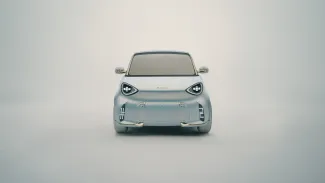
Let's get the corporate structure out of the way first. Smart is now a 50:50 joint venture between Mercedes-Benz and Geely. The #2 is designed in Europe but engineered and built in China on Geely's Sustainable Experience Architecture (SEA) — the same platform underpinning the Smart #1 and #3 crossovers. Only this time, the car is genuinely small. The numbers from the MIIT filing are refreshingly compact: 2,764 mm long, 1,669 mm wide, and 1,555 mm tall, with a 1,875 mm wheelbase. For context, that's 131 mm shorter than a Dacia Spring. Kerb weight comes in at 1,130 kg — nearly 200 kg heavier than the last petrol Fortwo, but impressively light for a modern EV with a floor-mounted battery. The rear-mounted motor produces 60 kW (80 hp), and top speed is capped at 130 km/h. This is not a car you take on the German Autobahn. It is a car you park in a gap a SUV driver wouldn't even glance at. The design? The production version keeps the concept's angry front fascia — slim LED daytime running lights, a closed-off grille, and chunky lower bumper intakes that make it look like it's scowling at every oversized crossover it shares the road with. The cloth-covered concept wheels are gone (predictably), replaced by aerodynamic covers. The overall silhouette is unmistakably Smart: short overhangs, wheels pushed to the corners, two doors, two seats.Battery, range, and charging — the numbers that matter
The European-spec Smart #2 gets a 35.7 kWh LFP (lithium-iron-phosphate) battery pack, with cells supplied by CATL and pack assembly handled by Geely. LFP chemistry is the logical choice here: cheaper per kWh than NMC, more tolerant of frequent 100% charging, and with a longer cycle life. The trade-off is lower energy density and worse cold-weather performance — but for a city car that likely spends its nights plugged in at home, neither is a deal-breaker. Smart claims a manufacturer-estimated range of 300 km WLTP (about 186 miles). That's nearly triple the 93 km EPA rating of the 2017 EQ Fortwo sold in the US — a car that, frankly, was a compliance vehicle with a range figure that made it unusable for anyone without a second car. Now, the 300 km figure is WLTP. What does that mean in the real world? We don't yet have Bjørn Nyland test data for the #2, but we can estimate based on similar small EVs with LFP packs. The WLTP consumption works out to roughly 11.9 kWh/100 km. Real-world summer driving in a 1,130 kg city car should land around 13.5–14.5 kWh/100 km, translating to 245–265 km of practical range. Winter, with cabin heating and the LFP's cold-weather characteristics, could push consumption to 17–19 kWh/100 km — giving you roughly 188–210 km, or about 30% below the WLTP figure. That's not terrible for a city runabout. But it's worth knowing before you buy. Charging speed is a pleasant surprise. Smart claims 10–80% in under 20 minutes. With a 35.7 kWh pack, that means adding roughly 25 kWh in 20 minutes — an average charging rate around 75 kW. For a car in this price bracket, that's competitive. The #2 also supports vehicle-to-load (V2L), letting you power external appliances from the high-voltage battery. Useful for camping, or just running a coffee machine during a blackout.What it actually costs to run — our calculation
This is where things get interesting. A small battery and low weight translate to exceptionally low running costs — but only if you charge at home. Let's run the numbers at 14 kWh/100 km (our estimated real-world summer consumption):- Home charging (EU average ~€0.25/kWh): €3.50 per 100 km
- Public AC charging (~€0.40/kWh): €5.60 per 100 km
- Fast charging (~€0.55/kWh): €7.70 per 100 km
How it stacks up against the budget EV competition
At an expected starting price below €25,000, the Smart #2 enters a segment that has suddenly become crowded: Dacia Spring (26.8 kWh, ~230 km WLTP, from ~€16,990): Cheaper and available now, but feels like a budget car inside. The Smart will almost certainly have a nicer cabin and faster charging. Citroën ë-C3 (44 kWh, ~320 km WLTP, from ~€23,300): Larger battery and more range for similar money. But it's a five-door hatchback — different category entirely. The #2 is for people who specifically want a tiny two-seater. Leapmotor T03 (37.3 kWh, ~265 km WLTP, from ~€18,900): Closest in spirit to the #2 — a Chinese-built small EV with European aspirations. The Smart brand and dealer network give the #2 an edge, even if the range is in the same ballpark. The Smart #2's real differentiator is the brand positioning and design. It's a Mercedes-adjacent product with a genuinely premium-feeling interior (if the #1 and #3 are any guide), wrapped in a package small enough to park anywhere. Whether European buyers will pay €25,000 for a two-seater when a five-door ë-C3 costs less remains to be seen.When can you actually buy one?
The Smart #2 will make its global debut at the Paris Motor Show in October 2026, with production starting in China shortly after. European deliveries should follow in early 2027. Smart hasn't ruled out localised European production if demand justifies the investment — a move that would help the #2 sidestep potential EU tariffs on Chinese-built EVs, though that's a 2028 conversation at the earliest. The price starting "below €25,000" positions the #2 above the Dacia Spring and Leapmotor T03, but below the likes of the larger, longer-range EVs that dominate headlines. For urban households looking for a second car — or anyone who remembers the original Fortwo fondly and wants an electric version that doesn't strand them after 90 km — the Smart #2 is genuinely promising. We'll reserve final judgment for a proper test drive. But the spec sheet, at last, makes sense. For the latest on affordable EVs entering the European market, check our coverage of Volkswagen's plans for budget electric models and the Volkswagen ID. Buzz Cargo's smaller battery and V2L option — the same V2L tech the #2 now offers in a far smaller package. And if you want to compare the #2 against every EV currently on sale in Europe, our EV catalog has full specs on 67 models.Source: https://insideevs.com/news/804340/smart-2-official-ev/