
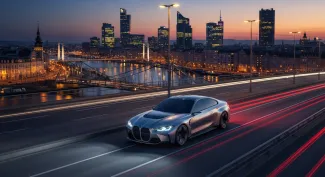
The 1000bhp Challenge: Performance Without Compromise
For decades, the BMW M3 has been the benchmark for driving dynamics in the compact executive segment. As the industry shifts toward electromobility, the question has always been whether an electric motor can replicate the visceral soul of a combustion engine. BMW’s answer appears to be a resounding yes, albeit through a different medium. By targeting 1000bhp (approximately 745 kW), BMW is positioning the M3 EV at the very top of the performance hierarchy.
This level of power is not merely for straight-line acceleration, though the 0-100 km/h times are expected to be blistering. The real challenge for BMW engineers lies in managing the immense torque and the increased weight inherent in high-capacity battery packs. To maintain the "Ultimate Driving Machine" ethos, the M3 EV will likely rely on advanced 800-volt architecture to ensure rapid energy deployment and efficient thermal management during aggressive driving sessions.
Pricing Parity: A Strategic Shift in the EV Market
Perhaps more significant than the power figures is the pricing strategy revealed by Autocar. Traditionally, high-performance electric vehicles have carried a significant "green premium," often costing much more than their internal combustion engine (ICE) counterparts due to the high cost of battery cells and specialized electric drivetrains.
If BMW succeeds in keeping the M3 EV in the same price bracket as the current petrol M3—which typically starts in the region of €85,000 to €100,000 depending on the market and specification—they will create a massive competitive advantage. This move targets the "sweet spot" of the premium market, where enthusiasts are looking for cutting-edge technology but are wary of the inflated prices seen in many luxury EVs. By narrowing this gap, BMW is directly challenging the dominance of the Tesla Model S Plaid and the Porsche Taycan, both of which occupy the high-performance, high-price territory.
Technical Hurdles: Weight, Agility, and the Battery
Transitioning a performance icon to electric power involves more than just swapping an engine for motors. The primary obstacle is mass. A battery capable of powering a 1000bhp machine will add hundreds of kilograms to the vehicle. In the European market, where driving enthusiasts value agility and precise handling on winding B-roads, weight is the enemy.
To combat this, BMW is expected to utilize its Neue Klasse technology, which focuses on more efficient motor layouts and potentially more energy-dense battery chemistries. By optimizing the placement of the electric motors—likely a dual-motor setup with independent control of the front and rear axles—BMW can implement advanced torque vectoring. This technology allows the car to pivot around corners more effectively, potentially offering a level of precision that a petrol engine cannot match.
The European Context and Global Competition
In Europe, where stringent CO2 regulations and the push for zero-emission zones are accelerating the transition, the M3 EV is perfectly timed. European consumers are increasingly demanding high-performance alternatives that do not compromise on environmental standards. However, the competition is fierce. While Tesla has mastered the software and efficiency side of the equation, and Porsche has mastered the chassis dynamics, BMW is attempting to bridge the gap by offering unmatched performance at a competitive price point.
Furthermore, the rise of high-end Chinese manufacturers like BYD and Nio, which are aggressively expanding into Europe with high-spec electric models, means BMW cannot afford to be complacent. The M3 EV must not only be fast; it must be a complete package of luxury, technology, and driving pleasure to defend its territory in the European premium segment.
Conclusion: A New Benchmark for Performance EVs
The announcement that the M3 EV will aim for 1000bhp and price parity with the petrol model is a clear signal of BMW's intent. They are not just participating in the electric transition; they are attempting to lead it by making high-performance electromobility accessible to a broader range of enthusiasts. If the execution matches the ambition, the M3 EV could become the definitive performance sedan of the mid-2020s.
Will the M3 EV have the same driving character as the petrol version?
While the sound and mechanical feel will differ, BMW is focusing on torque vectoring and advanced chassis tuning to ensure the electric version maintains the agility and precision expected from the M division.
How fast can the M3 EV charge?
Based on current trends for high-performance EVs, the M3 is expected to use an 800-volt system, allowing for ultra-fast DC charging that could significantly reduce wait times at high-power charging stations.
When can we expect the M3 EV to arrive in Europe?
While an exact date hasn't been confirmed, BMW's roadmap suggests that high-performance models based on the Neue Klasse architecture will begin appearing in the mid-to-late 2020s.