
Listen to this article:
A Small Car That Refused to Stay Small
When BYD launched the Seagull in 2023, it was the definition of a budget urban runabout: 3,780 mm nose to tail, a modest 55 kW motor, and a starting price in China equivalent to roughly €9,200. It worked. Through the first five months of 2026, the Seagull — badged as the Dolphin Surf in Europe and Dolphin Mini in selected export markets — shifted over 125,000 units globally, ranking it as the fifth best-selling electric vehicle on the planet according to data from CleanTechnica.
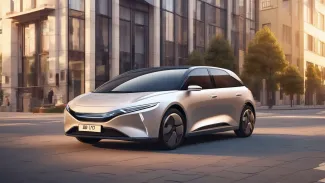
The newly homologated version, however, stretches that footprint to 4,205 mm — a gain of 425 mm that pushes the Seagull firmly into B-segment territory, closer to a Renault Clio or Volkswagen Polo than the A-segment microcars it previously competed against. Width increases by a modest margin to 1,810 mm, while the wheelbase remains unchanged at 2,650 mm, suggesting BYD has concentrated the added length in the rear overhang and crash structures rather than the cabin itself.
From 75 to 127 Horsepower: A Motor That Changes the Car's Character
The powertrain upgrade is equally significant. The outgoing model's 55 kW (75 hp) electric motor — adequate for city speeds but strained on highways — is replaced by a 95 kW (127 hp) unit. That is a 73% jump in output that should transform the Seagull's real-world usability, making motorway merging and overtaking a far less anxious experience. BYD has not yet confirmed battery specifications, but the current model's two Blade LFP options — 30.08 kWh for 305 km CLTC range and 38.88 kWh for 405 km CLTC — are expected to carry over, possibly with minor chemistry tweaks to offset the larger body's weight penalty.
This follows May 2026's mid-cycle refresh, which introduced a roof-mounted LiDAR sensor and BYD's God's Eye B (DiPilot 300) advanced driver-assistance system on higher trims — a feature set typically reserved for vehicles costing twice as much. Powered by an Nvidia Drive Orin chip, the system supports navigation on autopilot in both cities and on highways, plus automated parking. That a sub-€10,000 car in China can now be optioned with LiDAR tells you everything about the pace of BYD's engineering cadence.
What This Means for the European Dolphin Surf
The Seagull has been available on European soil since 2024 as the Dolphin Surf, priced from €22,990 in markets like Germany and France, and £18,675 in the UK. At that price point, it currently competes with the Dacia Spring (from €16,900), the Citroën ë-C3 (from €23,300), and the upcoming Hyundai Inster. The current Surf's 55 kW motor and compact dimensions have made it a competent city car, but the new, longer and more powerful version would reposition it as a genuine alternative to segment staples like the Peugeot e-208 or Opel Corsa Electric — at a considerably lower price.
BYD has not officially confirmed when these upgrades will reach the European-spec Dolphin Surf, but the pattern is well established: Chinese-market improvements typically trickle into export variants within six to nine months. With the EU's provisional tariffs on Chinese-built EVs currently sitting at 17% for BYD, the math still works. Even with duties, a longer, faster, LiDAR-equipped Dolphin Surf could land in European showrooms comfortably under the psychological €25,000 barrier — a price at which European manufacturers are still struggling to turn a profit on their small EVs.
The Speed Gap Europe Cannot Ignore
Zhang Zhuo, general manager of BYD's Ocean sales division, teased the new model on social media with the line: "As its silhouette gradually emerges in the shadows, the promise of growing up is about to be fulfilled." The phrasing is marketing, but the sentiment lands. BYD is evolving the Seagull on roughly an 18-month cycle — the kind of update tempo that European volume brands once reserved for their premium models and now struggle to match even there.
Consider the contrast: the Volkswagen Group is currently debating the closure of four German factories while BYD is quietly filing regulatory paperwork for a car that gained 11% more length and 73% more power between one model year and the next. The Dacia Spring, Europe's reigning affordability champion, received its first meaningful update only after three years on the market. BYD's pace is not just faster — it operates on a fundamentally different clock.
This is not solely a Chinese phenomenon. It reflects an industrial structure where vertical integration — BYD makes its own batteries, motors, semiconductors, and even ships for export — collapses the time between engineering decision and production line. European automakers, still navigating complex supplier networks and union-negotiated production schedules, simply cannot match that rhythm. The question is no longer whether the Chinese can build cheap EVs, but whether Europe can build them fast enough to stay relevant in the segment that will define mass adoption.
When will the updated BYD Dolphin Surf arrive in Europe?
BYD has not given an official timeline, but based on the company's established pattern of rolling out Chinese-market improvements to export variants within six to nine months, the longer, more powerful Dolphin Surf could reach European showrooms by early to mid-2027.
How does the new Seagull's size compare to a typical European hatchback?
At 4,205 mm, the updated Seagull now sits squarely between a Renault Clio (4,053 mm) and a Volkswagen Golf (4,284 mm). The earlier version at 3,780 mm was closer to a Fiat 500 or Toyota Aygo X — a noticeable jump that brings it into the mainstream B-segment.
Will the European Dolphin Surf keep the LiDAR system?
It is uncertain. The God's Eye B LiDAR system has so far been offered only on Chinese-market Seagull variants. Export versions of BYD models have historically received different ADAS configurations to match local homologation requirements and cost targets. However, BYD is increasingly standardising its technology stack globally, so partial availability on higher European trims is plausible.
Source: https://electrek.co/2026/07/10/byds-10k-seagull-ev-revealed-longer-body-more-upgrades/