Listen to this article:
What Is MEBeco — and Why Does It Matter?
The name MEBeco is shorthand for MEB Economy, a derivative of Volkswagen Group's proven MEB electric platform that has underpinned the ID.3, ID.4, Cupra Born, and a host of other models. Where MEB was designed for mid-range family EVs, MEBeco targets the entry-level segment — the compact and subcompact cars that form the backbone of European sales charts.
The APP290 designation is technical and precise: APP stands for "Asynchronous Permanent-magnet electric motor for the front axle", and 290 refers to the unit's maximum torque of 290 Newton-meters. Four distinct power levels cover the range from a city-focused 85 kW up to a sporty 166 kW, with 99 kW and 155 kW options in between. The most powerful VZ variant accelerates from 0 to 100 km/h in 6.8 seconds and reaches a top speed of 175 km/h — figures that position it as a genuinely capable, if city-oriented, powertrain rather than a mere commuter solution.
The powertrain is built on the MEB+ platform, an evolution of the architecture that brings improved efficiency and a higher degree of software integration than the original MEB. This means over-the-air updates, enhanced energy recuperation, and compatibility with the Group's expanding ecosystem of charging and energy management tools.
Győr: Where the New Engine Is Born
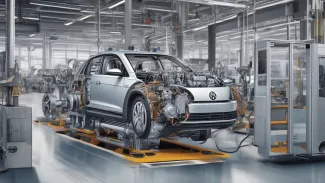
The production of the MEBeco drive marks a significant expansion of the Audi Győr facility in Hungary, one of the largest engine manufacturing plants in the world. Since 2022, the site has been undergoing conversion to accommodate electric powertrain production — a process requiring €350 million in total investment, of which the Hungarian government contributed €22.5 million.
The transition secures 260 jobs at the plant, with production starting on a single shift and planned to expand to three full shifts as demand across the model range ramps up. Győr now manufactures not just the complete drive units but also key components in-house: laminated cores, rotors, power electronics, and integrated software testing. This level of vertical integration reduces supply chain vulnerability — a lesson the automotive industry absorbed painfully during the chip shortage years — and gives VW Group tighter quality control over the heart of its affordable EV lineup.
"The launch of series production of the new electric drive is an important step on the Volkswagen Group's journey towards electromobility," said Gerd Walker, Member of the Board of Management of AUDI AG responsible for Production and Logistics.
Four Cars, One Powertrain Family
The first vehicle to roll out with the MEBeco drive is the Cupra Raval, built at SEAT's historic Martorell plant near Barcelona. Positioned as a stylish urban EV for younger European buyers, the Raval became the testbed for the new powertrain — and the reviews have been encouraging, with electrive.com praising its combination of agile dynamics and practical city credentials.
Three more models will follow with the MEBeco drive:
- VW ID. Polo — Volkswagen's long-awaited electric interpretation of its best-selling nameplate, targeting the heart of the European B-segment market.
- VW ID. Polo GTI — a performance-focused variant that will use the 166 kW version of the APP290, carrying on the GTI tradition in electric form.
- VW ID. Cross — a compact crossover SUV bridging the gap between the Polo-sized cars and the larger ID.3/ID.4 range.
- Škoda Epiq — Škoda's entry into the sub-€25,000 electric segment, aimed at making BEV ownership accessible to Central and Eastern European buyers.
Together, these four models represent the Volkswagen Group's most concentrated push yet into the affordable electric segment — a segment that European brands have largely ceded to Chinese manufacturers over the past two years. MEBeco is, in many ways, VW Group's answer to BYD and Leapmotor.
The Strategic Context: Europe's Affordable EV Gap
The timing of MEBeco's production launch is anything but accidental. European regulators have tightened CO₂ fleet targets for 2025 and 2026, pushing automakers to electrify their entry-level lineups or face substantial fines. Meanwhile, Chinese EVs — from BYD's Seagull to Leapmotor's B10, which is built in Europe by Stellantis — have demonstrated that affordable electric vehicles are not only possible but commercially viable.
VW Group's response is to use the enormous manufacturing scale and engineering depth built up at Győr to produce MEBeco drives at a cost that makes competitive pricing possible. The MEB+ platform's software-defined architecture also means that even the base 85 kW variant can be upgraded in functionality over time — a crucial differentiator in a market where Chinese rivals regularly push meaningful updates to their vehicles wirelessly.
The Cupra Raval already starts below €25,000 in several European markets, while Škoda has positioned the Epiq as targeting a sub-€25,000 entry point. If VW Group can hold those price points as production scales from one to three shifts in Győr, it will have answered one of the most persistent criticisms of European EV makers: that they cannot build a genuinely affordable electric car without compromising on quality or range.
What This Means for European EV Buyers
For European consumers, the MEBeco launch translates into something concrete: by late 2026 and into 2027, there will be a family of four closely related, software-rich, well-engineered small electric cars available from trusted European brands at prices that start to make EV ownership genuinely competitive with conventional alternatives — even without subsidies.
The APP290's range of power outputs also means buyers can choose a variant that matches their actual needs. A city commuter might opt for the 85 kW version; a driver who regularly uses motorways might choose 155 kW. And for those who want the full experience, the 166 kW GTI variant promises something that has rarely existed before: an electric hot hatch that carries a genuine badge of honour, not just a marketing label.
Production has started. The shifts will multiply. The cars are coming.
What does MEBeco mean, and how is it different from the MEB platform?
MEBeco stands for MEB Economy — it is a more compact and cost-optimised evolution of Volkswagen Group's MEB electric platform, designed specifically for smaller, more affordable vehicles. While MEB powers mid-range cars like the VW ID.3 and ID.4, MEBeco (built on the newer MEB+ architecture) targets the B-segment and subcompact classes, enabling cars like the VW ID. Polo and Škoda Epiq to be offered at significantly lower price points.
Where are MEBeco electric drives produced, and how many jobs does the factory support?
MEBeco drives (designated APP290) are produced at the Audi plant in Győr, Hungary. The facility received €350 million in investment to convert to electric powertrain manufacturing, securing 260 jobs. Production began in June 2026 on a single shift, with plans to scale to three shifts as demand from the four MEBeco-powered models grows.
Which cars will be powered by the MEBeco APP290 drive?
Four VW Group models will use the MEBeco powertrain: the Cupra Raval (already in production at Martorell, Spain), the VW ID. Polo and its GTI variant, the VW ID. Cross compact crossover, and the Škoda Epiq. The drive is available in four power outputs — 85 kW, 99 kW, 155 kW, and 166 kW — to suit different buyers across these models.
Source: https://www.electrive.com/2026/06/19/vw-group-starts-production-of-new-mebeco-electric-drive/