
Listen to this article:
The battle between steel and aluminum in automotive engineering is as old as the lightweight movement itself. Aluminum promises weight savings; steel offers proven strength and cost efficiency. BYD says it has now found a way to have both — and then some.
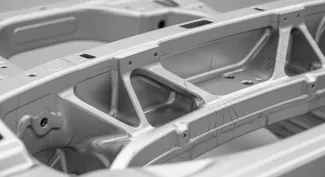
The Chinese automaker has announced that the Yangwang U8L, its top-tier luxury SUV, will be the first production vehicle in the world to use an integrated large-format frame manufactured via low-pressure casting — a method borrowed directly from the aerospace industry. The company co-developed the process with Hangte, an aerospace components supplier, over what it describes as years of material and process testing.
What Makes This Different From Tesla's Giga Press?
The immediate comparison any EV observer will draw is to Tesla's well-known Giga Press die-casting machines, which use extremely high pressure to inject molten aluminum into a mold at speed. BYD has taken the opposite approach: low-pressure casting pushes molten metal slowly upward into the mold, rather than forcing it in horizontally at high velocity.
The difference matters more than it might seem. According to BYD's engineers, the slower upward fill results in fewer internal voids, less turbulence in the molten material, and ultimately a denser, more uniform crystalline structure in the finished part. That translates to better mechanical properties across the board — not just raw strength, but resistance to fatigue and deformation over the vehicle's lifetime.
BYD also notes that it tested a wide range of alternative materials before settling on aluminum alloys, including hot-formed steel and titanium. The chosen material — a blend of aerospace-grade 6-series and 7-series aluminum alloys — offered the best balance of formability, strength-to-weight ratio, and weldability.
The Numbers: Weight, Rigidity, and Safety
The performance claims are substantial. BYD says the new aluminum frame weighs 56 kg (approximately 123 lbs) less than an equivalent steel frame for a similarly sized SUV. In the context of a large luxury vehicle, this is a meaningful gain: lower mass improves range, handling dynamics, and energy efficiency simultaneously.
Torsional rigidity — the frame's resistance to twisting forces — has improved by over 50% compared to steel frames of comparable dimensions. This is the metric engineers often cite when evaluating how "solid" a car feels to drive: it underpins steering precision, ride quality, and the suppression of squeaks and rattles over a vehicle's lifecycle.
Most impressively, the U8L became the first vehicle to pass a 12-ton lifting test using only its integrated frame structure. BYD demonstrated this to validate the structural integrity of the single-piece casting under extreme load conditions — a test that would be unusual, to say the least, for a standard steel unibody.
Manufacturing Efficiency Is Equally Striking
The structural gains come alongside a dramatic simplification of the manufacturing process itself. The U8L's new frame requires just 119 components, down from 251 in the previous design — a reduction of over 52%. Even more telling: 67 separate rear-frame parts have been consolidated into a single casting.
Weld length has been cut from approximately 100 meters to just 9 meters — a reduction of more than 90%. Every weld joint is a potential long-term failure point; fewer welds mean fewer locations where fatigue cracks can initiate, and fewer quality control variables during production.
The cumulative effect of these changes is a frame that is not only lighter and stiffer, but also structurally simpler and — in theory — more consistent from unit to unit.
Yangwang U8L: The Vehicle Behind the Technology
The Yangwang U8L is BYD's most premium product, sitting at the top of the Yangwang sub-brand that was established to compete directly with ultra-luxury off-road vehicles. The U8L is not a volume seller, but it serves as BYD's technology showcase — much as the original Prius served Toyota in its era.
The vehicle has already demonstrated its structural resilience in unusual ways: during a previous durability test, a tree was dropped onto the vehicle to test frame integrity, and the cabin remained intact. The new aluminum frame architecture builds on that foundation with a more engineered approach to structural protection.
What It Means for the Broader EV Industry
BYD's announcement lands at a moment when the European and global automotive industries are watching Chinese manufacturers closely — not just for price competitiveness, but for genuine engineering innovation. The low-pressure casting process, if it delivers as claimed in real-world production, could set a benchmark that other premium EV makers will need to address.
Traditional high-pressure die-casting, as used by Tesla, offers speed and scalability but can introduce porosity issues that require additional heat treatment steps before structural use. BYD's slower low-pressure approach claims to avoid these issues by design, potentially simplifying the post-casting process even if the casting cycle itself takes longer.
For European consumers and fleet buyers evaluating premium electric SUVs, the broader takeaway is clear: the engineering ambition behind Chinese EVs is no longer limited to cost reduction. It is increasingly reaching into structural innovation that affects safety, longevity, and driving dynamics — the attributes European buyers have historically used to justify premium prices for German and Swedish brands.
Whether this technology eventually filters down to more affordable BYD models — or inspires similar developments at competitors like Mercedes-Benz, BMW, or Volvo — remains to be seen. But as a first application, the Yangwang U8L's cast aluminum frame marks a notable step forward in how electric vehicles are built.
How does BYD's low-pressure casting differ from Tesla's Giga Press?
Tesla's Giga Press uses high-pressure die-casting, forcing molten aluminum rapidly into molds at high velocity. BYD's low-pressure casting instead pushes metal slowly upward into the mold, resulting in fewer internal voids, less turbulence, and a denser, more uniform structure. BYD claims this produces better mechanical properties and fewer long-term failure points without the need for additional heat treatment.
Will this aluminum frame technology appear in more affordable BYD models?
BYD has not announced plans to bring this specific technology to mass-market models. The Yangwang U8L is the company's flagship luxury SUV and typically serves as a technology testbed. If production costs can be reduced as the process matures, it could eventually appear in broader BYD or Yangwang lineups, but no timeline has been given.
Is the BYD Yangwang U8L available in Europe?
The Yangwang U8L is currently sold primarily in China as a flagship luxury off-road SUV. BYD has not announced a formal European launch for the U8L, though the technology developed for it may eventually influence BYD models that are sold in Europe under other nameplates.