Ford Sells Part of Valencia Plant to Geely: The First Chinese-Badged EV Will Be Built in Spain
What's on the Table: The Body 3 Assembly Hall
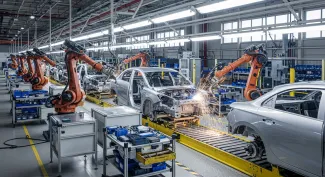
The deal centres on one specific part of Ford's sprawling Valencia facility: the Body 3 assembly hall. This is the production line that once churned out the Mondeo, Galaxy, and S-Max — three models that defined Ford's European family-car strategy for decades. All three have since been discontinued.
Today, the Almussafes plant has an annual capacity of 300,000 vehicles but operates well below its potential. According to Autocar, which first reported the story in English, the only model currently built there is the Ford Kuga — a far cry from the factory's glory days. Spanish outlet La Tribuna de Automoción reports that the deal is already "very advanced" and that Geely has begun reaching out to local suppliers in the Valencia region.
The sale, while not yet finalised, would hand Geely control of the Body 3 hall while Ford retains the rest of the Almussafes complex — at least for now.
The Car: Geely Galaxy EX2, a Puma-Sized Electric Crossover
The first vehicle Geely intends to build in Valencia is the Galaxy EX2, a compact electric crossover roughly the size of a Ford Puma. This is the European-market version of the Geely Galaxy Xingyuan, which became China's best-selling EV in its segment last year. The EX2 will sit on Geely's modular GEA (Global Energy Architecture) platform, a versatile base that can accommodate fully electric or plug-in hybrid powertrains across multiple body sizes.
While official European specifications have yet to be released, the Chinese-market Galaxy Xingyuan offers approximately 400 km of CLTC range, a competitive interior with Geely's Flyme Auto infotainment system, and a price-to-equipment ratio that has helped it dominate its home market. Expect European versions to be tuned for local tastes — and likely a slightly higher price tag than its Chinese counterpart.
The GEA platform is quickly becoming the backbone of Geely's global EV ambitions. It already underpins the Geely EX5 (sold in export markets) and the recently unveiled Starship 7 EV, which offers up to 605 km of range from a 68.4 kWh battery pack.
Why Geely Needs a European Factory
The motivations on Geely's side are straightforward — and largely financial. The European Union imposed 18.8% additional tariffs on electric vehicles imported from Chinese manufacturers, including Geely. Building cars directly on EU soil eliminates those tariffs overnight, allowing Geely to price its vehicles far more aggressively against European incumbents.
But there is more to it than tariffs. A local manufacturing footprint shortens supply chains, improves relationships with European parts suppliers, and — perhaps most importantly — builds consumer trust. European buyers remain cautious about Chinese automotive brands, and a "Made in Spain" label offsets some of that scepticism.
Geely is no stranger to Europe. As the parent company of Volvo, Polestar, Lotus, Zeekr, and Lynk & Co, it already has a deep understanding of the European market. What is changing now is the decision to sell cars under its own Geely badge — a brand that, until now, has had no direct manufacturing presence in Europe.
What Ford Gets: Cash and a Platform
For Ford, the deal represents a dual benefit. First, the direct sale of the Body 3 hall provides a much-needed cash injection for a European division that has been bleeding sales. Ford's European market share has eroded steadily, and models like the Explorer EV and Capri have not yet delivered the volume the company hoped for.
Second, and perhaps more strategically interesting, the partnership with Geely could open the door for Ford to build its own model on the GEA platform. Last year, Ford sources told Autocar that Valencia would be home to a new compact crossover — a model that would indirectly replace the Focus and come with both hybrid and electric powertrains. Initially, Ford had planned to use its own C2 platform (the same architecture under the Kuga) to save retooling costs. A collaboration with Geely on the GEA architecture could change that calculus entirely.
This would not be the first time Ford has leaned on a partner's platform in Europe. The Explorer EV and Capri both ride on Volkswagen's MEB architecture, while two upcoming affordable EVs — expected before the end of this decade — will use Renault's Ampr platform. If Ford ends up building its Focus successor on Geely's GEA architecture, it would mark the third major platform-sharing deal in Ford's European rebirth strategy.
A Pattern, Not an Anomaly
The Ford-Geely deal, if finalised, is not happening in isolation. It is part of a broader reshaping of Europe's automotive manufacturing landscape, as Chinese automakers move from exporting cars to Europe to building them on European soil.
BYD is reportedly negotiating to take over part of Volkswagen's Dresden plant. Chery has already taken over the former Nissan factory in Barcelona. Leapmotor is using Stellantis capacity in Tychy, Poland, to assemble vehicles for the European market. Chinese brands are rapidly acquiring production capacity that legacy European and American automakers no longer need — or can no longer afford to keep running.
For Ford, the Valencia plant sale is part of a longer narrative of retrenchment. Once a full-line European manufacturer with factories stretching from the UK to Spain, Ford's footprint on the continent has been shrinking for years. The question now is whether sharing platforms and selling factory space to Chinese partners is a survival strategy — or a managed exit.
The Union Factor
One element not to be overlooked is the role of Spanish labour unions. Workers and union representatives at Almussafes have been anxious about the plant's future since the Mondeo, Galaxy, and S-Max were phased out. The prospect of a new manufacturer — especially one with Geely's resources — filling idle capacity is likely to be met with cautious optimism. Jobs, even under new ownership, are still jobs.
The deal's specifics regarding workforce transition have not yet been disclosed, but Geely's engagement with local suppliers suggests the company is planning a meaningful presence, not a token assembly operation.
What Comes Next
Neither Ford nor Geely has officially confirmed the deal, but the indicators point toward an announcement in the coming weeks. Geely is already sounding out suppliers. Spanish media reports frame the negotiation as the final stage of a long process. And the strategic logic — for both sides — is difficult to dispute.
If the Galaxy EX2 does start rolling off a Spanish production line sometime in 2027 or 2028, it will mark a symbolically potent moment. A Chinese car brand, building electric crossovers in a former Ford factory, selling to British and European buyers under a "Made in Spain" badge. For some, it will look like the future of European car manufacturing. For others, it will feel like the end of an era.
Will the Ford Valencia plant be fully sold to Geely?
No, the reports indicate that only the Body 3 assembly hall — where the Mondeo, Galaxy, and S-Max were previously built — is part of the deal. Ford will reportedly retain the rest of the Almussafes complex, including the line that currently produces the Kuga.
What is the difference between the Geely Galaxy EX2 and the Xingyuan?
The Geely Galaxy EX2 is the European-market version of the Geely Galaxy Xingyuan sold in China. The Xingyuan became China's best-selling EV in its segment last year. While the platform and core design will be shared, the European EX2 is expected to receive specific tuning for European roads and regulations. Official specs, pricing, and exact range figures for the European version have not yet been released.
Does this mean Ford is leaving the European market?
Ford has not announced plans to leave Europe entirely. However, the sale of part of its Valencia plant, combined with its increasing reliance on partner platforms (VW's MEB and Renault's Ampr), suggests the company is fundamentally restructuring its European operations rather than exiting outright. Ford continues to sell models like the Kuga, Puma, Explorer EV, and Capri in European markets.