
Listen to this article:
When Renault and Geely Pool Their Engine Expertise
Horse Powertrain is not a name that rolls off the tongue yet, but it represents something rarely seen in the automotive industry: a joint venture between a European manufacturer and a Chinese conglomerate built specifically around combustion and hybrid powertrain technology. Renault and Geely established the company to develop and manufacture engines, transmissions, and — increasingly — electrified powertrain systems for a world still transitioning away from fossil fuels.
Operating across three continents with around 19,000 employees and five global R&D centres, Horse Powertrain is quietly positioning itself as the supplier of choice for automakers who need flexible, emissions-compliant propulsion solutions. Its latest creation, the D20 Methanol range extender, is the clearest signal yet of where that ambition is headed.
What a Range Extender Actually Does — and Why Methanol Changes the Equation
Before diving into the D20's specifications, it is worth being clear about what a range extender is. Unlike a plug-in hybrid, where the combustion engine can directly drive the wheels, a range extender operates exclusively as an on-board generator. The petrol — or in this case, methanol — engine runs only to produce electricity, which feeds the traction battery. The wheels are always powered by electric motors. The result is a driving experience that remains fundamentally electric, while the range anxiety that still plagues pure BEVs is eliminated.
The choice of methanol as the fuel is significant. Unlike petrol or diesel, methanol can be produced from renewable sources — including captured CO₂ and green hydrogen — meaning the fuel's carbon footprint is potentially far lower than conventional hydrocarbons. China has invested heavily in methanol infrastructure over the past decade, making it a pragmatic choice for a technology initially targeting the Chinese market. But Horse Powertrain has also engineered the D20 to meet Euro 7 emission standards, which signals clear European ambitions.
The D20 Methanol: Specifications That Demand Attention
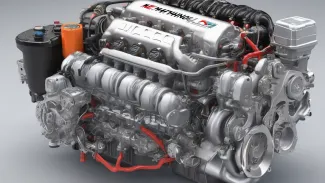
The headline numbers are compelling. The D20 Methanol delivers up to 105 kW of electrical output from a 2.0-litre turbocharged four-cylinder engine running on 100% methanol. The complete integrated system — engine, generator, and power electronics — weighs 170 kg.
Efficiency figures are where the D20 makes its most persuasive argument. The system achieves 96.4% electrical efficiency and a fuel-to-electricity efficiency of 47%. In practical terms, Horse Powertrain demonstrated that the D20 can fully recharge a 40 kWh traction battery using just 19.6 litres of methanol under laboratory conditions. For context, that is roughly half a tank of fuel in a conventional car, replenishing an electric range that most European drivers would find entirely adequate.
Cold-weather performance has been engineered to real-world demands. A high-energy ignition system enables reliable cold starts at temperatures as low as minus 35 degrees Celsius — a figure that makes the system viable across Scandinavia, Eastern Europe, and much of Northern Asia without modification.
The Axial Flux Generator: A Quiet Engineering Masterstroke
Perhaps the most technically interesting aspect of the D20 is not the engine itself but the generator attached to it. Conventional range extenders and hybrid systems typically use radial flux generators, where the magnetic flux travels radially outward from a central shaft. Horse Powertrain has instead adopted an axial flux design — a disc-shaped configuration where the rotor and stator face each other across a flat airgap.
The advantages are substantial. Compared to a comparable radial flux generator, the axial flux unit in the D20 achieves a 46% shorter build length and a 63% higher volumetric power density. In simpler terms: it packs more electrical output into a smaller, lighter package. For vehicle packaging engineers, this is not a minor detail — it means the D20 can fit into platforms not originally designed around a range extender, opening the technology to a wider range of vehicles.
Meeting the Standards That Matter: CN6b and Euro 7
The D20 Methanol meets both Chinese CN6b emissions standards and the demanding Euro 7 regulations, with nitrogen oxide emissions within the thresholds set by both frameworks. This dual compliance is not accidental. It means the same core powertrain can be deployed in vehicles sold in Shanghai and in Stuttgart without fundamental re-engineering.
Euro 7 has been among the most debated regulatory frameworks in the European automotive industry, with manufacturers arguing over its costs and timelines. A range extender that meets Euro 7 while running on a fuel that can be produced renewably presents an interesting regulatory positioning: it is not an ICE vehicle in the traditional sense, nor a pure BEV. It occupies a transitional space that regulators are still learning to categorise.
The REEV Market Moment — and Why Europe Should Pay Attention
China's range-extended electric vehicle market has expanded at a pace that surprised even optimistic forecasters. Companies such as Li Auto built entire product lines on the concept, while newer entrants from Huawei's HIMA alliance to Nio's sub-brands have explored extended-range architectures. The appeal is clear: buyers get the smooth, quiet power delivery of an electric car without being dependent on a charging network that, outside of major Chinese cities, remains unevenly distributed.
Europe faces a structurally similar challenge. Public charging infrastructure is growing rapidly — Germany crossed 200,000 public charge points earlier this year — but the density outside urban centres and motorway corridors remains insufficient for drivers without home charging. A range extender that meets Euro 7 and runs on a potentially renewable fuel could serve as a credible bridge technology for markets where the full BEV transition is happening slower than policy targets assume.
Horse Powertrain's Broader X-Range Strategy
The D20 Methanol does not stand alone. In April 2026, Horse Powertrain introduced the X-Range C15 Direct Drive, a system enabling vehicles originally designed as pure electric platforms to function as full hybrids, plug-in hybrids, or range extenders. Together, the two products outline a coherent strategy: give automakers a flexible toolkit to electrify their portfolios without committing entirely to a single powertrain architecture before the market, the infrastructure, and the regulation have settled.
It is a pragmatic position — and one that a joint venture between Renault's engineering depth and Geely's manufacturing scale is perhaps uniquely positioned to execute. The question now is which vehicle programmes adopt the D20 first, and whether European carmakers — some of whom remain shareholders or partners of both Renault and Geely entities — will be among them.
What is methanol and why is it used as a fuel for range extenders?
Methanol is a simple alcohol fuel that can be produced from natural gas, coal, or — increasingly — from captured CO₂ and green hydrogen via renewable energy. Unlike petrol, it carries the potential to be a low-carbon fuel when produced renewably. For range extenders, it burns cleanly enough to meet strict emission standards like Euro 7, and China already has growing methanol refuelling infrastructure, making it a practical choice for that market.
How is a range extender different from a conventional hybrid or plug-in hybrid?
In a conventional hybrid or plug-in hybrid, the combustion engine can directly drive the wheels via a mechanical connection. In a range extender, the combustion engine is purely a generator — it only produces electricity to recharge the traction battery, and the wheels are always driven by electric motors. This means the driving experience is fundamentally electric at all times, with the engine acting as a portable power station rather than a direct propulsion source.
Will the Horse Powertrain D20 Methanol be available in European cars?
Horse Powertrain has engineered the D20 to meet Euro 7 emission standards, which is a strong indicator of European market intent. However, no specific vehicle programmes or European launch partners have been announced publicly as of July 2026. The technology is initially targeting China's established range-extended EV market, but the dual regulatory compliance keeps European deployment firmly on the table.
Source: https://www.electrive.com/2026/07/16/horse-powertrain-presents-methanol-range-extender/