
Listen to this article:
What the Astraux AL6 and AL7 Pro Bring to the Table
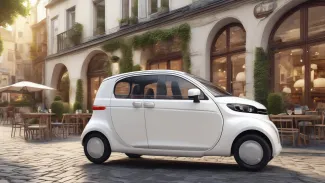
The Astraux AL6 is the entry-level model, priced at €7,990 — essentially the same as the Citroën Ami. But the comparison stops there. Where the Ami offers a 5.5 kWh battery, a top speed of 45 km/h, and a famously spartan interior with optional heating (extra cost), the AL6 comes standard with a 5 kWh LFP battery good for 95 kilometres of range, air conditioning, electric windows, a full infotainment screen with Apple CarPlay, around-view cameras, rear parking sensors, USB charging ports, and even a wireless phone charger. Customers can opt for a 10 kWh pack that extends range to 180 kilometres. Both are LFP chemistry, which means longer cycle life and better thermal stability than the standard NMC cells used in most European competitors. Step up to the AL7 Pro at €11,990, and you enter L7e territory — the heavier quadricycle class that permits speeds up to 90 km/h and excludes vehicles that must stay below 45 km/h. With 20 kW (27 hp), the AL7 Pro reaches 90 km/h and claims a range of 150 kilometres from a 10 kWh LFP battery. The acceleration, as shown in video demonstrations from China, is brisk enough to not feel like a rolling roadblock on faster urban arterial roads. This places the AL7 Pro in direct competition with the Microlino, which starts at roughly double the price, and the upcoming Eli Zero, yet the Astraux offers more standard equipment than either.A Segment That Has Barely Evolved
Europe's L6e and L7e quadricycle categories have existed for decades, but the vehicles populating them have historically been agricultural in their approach to comfort and equipment. The Citroën Ami, launched in 2020, was praised for its bold design and urban practicality, yet its interior is closer to a golf cart than a car: manual windows, a basic smartphone mount instead of a screen, and a heater that costs extra. The Fiat Topolino, essentially a restyled Ami with a slightly more charming exterior, did nothing to alter the formula. Even the Renault Twizy, which preceded both, was famously open to the elements and offered scissor doors but no windows at all. Astraux is not the first Chinese company to spot this gap. Brands like XEV with the Yoyo and the aforementioned Microlino (Swiss-designed, Italian-built) have demonstrated that buyers will pay more for a quadricycle that feels like a real car. What makes Astraux different is the aggressiveness of its value proposition: it is essentially offering Microlino-level equipment at Ami-level pricing, a combination that, if executed properly, could reset expectations across the entire segment. The AL6's monocoque steel construction also sets it apart structurally from the Ami's welded tube frame wrapped in plastic body panels, suggesting a more substantial approach to occupant protection, even if quadricycles are not required to pass the same crash tests as passenger cars.What This Means for Europe
The European quadricycle market is not enormous, but it is growing steadily as cities across the continent tighten low-emission zones and younger buyers look for affordable electric mobility that does not involve two wheels and a helmet. France, Italy, Spain, and increasingly Germany and the Netherlands all have urban environments where a 45 km/h vehicle with a 100-kilometre range is genuinely useful for daily commuting. For many households, a quadricycle serves as a second or third vehicle — the one used for school runs, shopping, and short commutes — making price sensitivity particularly acute. Astraux entering this space with a significantly better-equipped product at the same price as the segment leaders represents a familiar pattern: Chinese manufacturers leveraging supply chain scale, lower labour costs, and aggressive pricing to enter European niches that incumbents have underserved. The same dynamic has played out with BYD, MG, and Xpeng in the passenger car segment. The difference here is the target — not the €30,000–€50,000 family car buyer, but the €8,000–€12,000 urban mobility customer who has until now been choosing between extreme minimalism (Ami, Topolino) or spending significantly more (Microlino).The Risks of an Unknown Player
Astraux is a brand-new entity with no track record, no established dealer network, and no history of after-sales support in Europe. The quadricycle category may have lower regulatory barriers than full passenger cars — L6e and L7e vehicles face less stringent homologation — but European customers still expect their vehicles to start every morning and survive several winters. Chinese micro-EV brands have a mixed record abroad: some, like the XEV Yoyo, have built modest but sustainable European operations, while others have launched with fanfare only to disappear when warranty claims and spare parts shortages overwhelmed their minimalist distribution networks. The AL7 Pro's claimed range of 150 kilometres and top speed of 90 km/h are respectable on paper, but real-world figures in European winter conditions — where the heater will be running and LFP batteries lose efficiency in cold weather — will inevitably be lower. The 20 kW motor, while adequate for flat urban terrain, may struggle on the steep cobblestone hills of Lisbon or the Alpine gradients of northern Italy. These are not deal-breakers for the target audience — nobody buying a €7,990 quadricycle expects Autobahn performance — but they are factors that European reviewers and early adopters will scrutinise closely.The Broader Picture: China's Push Into Every Segment
Astraux is one data point in a larger trend. Chinese manufacturers are no longer content to compete only in the mid-size SUV segment; they are systematically targeting every European vehicle category, from full-size luxury sedans like the Nio ET9 to compact crossovers like the BYD Atto 2 and now micro quadricycles. The Astraux AL6 and AL7 Pro represent the thin end of the wedge — if a Chinese company can offer a demonstrably superior product at the very bottom of the market, it raises uncomfortable questions about why European manufacturers have not done the same. Stellantis, which owns both Citroën and Fiat, has the engineering resources to build an Ami successor with air conditioning, a proper infotainment system, and an LFP battery. It simply has not chosen to do so. The Ami and Topolino have been on the market for years with only minor trim updates. Astraux's arrival may not steal significant market share overnight, but it signals to European carmakers that the era of offering a stripped-down box on wheels and calling it adequate is coming to an end — even at the very bottom of the price ladder.What is the difference between L6e and L7e quadricycles?
L6e quadricycles are limited to 45 km/h, weigh up to 425 kg (excluding battery), and are essentially motorised four-wheelers for urban use. L7e vehicles can reach 90 km/h, weigh up to 450 kg (or 600 kg for passenger versions), and can drive on faster urban and suburban roads. The Astraux AL6 is L6e; the AL7 Pro is L7e.
Can the Astraux AL6 or AL7 Pro be driven on European motorways?
No. Neither model is homologated as a full passenger car (M1 category). The AL6 is restricted to 45 km/h, making it unsuitable for any road with a minimum speed requirement. The AL7 Pro reaches 90 km/h, making it usable on some suburban dual carriageways, but it is still classified as a quadricycle and cannot legally travel on motorways or roads with minimum speed limits above its top speed.
Do I need a full driving licence to drive an Astraux quadricycle in Europe?
Regulations vary by country. In most EU member states, the L6e AL6 can be driven from age 14 or 16 with an AM licence (moped category). The L7e AL7 Pro typically requires at least a B1 licence, and in some countries a full category B (car) licence. Always check your national regulations, as rules differ between France, Germany, Italy, and other EU countries.
Source: https://insideevs.com/news/801381/astraux-al7-well-equipped-microcar/