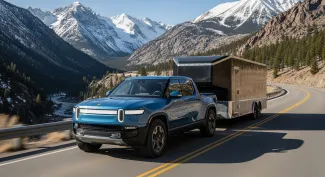
On the US market, where the electric pickup truck segment is fiercely contested, a real-world towing test has delivered a verdict that challenges one of the most persistent arguments against electric vehicles. A grassroots racing team hauled a 2-tonne trailer 2,400 kilometres across the Rocky Mountains in a Rivian R1T — and spent just a third of what an equivalent petrol or diesel truck would have burned in fuel. While Rivian does not yet sell in Europe, the data from this cross-country trip carries direct implications for European drivers watching the electric pickup and SUV segment with scepticism.
Listen to this article:
The man behind the wheel was Tyler Joy, a member of the grassroots racing outfit Team Arcblast, which previously built an electrified Datsun mini-truck with swappable battery packs that holds the EV endurance record in the 24 Hours of Lemons series. The mission was straightforward: transport the team's converted electric race truck to a competition in Willows, California. The test vehicle was a first-generation Rivian R1T Launch Edition, equipped with four electric motors producing a combined 835 horsepower and an EPA-rated range of 314 miles (505 km) on a full charge.
With the 4,500-pound trailer hitched, that theoretical range collapsed to a realistic 160 to 170 miles (257–274 km) between charging sessions — roughly half the unladen figure. This translated into 14 individual stops at fast-charging stations, injecting an estimated 10 extra hours into the overall journey time. On paper, that sounds like a dealbreaker. In practice, Joy had already planned for a three-day road trip, and the additional charging downtime proved surprisingly tolerable. "It was still the best tow vehicle I've ever driven," he told EV Tuners, a YouTube channel that documented the run.
The financial arithmetic, however, is where the real story lies. Based on current US fuel prices, Joy calculated that recharging the R1T cost approximately one-third of what refuelling a comparable diesel or petrol pickup would have required for the same 2,400-kilometre journey. With an estimated 9,600 kilometres of towing planned for the 2026 racing season, the cumulative savings become substantial — potentially thousands of dollars that stay in the team's pocket rather than evaporating at the pump. For European drivers, where diesel currently hovers around €1.60–1.80 per litre in many countries and public fast-charging rates can dip below €0.45 per kWh with the right subscription, the same arithmetic holds even more weight.
The journey through the Rocky Mountains also highlighted an underappreciated advantage of electric towing: regenerative braking. On steep descents, the R1T's motors fed energy back into the battery pack while simultaneously keeping the mechanical brakes cool — a stark contrast to combustion trucks, where drivers must carefully manage brake temperature on long downhill grades to avoid fade. Joy noted that in previous towing experiences with diesel trucks, mountain passes meant mashing the throttle on the way up and nervously managing the brakes on the way down. The Rivian handled both extremes with composure, delivering instant torque for climbing and smooth, controlled deceleration for descending.
One counterintuitive lesson emerged mid-trip: slowing down can actually shorten the total journey. At one point, the R1T arrived at a charging station with just 5% remaining charge. After experimenting with different cruising speeds, Joy discovered that driving at 60 mph (97 km/h) instead of 80 mph (129 km/h) reduced energy consumption so dramatically that it eliminated at least one complete charging stop — more than offsetting the slower road speed. This aerodynamic reality applies universally: at highway speeds, air resistance — not weight — becomes the dominant factor in energy consumption, and reducing speed by 25% can cut drag by over 40%.
What does this mean for Europe? Rivian has not yet launched on this side of the Atlantic, and the R1T's sheer size — over 5.5 metres long — makes it an awkward fit for narrow European city streets. However, the towing economics demonstrated in this test apply directly to the growing number of electric SUVs and pickups entering the European market: the Ford F-150 Lightning (available in select markets like Norway and Switzerland), the Maxus T90EV, the incoming Kia EV9 and Volvo EX90 — all rated for towing capacities above 2,000 kg. The caravaning and horse-trailer communities, particularly active in Germany, the Netherlands, and Scandinavia, stand to benefit most from this cost equation. A typical summer holiday trip from Munich to the Italian Riviera with a caravan in tow could see fuel costs slashed by two-thirds — provided drivers plan charging stops around Europe's increasingly dense HPC network.
There are, of course, caveats. The charging infrastructure must keep pace. Pulling a trailer into a standard fast-charging bay often means unhitching first — a genuine inconvenience that the industry is only beginning to address through drive-through charging layouts. And while Europe's public charging network added over 200,000 new charge points in 2025 alone, gaps remain in rural and mountainous regions. The economics, however, are becoming impossible to ignore. As Joy's 2,400-kilometre experiment demonstrates, the range penalty of electric towing is real — but the savings are even more real.
Does towing with an electric vehicle really cost one-third of a diesel equivalent?
In this specific real-world test, yes. Tyler Joy of Team Arcblast reported that recharging the Rivian R1T during a 2,414 km towing trip cost roughly one-third of what refuelling a comparable diesel pickup would have required at current US fuel prices. The ratio will vary depending on local electricity and fuel rates — in many European countries with high diesel taxes and competitive overnight electricity tariffs, the savings could be even greater.
Are there any electric pickups or SUVs available in Europe that can tow a large trailer?
Yes. The Ford F-150 Lightning is available in select European markets including Norway and Switzerland, while the Maxus T90EV serves the commercial pickup segment. Among SUVs, the Kia EV9 (2,500 kg towing capacity), Volvo EX90 (2,200 kg), BMW iX (2,500 kg), and Mercedes-Benz EQS SUV (1,800 kg) all offer credible towing capabilities. The upcoming Rivian R2, announced for European availability, is expected to retain a practical towing rating in a more compact footprint.
How much does towing reduce an electric vehicle's range?
Expect a reduction of 40–60%, depending on trailer weight, aerodynamics, speed, and terrain. In the Rivian R1T test, a 2,040 kg trailer cut the EPA-rated range from 505 km to approximately 257–274 km between charges. Aerodynamic drag from the trailer is typically the dominant factor, meaning a lower, more streamlined trailer will have less impact than a tall, boxy caravan.
Source: https://insideevs.com/news/798734/rivian-r1t-towing-cost/