Listen to this article:
The Numbers Behind the Problem
Documents obtained from Austin city records show that Waymo's robotaxis have received a total of $9,325 in parking fines since the service launched in the Texas capital. Of that, the company has paid $7,433 — covering 83 citations — leaving $1,892 still outstanding. Individual fines ranged from a modest $20 to a steep $519 depending on the severity of the violation.
The violations themselves paint a revealing picture of where autonomous navigation still struggles in the real world. The largest category — 63 citations — were for stopping in tow-away zones, suggesting the vehicles repeatedly chose drop-off or pick-up spots that human drivers are specifically trained to avoid. Thirteen tickets related to unpaid meter violations, nine to double parking, and one to a disabled-spot infringement — the kind of citation that carries real reputational weight for a company that markets its technology partly on the basis of consistency and rule-following.
Two of the Austin cases were ultimately dismissed through plea bargains. Waymo said it "reviews all received citations and may engage with the court to address and resolve them."
Not Just an Austin Problem
Austin is not the first city where Waymo has found itself on the wrong side of a traffic warden. In San Francisco — where the company has operated longer and with a larger fleet — Waymo's robotaxis accumulated over $65,000 in parking citations during 2024 alone. That figure drew considerable media attention and triggered discussions between the company and San Francisco city officials about how to better programme vehicles' kerb behaviour in dense urban environments.
By comparison, Austin's $9,325 total is modest. The city collected $6.3 million in traffic fines during fiscal year 2025, meaning Waymo's contribution amounts to a rounding error in municipal revenue terms. But the pattern matters more than the sum.
Why Do Robotaxis Park Badly?
The explanation lies in a fundamental tension within autonomous vehicle design. Waymo's software — the sixth-generation "Waymo Driver" system — is built to optimise for passenger convenience and route efficiency. When a passenger requests a pick-up or drop-off, the vehicle must find the nearest suitable stopping point. In a busy city like Austin or San Francisco, that calculation does not always match what a human driver would instinctively know to avoid.
Tow-away zones, for instance, are often located near high-demand locations: restaurant entrances, hotel lobbies, transit stops. The vehicle's sensors and mapping data may correctly identify a physical space to stop, but fail to weigh the legal designation of that space heavily enough — or fail to update quickly when a zone's rules change temporarily for a construction project or event.
Double parking in particular is a behaviour that human taxi and rideshare drivers routinely engage in despite its illegality, because it is the fastest option in dense traffic. The fact that Waymo's vehicles also resort to it at times shows that the pressure of urban logistics does not disappear just because the driver is a machine.
A Fleet of 200 on Austin's Streets
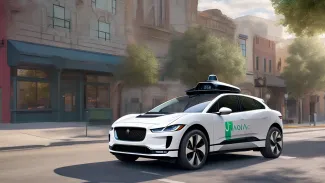
Waymo operates approximately 200 Jaguar I-Pace vehicles in Austin as of mid-2026. The I-Pace, Jaguar's all-electric SUV, has served as the backbone of Waymo's commercial fleet since the early days of the One ride-hailing service. The company is expected to transition to its purpose-built Waymo One Ojai robotaxi — unveiled in May 2026 — as it scales further, though no firm Austin timeline has been confirmed.
Austin was chosen as an expansion market partly for its relatively straightforward road layout compared to San Francisco's hills and tight grids, and partly for its younger, tech-forward demographic that has been receptive to autonomous ride services. The city's regulators have broadly welcomed Waymo's presence, though incidents like these parking violations serve as a reminder that even in welcoming environments, the technology operates in a physical world with physical rules.
The Broader Regulatory Picture
The parking ticket issue points to a gap in how cities regulate autonomous vehicles. Most municipalities have enforcement frameworks built entirely around human accountability — a driver who parks illegally can be issued a fine on the spot, warned verbally, or asked to move. With a robotaxi, there is no one behind the wheel to receive the citation or respond to a traffic warden's instruction. The vehicle simply sits there, and the fine eventually finds its way to the operator's legal department.
This creates a structural problem: enforcement is delayed and diluted. A human driver who double parks gets immediate feedback. A Waymo vehicle that double parks 83 times accrues 83 fines that are later reviewed by a legal team and, in some cases, negotiated down or dismissed. The deterrent mechanism works very differently — and arguably far less effectively.
In the United States, regulators at the federal level are still developing comprehensive frameworks for autonomous vehicle operations, with the National Highway Traffic Safety Administration (NHTSA) focused largely on safety incidents rather than parking behaviour. Individual cities are left to manage the day-to-day friction on their own.
Waymo's London expansion — planned for late 2026 following a $16 billion fundraising round in February — will test how the company's systems adapt to an entirely different regulatory environment. London's parking enforcement is notably aggressive, with an extensive network of cameras and rapid-response wardens. Whether the lessons from Austin and San Francisco have been absorbed remains to be seen.
Small Fine, Big Question
For Waymo, a company valued in the tens of billions of dollars, paying $9,325 in parking fines is not a financial burden. But the story is not really about money. It is about whether autonomous vehicles are truly ready to navigate not just the physics of urban driving, but the social and legal fabric that human drivers internalise over years of experience.
Knowing not to stop in a tow-away zone is not just a rule — it is a learned instinct built from seeing the consequences, from being honked at, from watching a truck haul away a neighbour's car. Replicating that kind of embedded, consequence-driven knowledge in software is one of the subtler challenges of autonomous driving — and it turns out, it is not yet solved.
Does Waymo pay parking fines its robotaxis receive?
Yes. Waymo says it reviews all citations received by its autonomous vehicles and pays applicable fines. In Austin, the company paid $7,433 of the $9,325 in total parking fines issued, with the remainder either outstanding or dismissed. In some cases, Waymo has engaged with courts to negotiate or resolve citations.
Are Waymo robotaxis available outside the United States?
Not yet commercially. Waymo currently operates paid ride-hailing services in San Francisco, Phoenix, Los Angeles, and Austin. The company has confirmed plans to launch in London by the end of 2026, following a $16 billion funding round in early 2026, but international commercial services have not yet begun.
What happens when a driverless car is illegally parked — can it be towed?
In principle, yes. A vehicle parked illegally can be towed regardless of whether it has a human driver. In practice, Waymo's operations team monitors vehicles remotely and can intervene — instructing the car to move — before a tow truck arrives. However, in cases where the vehicle has already stopped and a citation is issued, the fine is processed through Waymo's legal team rather than going to an individual driver.
Source: https://insideevs.com/news/802842/waymo-robotaxi-austin-parking-tickets/