Listen to this article:
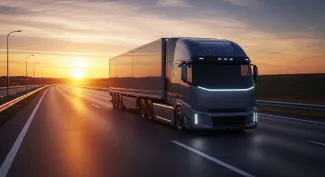
When Aurora Innovation launched its first driverless freight operations in 2025, sceptics called it a publicity stunt. Fourteen months later, the company is answering with hardware. On 22 July 2026, Aurora announced the commercial deployment of its second-generation Aurora Driver — a more powerful onboard system that the company says is built to last one million miles (1.6 million kilometres) and capable of scaling to hundreds of trucks.
The announcement matters beyond the United States. Aurora operates its system on Volvo Trucks platforms alongside International Motors LT Series and PACCAR vehicles — and Volvo is one of Europe's most active champions of electric and autonomous freight. The intersection of autonomy and electrification is arriving faster than most logistics operators expected.
Ten routes, 440,000 miles — and growing fast
Aurora's current commercial network covers ten autonomous freight routes across the US Sun Belt, the warm southern corridor where weather conditions suit early-stage autonomous operations. By the end of June 2026, the Aurora Driver system had completed nearly 440,000 driverless miles — all without a safety driver sitting behind the wheel.
The second-generation hardware brings greater computing performance compared to the first-generation system, allowing Aurora to process more sensor data in real time and handle a broader range of road scenarios. Crucially, the platform is designed to be powertrain-agnostic — meaning it is engineered for integration with battery-electric trucks, not just the diesel Class 8 vehicles on which it currently operates.
"Deploying our second-generation truck allows us to put hundreds of autonomous trucks on the road and ultimately into the hands of more customers," said Chris Urmson, CEO and co-founder of Aurora Innovation.
500 trucks: the first major commercial order signal
Commercial interest is solidifying. One unnamed customer has announced plans to purchase 500 autonomous trucks equipped with the Aurora Driver system — a figure that would represent a significant expansion of the current fleet. Aurora has not disclosed the buyer's identity, but the scale of the commitment signals that logistics operators are no longer treating autonomous freight as an experiment.
The freight sector's economics make the case clearly. Long-haul trucking in the United States faces a structural driver shortage estimated at tens of thousands of positions annually. Autonomous systems do not require rest breaks under hours-of-service regulations, which means trucks equipped with Aurora Driver can, in principle, run for longer stretches without stopping — improving asset utilisation and delivery windows. For freight operators watching fuel and labour costs, the business case is becoming harder to dismiss.
The electric frontier still ahead
There is one significant gap in Aurora's current story: no electric autonomous trucks have been commercially deployed despite the Aurora Driver being explicitly designed for electric powertrains. The company's current fleet runs on diesel. This is partly a pragmatic choice — battery-electric Class 8 trucks are still building out charging infrastructure and refining range on long-haul corridors — but it also means the full environmental promise of autonomous freight remains on the horizon.
Volvo Trucks, one of Aurora's hardware partners, has been aggressive in electrifying its lineup. The Swedish manufacturer already sells electric heavy trucks in Europe and has partnered with a range of charging infrastructure providers. When Aurora's software eventually pairs with electric hardware at commercial scale, Volvo Trucks is positioned to play a central role.
In Europe, the regulatory landscape for autonomous trucks is developing more slowly than in the United States. The EU's framework for highly automated vehicles is still being finalised, and cross-border autonomy presents jurisdictional complexity that does not exist on a single continuous interstate network. Nevertheless, Aurora's progress creates commercial pressure: European logistics operators will watch closely as American competitors begin reducing per-mile costs with autonomous diesel trucks — and eventually electric ones.
What Aurora's progress means for European freight
The European heavy truck market is in transition. Manufacturers including Volvo, Scania, DAF, and Mercedes-Benz Trucks are electrifying their ranges while simultaneously investing in driver-assistance and automated driving systems. The question is no longer whether autonomous electric trucks will arrive in Europe — it is when, and which operators will be ready.
Aurora's second-generation deployment answers part of that question by showing that driverless freight is technically viable at commercial scale, even if profitability at scale is still being established. The company's one-million-mile hardware durability target is significant: if a truck can operate autonomously for that distance without major hardware replacement, the economics begin to look compelling even at current electric truck purchase prices.
For European fleet operators and logistics companies — many of whom are already navigating the transition to zero-emission vehicles ahead of EU CO₂ targets — Aurora's roadmap offers a preview of what the next decade could look like: driverless, electric, and running around the clock.
What is the Aurora Driver and how does it work on trucks?
The Aurora Driver is an autonomous driving system fitted to Class 8 heavy trucks. It uses a combination of cameras, lidar, and radar sensors together with onboard computing hardware to navigate highways without a human driver. The second-generation system offers greater computing performance and is designed to last one million miles (1.6 million kilometres) in commercial operation.
Is Aurora planning to deploy autonomous electric trucks?
Aurora has designed its system to be powertrain-agnostic, meaning it is technically compatible with battery-electric trucks. However, as of July 2026, all commercially deployed Aurora Driver trucks run on diesel. The company has not announced a timeline for commercial autonomous electric truck operations.
When could autonomous trucks like Aurora's arrive in Europe?
European regulations for highly automated vehicles are still being developed, and cross-border autonomy within the EU adds jurisdictional complexity. Manufacturers such as Volvo Trucks — one of Aurora's hardware partners — are active in both electric and automated trucking in Europe, but commercial driverless operations on European roads are not expected within the next few years under current regulatory timelines.
Source: https://www.electrive.com/2026/07/24/aurora-deploys-second-generation-driverless-trucks/