
Listen to this article:
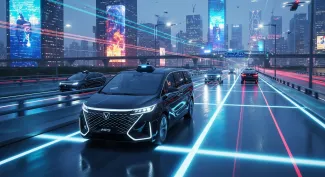
The landscape of the premium MPV market is shifting rapidly. On May 15, 2026, the Luxeed V9 was officially unveiled, marking a strategic expansion for the Huawei-led HIMA alliance. This move is clearly aimed at challenging established players like General Motors and BYD in the high-end commercial and family vehicle sectors in China. With over 40,000 pre-orders already secured since late April, the market response suggests a significant appetite for highly digitized, long-range luxury transport.
A Sophisticated Powertrain: The EREV Advantage
Unlike many pure battery electric vehicles (BEVs) that dominate European headlines, the Luxeed V9 utilizes an Extended-Range Electric Vehicle (EREV) architecture. For readers unfamiliar with this term, an EREV uses a small internal combustion engine not to drive the wheels directly, but to act as a generator that charges the battery on the go. This setup effectively eliminates "range anxiety" while maintaining the smooth, quiet driving experience of an electric motor.
The V9 is equipped with a 1.5-liter turbo gasoline range-extender engine and high-performance battery packs supplied by CATL. Customers can choose between two battery capacities: 37 kWh or 53.4 kWh. While the pure electric range is modest—between 158 and 223 kilometers—the total combined range when the fuel tank is full reaches a staggering 1,250 kilometers. This makes it an ideal candidate for long-distance travel where charging infrastructure might be sparse.
Pricing for the Luxeed V9 starts at 389,800 yuan (approximately €53,000), with higher trims reaching up to 519,800 yuan. The vehicle is available in four distinct trims: Max, Max+, Ultra, and Ultra+.
Intelligence at the Core: Huawei ADS 5
What truly sets the Luxeed V9 apart from traditional minivans is the integration of Huawei's cutting-edge software and sensor suite. The vehicle is built on the Huawei Turing platform and features the latest ADS 5 (Advanced Driving System). This system is supported by a massive array of 38 sensors, including Huawei’s proprietary 896-channel LiDAR.
During the launch event in Shanghai, Huawei executive director Richard Yu emphasized that this sensor density allows for complex road perception and obstacle avoidance that can, in many scenarios, surpass human reaction times. For the driver, this means a level of autonomy and safety that was previously reserved for much more expensive, niche technology demonstrators. To ensure the large vehicle remains manageable in tight urban environments, all models come standard with rear-wheel steering, significantly reducing the turning circle.
Luxury as a Mobile Lounge
The interior of the Luxeed V9 is designed to compete with the highest tier of luxury travel. Measuring 5,359 mm in length and featuring a 3,250 mm wheelbase, the seven-seat cabin offers immense space. Key luxury features include:
- Zero-gravity second-row seats: These can rotate 180 degrees, allowing for a face-to-face social arrangement.
- In-car oxygen concentrator: Designed to improve passenger well-being during long journeys.
- High-power climate control: A specialized refrigerator capable of maintaining temperatures for over 12 hours even after the vehicle is powered off.
Market Context and European Implications
While the Luxeed V9 is currently focused on the Chinese market, its arrival is a signal to the global automotive industry. The heavy investment by Chery—reportedly over 20 billion yuan into the Luxeed project—demonstrates how deeply integrated Chinese manufacturers are becoming with tech giants like Huawei.
For the European market, where MPVs like the Mercedes-Benz V-Class or the Volkswagen Multivan are staples for premium transport, the Luxeed V9 represents a different kind of competition. While the EREV technology might face different regulatory hurdles in the EU compared to China, the emphasis on software-defined vehicles and advanced LiDAR-based autonomy is a trend that European manufacturers cannot ignore. As Chinese brands continue to refine their luxury offerings, the pressure to match this level of integrated technology will only increase.
What is an EREV and how does it differ from a Plug-in Hybrid (PHEV)?
In an EREV, the gasoline engine never directly drives the wheels; its only job is to charge the battery to power the electric motors. In a typical PHEV, the engine can actively assist the electric motor in turning the wheels, which can sometimes lead to different driving dynamics and efficiency profiles.
Will the Luxeed V9 be available for purchase in Europe?
As of now, there is no official announcement regarding a European launch. The Luxeed V9's EREV powertrain and specific software configurations are currently tailored for the Chinese market, though the technological advancements seen here often influence future global models.
How does the rear-wheel steering help a large MPV?
Rear-wheel steering allows the back wheels to turn slightly in the opposite direction of the front wheels during low-speed maneuvers. This effectively reduces the vehicle's turning radius, making a large 5.3-meter vehicle much easier to park and navigate through narrow streets.