
Listen to this article:
What is a Software-Defined Vehicle — and Why Does It Matter?
The term software-defined vehicle (SDV) has become one of the most debated concepts in the automotive industry. In practice, it means shifting the core intelligence of a car from dedicated hardware modules to a centralised software architecture — one that can be updated, expanded, and fundamentally changed over the air, much like a smartphone.
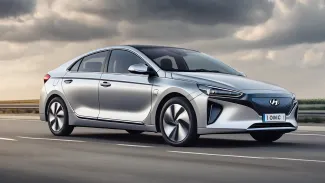
For Hyundai, the SDV transition is not a distant ambition. The Korean automaker has publicly committed to becoming a "software-centric mobility leader," and the IONIQ 6 prototype being tested in Europe is a visible step in that direction. The test mule carries the company's new Pleos Connect system — an AI-based infotainment platform developed simultaneously at UX studios in Seoul, Irvine, Frankfurt, and Shanghai.
Pleos Connect: A Dual-Screen, AI-First Cockpit
Hyundai officially unveiled Pleos Connect in April 2026, debuting it first on the new Grandeur sedan in South Korea in May 2026. The system is now being evaluated in the IONIQ 6 — a car that serves as Hyundai's long-range EV flagship in Europe — ahead of a wider global rollout.
The hardware centrepiece is a dual-screen layout. A large central touchscreen is divided into three functional zones: driver information on the left, navigation and apps on the right, and a persistent bottom bar for pinned or recently used applications. A slimmer driver-facing display handles speed readouts, media information, and turn-by-turn directions without distraction.
Importantly, Hyundai has retained physical controls — buttons below the main screen and on the steering wheel cover climate, media, and core vehicle functions. This is a deliberate choice after years of industry-wide backlash against all-touchscreen interiors that force drivers to dig through menus while moving.
Gleo AI: The Voice Assistant Built to Learn
At the heart of Pleos Connect is Gleo AI, a voice assistant built on large language models. Unlike the rigid voice commands of earlier automotive systems, Gleo is designed to handle natural speech: "navigate there," "find a restaurant near me," or questions about the weather and upcoming sports results.
The key differentiator Hyundai is highlighting is that Gleo learns from individual users over time — adapting to preferences, habits, and conversational patterns. Combined with over-the-air (OTA) updates, this means the system delivered at purchase is just a starting point, not a fixed product.
The approach reflects broader industry momentum. Competitors including Xpeng and Mercedes-Benz have invested heavily in AI-driven in-car assistants, and the race to offer the most capable digital cockpit experience is now as fierce as the competition over range and charging speed.
IONIQ 6: The Right Test Platform for Europe
The choice of the IONIQ 6 as the European test platform is significant. The aerodynamic sedan — based on Hyundai's E-GMP platform — remains one of the most efficient long-range EVs available in Europe, with up to 614 km WLTP range in rear-wheel-drive configuration. It is a vehicle that European drivers already associate with technological sophistication.
While Hyundai has confirmed the IONIQ 6 will not continue in the United States market beyond the 2025 model year, European sales continue and the model retains a loyal following among drivers prioritising range and efficiency over SUV practicality.
Testing Pleos Connect on the IONIQ 6 prototype near the European R&D centre suggests Hyundai is calibrating the system specifically for European user behaviour, road networks, and regulatory requirements — a reminder that software localisation is as complex as hardware engineering.
The Road to 20 Million Connected Vehicles
Hyundai's ambition stretches well beyond a single infotainment upgrade. The company has outlined a target to equip approximately 20 million vehicles across the Hyundai, Kia, and Genesis brands with its SDV architecture by 2030. The first fully connected, software-defined vehicle built on the new platform is expected to launch in late 2027.
The next major milestone is the all-new IONIQ 3, which will be among the first models outside Korea to receive Pleos Connect as part of a broader rollout following the Grandeur's domestic launch.
For European customers, the timeline means that within three to four years, the experience of buying a Hyundai EV could look fundamentally different — closer to subscribing to a connected platform than purchasing static hardware.
A Wider Industry Shift
Hyundai is not moving in isolation. Volkswagen Group has restructured its software division after years of delays. BMW introduced its Neue Klasse architecture explicitly around a centralised compute layer. Tesla has operated on an OTA-first model for over a decade and continues to pull ahead on cumulative software iterations.
What separates Hyundai's approach is the scale of its ambition across three distinct brands simultaneously, combined with a deliberate effort to keep physical controls alongside digital interfaces — a balance that regulators in both Europe and the UK are increasingly expecting from carmakers.
The IONIQ 6 prototype spotted in Europe may look unremarkable on the outside. Inside, it is carrying the software blueprint for millions of future Hyundai vehicles — and the pressure to get it right is considerable.
Will Pleos Connect be available on existing Hyundai EVs via a software update?
Pleos Connect requires the new dual-screen hardware configuration, so it cannot be retrofitted to existing IONIQ 5 or IONIQ 6 models via OTA update. It will debut on new production vehicles, starting with the Grandeur in Korea and rolling out globally from 2026 onwards.
What makes Hyundai's SDV approach different from Tesla's software model?
Tesla built its OTA-first model from scratch on proprietary hardware. Hyundai is transitioning an existing, large-scale global manufacturing operation across three brands (Hyundai, Kia, Genesis) to a centralised software architecture — a far more complex undertaking, but one that gives it reach across a much wider vehicle price range.
Is the Hyundai IONIQ 6 being discontinued in Europe?
No. The IONIQ 6 is being discontinued in the United States after the 2025 model year, but it continues to be sold in Europe, where it remains one of the most range-efficient electric sedans available with up to 614 km WLTP range.
Source: https://electrek.co/2026/05/27/hyundai-testing-new-sdv-setup-in-ioniq-6-ev-images/