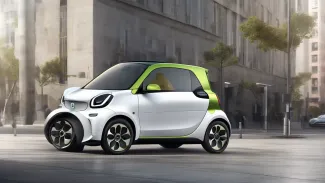
The Smart brand has always occupied a peculiar corner of the automotive world: beloved by city dwellers, overlooked by mainstream buyers, perpetually under threat of discontinuation. Since Geely took a 50% stake in the Daimler-founded brand in 2019, however, Smart has been quietly reinventing itself. The #1 and #3 crossovers arrived in Europe, and now, ahead of its formal world premiere at the Paris Motor Show in October 2026, Smart is showing the world what comes next: the #2.
A Platform Built for the City — and Beyond
At the heart of the Smart #2 concept lies a new dedicated architecture called the Electric Compact Architecture (ECA). Unlike adapted platforms shared with combustion-engine siblings, ECA was engineered from scratch for urban electric mobility — and it shows. The platform is designed to be scalable, suggesting Smart and its backers at Geely see it powering more than just one model in the years ahead.
The chassis underpins a car with short overhangs to maximise cabin space, paired with a next-generation Tridion Cell safety structure — the spaceframe concept that has defined Smart's crash protection philosophy since the original city car. An impressively tight turning diameter of just 6.95 metres confirms this is still fundamentally a car designed for dense urban environments, even if its range ambitions reach further.
35.7 kWh and 300 km: Right-Sized, Not Compromised
In an era of 100+ kWh battery packs and 700 km claims, the Smart #2's 35.7 kWh integrated high-voltage battery is almost refreshingly restrained. Smart isn't chasing range anxiety headlines — it's targeting the daily reality of city and suburban driving, where most journeys are under 50 km and weekly charging is the norm rather than the exception.
The projected ~300 km WLTP range is meaningful for the segment: it covers a week of typical European commuting with room to spare, and positions the car against established rivals like the Volkswagen ID.3 in its smaller configurations and the Citroën ë-C3. Where the Smart #2 differentiates itself is DC fast charging: the concept is said to charge from 10% to 80% in approximately 20 minutes, which for a compact city EV would be among the fastest charge curves in its class.
Interior: Where the Real Story Is
The cabin of the Smart #2 concept may be the most revealing element of the entire car. Designed by the Mercedes-Benz global design team, it reflects a minimalist philosophy that strips away the visual noise plaguing so many modern EV interiors.
The defining feature is a continuous passenger bench seat that eliminates the centre partition found in conventional car seating. In a two-seat or compact four-seat format, this creates a sense of spaciousness that the exterior dimensions wouldn't suggest. An S-shaped cockpit module wraps the driver area in a way that improves ergonomics and visual clarity, while frameless side doors with two-tone colour treatment add a premium feel that the original smart city car could never have claimed.
The result is an interior that feels closer to a boutique product than a budget urban runabout — which is clearly Smart's intention as it competes not just on price and range, but on desirability.
The China Challenge — and the European Opportunity
Smart's market reality is a tale of two continents. In China, where the #1 and #3 compete in one of the world's most brutally competitive EV markets, the brand sold just 2,122 units in May 2026 — a 24.6% sequential gain from April, but still a fraction of what rivals like BYD or even Nio's sub-brands shift weekly. The #2 needs to move the needle more dramatically if Smart is to justify its ongoing investment in the Chinese market.
In Europe, however, the picture is more nuanced. Smart's positioning as a premium compact EV — with Mercedes design DNA and European heritage — gives it a narrative that Chinese domestic brands can't easily replicate on this side of the world. The Paris Motor Show debut in October 2026 is shrewdly chosen: it's Europe's most prestigious automotive stage, and it signals that the #2 is aimed squarely at European buyers who want something smaller, smarter, and more distinctly designed than the crossover-heavy alternatives.
What Makes the #2 Significant
The broader context matters here. Europe desperately needs more affordable, right-sized electric cars. The EU's CO₂ targets are forcing manufacturers toward electrification, but consumer uptake remains hampered by price and range anxiety — particularly in the sub-€30,000 segment where the Smart #2 is likely to compete. A genuinely well-engineered compact EV with 300 km WLTP range and rapid charging, backed by Mercedes design credibility and Geely production efficiency, addresses a real gap in the market.
The ECA platform's scalability also hints at what's possible beyond the #2 itself. If Geely and Mercedes-Benz can leverage this architecture across multiple Smart models — and potentially share it with other brands in the Geely ecosystem — the economics of small EV production become considerably more viable.
Smart will need to turn concept promise into production reality convincingly. The Paris reveal in October 2026 will be the first real test of whether the #2 can generate the consumer excitement that the brand's sales figures in China currently lack. Based on what's been shown in Rome, there's genuine reason to pay attention.
When will the Smart #2 go on sale in Europe?
Smart has not yet announced a production launch date or pricing for the #2. The concept will make its official world premiere at the Paris Motor Show in October 2026. European sales timing will likely be confirmed around or after that event.
How does the Smart #2's range compare to rivals like the VW ID.3 or Renault 5?
The projected ~300 km WLTP range is competitive but not class-leading. The Renault 5 offers up to 410 km WLTP in its larger battery variant, and the VW ID.3 reaches 427 km. However, the Smart #2's 35.7 kWh battery is notably smaller and lighter, which may translate into faster charging and a lower purchase price — both important factors for city-focused buyers.
Is the Smart #2 based on a Geely platform?
No. The Smart #2 uses a dedicated Electric Compact Architecture (ECA) developed specifically for Smart by the Mercedes-Benz and Geely joint venture. It is designed as a scalable platform for compact electric vehicles, separate from Geely's existing architectures used by brands like Zeekr or Volvo.