
Listen to this article:
The ambition is not subtle. In a wide-ranging interview with InsideEVs published this week, Cutler outlined how Ionna intends to close the gap with Tesla's Supercharger network — and why he believes the window to do so is now open.
Eight Automakers, One Network
Ionna launched its first chargers in December 2024, backed by a consortium that includes BMW, Honda, Hyundai, Kia, Mercedes-Benz, Stellantis, Toyota, and Rivian. The logic was simple: rather than each automaker running its own fragmented charging app and partnership, they would pool resources into a single premium network built to a consistent standard.
The result is a network where every stall delivers up to 400 kilowatts of DC fast charging, and every station supports both CCS and NACS connectors — meaning it is compatible with virtually every EV sold in the United States today, including all Tesla models. Standard pricing ranges from $0.33 to $0.39 per kilowatt-hour, which sits competitively against the broader charging market.
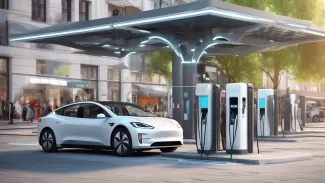
Cutler's ambition goes further than convenience. He described Ionna stations as "rechargeries" — locations that are well-lit, clean, and placed near food, restrooms, and retail. The bet is that Americans will not stop at a charging station the way they stop at a petrol pump: they will choose where to spend 25 or 30 minutes based on what is around them.
100 Stations and 1,000 Bays — The First Milestone
In March 2026, Ionna celebrated its second anniversary by reaching its 100th operational station — a milestone the company marked by offering discounted $0.20/kWh rates at newly opened locations for the first week after launch. Nearly 1,000 individual charging bays have been energized since the network went live.
The numbers behind the milestone tell an equally striking story. Ionna currently has:
- ~1,500 bays under construction
- 4,700 bays contracted nationwide
- A target of 30,000 DC fast charging bays by 2030
That 2030 target is not chosen arbitrarily — it is roughly where Tesla's Supercharger network stands today. The message is clear: Ionna intends to match Tesla's current scale within this decade.
Ionna even demonstrated that deployment speed need not be a bottleneck. In March, working with infrastructure developer 3V3i, the company installed a three-stall 400 kW station in Oklahoma City's Bricktown district in just five business days — roughly half the time a typical installation requires. The stalls use Alpitronic HYC400 dispensers and carry both CCS and NACS connectors. Speed of deployment, as 3V3i noted, is "one of the biggest challenges facing EV infrastructure expansion," and demonstrating a faster path matters enormously if the 2030 goal is to be met.
The Circle K Deal: Convenience Stores as the New Motorway Service Area
Perhaps the most strategically significant move Ionna has made so far is its partnership with Circle K, one of the largest convenience store chains in North America. Under the deal, announced in April 2026, Ionna will install 400 kW chargers at more than 350 Circle K locations and take over operations of the retailer's existing 378 EV charging ports at 93 sites — upgrading approximately 85 of them rapidly.
This follows earlier retail tie-ups with Sheetz and Wawa, two well-loved convenience chains in the US Mid-Atlantic and Southeast. The pattern is deliberate. EV charging sessions typically run 25 to 35 minutes — far longer than a petrol stop — and that dwell time is commercial gold for retailers who want customers browsing their shelves, buying coffee, and using loyalty apps. For Ionna, the retailer brings the footfall and the real estate; Ionna brings the hardware and the reliability.
The comparison to Tesla is instructive here too. Tesla Superchargers are often placed at Tesla-approved highway locations and retail partners, but the experience varies. Ionna is making consistent quality — clean, well-lit, high-powered, amenity-rich — a founding principle rather than an aspiration.
Grid Challenges and the Megawatt Horizon
In the CEO interview, Cutler did not shy away from the industry's hardest problem: grid connection timelines. Utility interconnection queues across the United States can run to years rather than months, and that challenge affects every charging operator regardless of ambition or funding. It is one reason why the deployment speed demonstrated in Oklahoma City matters — the faster the physical installation can happen once grid access is secured, the less time is wasted.
Cutler also addressed emerging technology on the horizon, including megawatt-class charging of the kind BYD has been demonstrating in China — where charging speeds of 1,000 kW or more could theoretically add 400 km of range in roughly five minutes. For the American market, Cutler was measured: the technology is real, but infrastructure investment cycles mean 400 kW is the right focus for now. The grid simply cannot deliver megawatt charging at scale without years of upstream investment.
Partner Brand Discounts: A Loyalty Play
Ionna is leaning into its automaker backing by offering brand-specific pricing incentives. From mid-May through 30 September 2026, BMW and Mini EV drivers receive a 20% discount on charging costs — activated via Plug&Charge or the My BMW app integrated with Shell Recharge. At standard rates of $0.33–$0.39/kWh, that brings the effective cost to roughly $0.27–$0.32/kWh.
General Motors drivers — Cadillac, Chevrolet, GMC — can access a 10% discount through the respective brand apps. New-station launch specials at $0.20/kWh for the first week create additional early-adopter incentives. More partner brand loyalty programmes are expected as the network grows.
Is It Enough to Challenge Tesla?
Tesla's Supercharger network remains formidable: approximately 30,000 stalls across the United States, broadly recognized for reliability and coverage, and now open to all NACS vehicles. Tesla has also added virtual queuing at select locations — a quality-of-life feature that Ionna will need to match as it scales.
What Ionna has that Tesla did not have during its build-out phase is automaker commitment from day one. BMW, Hyundai, Kia, Mercedes-Benz, and the others are not merely investors — they have a direct commercial interest in ensuring their EV buyers have a world-class charging experience. That alignment creates accountability that a purely commercial operator does not have.
Coverage gaps remain the most honest critique. With 100 stations, there are large regions of the US where Ionna simply does not appear on a route map yet. The 4,700 contracted bays suggest that will change substantially in the next 18 to 24 months, but for now, most drivers will need to supplement Ionna with other networks on longer trips.
Cutler's stated goal — becoming the network drivers name first, not a backup — is exactly the right aspiration. Whether Ionna achieves it will depend on execution: keeping the chargers working when drivers arrive, building at the pace the contracts imply, and delivering the experience that justifies the backing of eight of the world's largest vehicle brands.
So far, the evidence suggests they are moving in the right direction. Whether it is fast enough remains the open question.
How does Ionna's charging speed compare to Tesla Superchargers?
Ionna stations deliver up to 400 kilowatts per stall, which is broadly comparable to Tesla's V3 and V4 Superchargers. Both networks support high-speed DC fast charging capable of adding significant range in 20–30 minutes. Ionna stations use both CCS and NACS connectors, making them compatible with virtually all EVs on the market, including Teslas.
Which automakers are behind Ionna, and can non-partner brand drivers use it?
Ionna was founded by a consortium of eight automakers: BMW, Honda, Hyundai, Kia, Mercedes-Benz, Stellantis, Toyota, and Rivian. However, the network is open to any EV driver — membership in a partner brand is not required to charge. Partner brand drivers simply receive loyalty discounts when they activate charging through designated brand apps.
Is Ionna available in Europe?
Currently, Ionna operates exclusively in the United States. The network's 30,000-bay target by 2030 refers to US locations. European EV drivers benefit indirectly from the network through the manufacturers backing it, several of which — BMW, Hyundai, Kia, Mercedes-Benz — are also partners in IONITY, Europe's premium high-power charging network.
Source: https://insideevs.com/features/796067/ionna-ceo-interview-charging-progress-2026/