
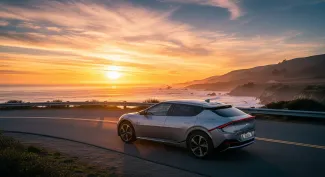
Kia has unveiled the 2026 EV6 for the United States with a clear priority: win back buyers through lower prices. The base EV6 Light SR RWD now starts at $37,900, a $5,000 reduction compared with the outgoing 2025 model. Mid-tier Wind and GT-Line variants receive even deeper cuts of $5,500 each, landing at $44,800 and $48,700 respectively. The changes are not cosmetic giveaways; they represent a direct response to a cooling market in which the EV6 has struggled to maintain momentum.
The urgency behind these cuts becomes clear when looking at sales figures. During the first three months of 2026, Kia sold just over 2,000 EV6 units in the US, a 46% drop from the same period last year. A major factor is the expiration of the $7,500 federal tax credit at the end of September 2025, which effectively raised the net cost of the EV6 for many American buyers overnight. With Chinese brands still largely absent from the US and Tesla maintaining strong pricing power, Kia found itself in a difficult middle ground where its once-competitive crossover suddenly looked expensive.
For European readers, the American price slash is both instructive and frustrating. In Germany, the Kia EV6 currently opens at €44,990 for the Air trim—roughly equivalent to $48,500 at current exchange rates, or about $10,600 more than the new US base price. Even accounting for differences in standard equipment and trim structures, the gap is substantial. European markets still benefit from various national purchase incentives and tax advantages, yet the list price itself has not moved in the same downward direction. The disparity raises an uncomfortable question: if Kia can afford to absorb thousands of dollars per vehicle in the United States, why are European customers still paying a premium?
The answer likely lies in competitive pressure. In the US, Kia is fighting to keep the EV6 relevant against a resurgent Tesla lineup and the upcoming wave of affordable domestic EVs. In Europe, the brand has so far been able to hold pricing steady thanks to strong demand for its design and 800-volt charging architecture, even as Chinese rivals such as BYD and MG crowd the segment with lower-cost alternatives. That equilibrium may not last. With the Kia EV3 now rolling out across Europe as an entry-level option and the EV5 poised to undercut the EV6 in size and price, the company will eventually face the same margin squeeze on this side of the ocean.
Beyond pricing, the 2026 US model brings only modest technical changes. A dual-voltage charging cable is now standard across all trims, and buyers in California and other zero-emission states receive a DC fast-charger adapter. The battery options remain unchanged: a 63 kWh pack offering up to 237 miles of EPA range, or an 84 kWh long-range variant delivering up to 319 miles in rear-wheel-drive form. One notable absence is the high-performance EV6 GT, which Kia has delayed indefinitely according to a company spokesperson. The decision leaves a gap in the brand's performance portfolio and suggests that resources are being redirected toward volume models like the EV3, a small SUV that Kia hopes will attract the type of budget-conscious buyer who once considered the Chevrolet Bolt or Nissan LEAF.
Ultimately, Kia's American price cut is a warning shot for the global EV market. As subsidies shrink and competition intensifies, legacy pricing structures are becoming unsustainable. European buyers should watch closely: if Kia is willing to sacrifice margin in the US to protect market share, similar moves in Europe may only be a matter of time—especially as the EV6 enters the second half of its product cycle and newer, cheaper rivals continue to close in.
Will Kia reduce EV6 prices in Europe too?
There is no official announcement yet, but the American cuts show Kia is prepared to lower margins to defend market share. With Chinese brands and new entry-level Kia models pressuring the segment, European price adjustments cannot be ruled out later this year.
Why is the EV6 cheaper in the US than in Europe?
List prices differ due to regional trim structures, taxes, and shipping costs, but the main driver is market pressure. In the US, Kia faces a steep sales decline after the federal tax credit expired, forcing it to cut prices aggressively to stay competitive.
What happened to the EV6 GT?
Kia has delayed the high-performance EV6 GT indefinitely, a spokesperson confirmed. The decision suggests the brand is prioritising volume models like the EV3 and EV5 over niche performance variants during a period of intense price competition.