
The Video That Sparked a Firestorm
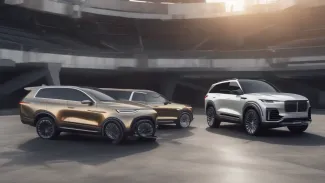
On June 5, 2026, Nio's Vice President Ma Lin took to Chinese social media to question the authenticity of a chassis comparison video released through Li Auto's official channels. The clip pitted the Li Auto L9 Livis against the Nio ES9 — two full-size luxury electric SUVs competing directly for the same affluent Chinese buyers — and showed suspension performance comparisons at what appeared to be Li Auto's advantage.
But Ma Lin wasn't buying it. He pointed to a glaring technical inconsistency: in the footage, the Nio ES9 appeared to shake at similar speeds in both its "Standard" and "Ultra-Soft" suspension modes. That, he argued, makes no physical sense. Ultra-Soft mode is specifically designed to minimize chassis agitation, absorbing road imperfections with greater compliance than Standard. If both modes produce similar vibration, something doesn't add up — either the test conditions were manipulated, or the vehicle settings weren't what Li Auto claimed.
Ma Lin publicly demanded that Li Auto verify the video's authenticity, clarify its source, and disclose the exact environmental conditions and suspension settings used during testing. It was a direct, pointed accusation from a senior executive of one of China's most prominent EV brands — not the kind of statement that gets made lightly.
Li Auto Quietly Pulls the Video
Li Auto's response was conspicuous in its silence: the original video disappeared from the company's official channels. Independent bloggers had already circulated copies, and Dongchedi, a widely trusted third-party automotive platform in China, conducted its own comparable testing — though the results of that independent evaluation and whether they vindicated either party remained the subject of ongoing online debate at time of publication.
The removal of the video without official explanation did little to help Li Auto's credibility in this dispute. In the absence of a clear rebuttal, the implication that the comparison may have been staged — or at least selectively presented — was hard to dismiss.
Two Giants, Two Very Different Machines
To understand why this comparison resonated so deeply in China's EV community, it's worth knowing what these vehicles actually are.
The Nio ES9, which only began deliveries on June 1, 2026, is a technological statement. At 5,365mm long with a 3,250mm wheelbase — only 17mm shorter than a Cadillac Escalade but with a 179mm longer wheelbase — it is a genuine full-size luxury SUV. It rides on a full active air suspension system with steer-by-wire technology and rear-wheel steering. Its dual-motor powertrain delivers 520kW (697 hp) and 700Nm of torque, fed by a 102kWh CATL battery offering up to 620km of CLTC range. Three LiDAR sensors, a 900V architecture, and Nio's own Shenji NX9031 chip complete the picture. Starting price: approximately 500,000 yuan (around €63,000), making it one of the most expensive Chinese-brand EVs on the market.
The Li Auto L9 Livis competes in the same premium space but with a different technological philosophy. The L9 line has historically used Li Auto's extended-range electric vehicle (EREV) architecture — combining a battery pack with a petrol generator — which delivers exceptional total range (reportedly over 1,100km) while eliminating range anxiety altogether. The Livis designation points to an evolved variant, though both models target the same buyer: a Chinese family seeking the ultimate combination of space, technology, and prestige.
Both vehicles feature advanced adaptive suspension systems, which is precisely why the technical claim at the heart of this dispute matters so much. If a suspension system's modes are indistinguishable in a video, the entire comparative exercise becomes meaningless.
A Pattern of Aggressive Marketing
This is not the first time Li Auto has found itself at the center of a marketing controversy. In July 2025, the company released a collision test video featuring its i8 model against an 8-ton Dongfeng truck. Dongfeng Chenglong — the commercial vehicle brand involved — fired back, claiming the scenario "deviated from everyday road conditions" and was designed specifically to disparage competitors. That same month, Li Auto and Nio-Onvo clashed publicly over allegations of coordinated "Black PR" campaigns, with executives trading accusations on Weibo.
The pattern is revealing. China's EV market has become so intensely competitive that automakers — including established players like Li Auto — are willing to push marketing boundaries in ways that would be inconceivable in Europe. The result is a landscape where buyers must scrutinize not just the cars themselves, but the context and conditions under which comparisons are made.
Li Auto's Broader Moment of Pressure
The controversy arrives at a delicate time for Li Auto. The company's year-over-year sales have declined for most months in 2026, a notable reversal from the explosive growth that made it one of China's most celebrated EV success stories. Yet its pure-electric i6 model bucked that trend in April 2026, ranking as China's fourth best-selling car — a signal that the company's pivot toward pure electric vehicles is beginning to take hold.
For Li Auto, the stakes of the L9 Livis vs. ES9 narrative are high. These premium large SUVs are not volume sellers, but they define brand perception in a segment where Chinese consumers are increasingly sophisticated and well-informed. A poorly conducted — or worse, faked — comparison doesn't just damage a single product launch. It raises questions about a brand's integrity at precisely the moment when trust matters most.
What It Means for European Watchers
European observers might be tempted to dismiss this as a distant Chinese industry squabble. But both Nio and Li Auto have active or announced European ambitions. Nio already sells vehicles in Norway, Germany, the Netherlands, and other markets; Li Auto has signaled broader international expansion plans. The marketing culture — and the competitive habits — that develop in China's domestic market tend to travel with these brands.
More broadly, the dispute highlights something important: in an age of social media and instant video dissemination, manufacturer-led comparisons face an unprecedented level of scrutiny. The moment Nio's VP pointed out a physical inconsistency in the suspension behavior, thousands of technically literate viewers began analyzing every frame. That kind of real-time peer review is a double-edged sword for any brand willing to play fast and loose with test conditions.
Whether Li Auto's video was genuinely manipulated or simply poorly documented, the lesson is the same: in China's EV market in 2026, authenticity isn't optional.
What is the Li Auto L9 Livis, and how does it differ from the standard L9?
The L9 Livis is an updated or variant version of Li Auto's flagship full-size L9 SUV. The L9 line is known for its extended-range electric architecture (EREV), combining a battery pack with a petrol generator for very long total range. The Livis designation likely refers to a revised or higher-specification version, though Li Auto has not published detailed differentiation specs in international media at time of writing.
Does the Nio ES9 have active air suspension, and how does it work?
Yes, the Nio ES9 features a full active air suspension system with multiple selectable modes, including Standard and Ultra-Soft. In Ultra-Soft mode, the suspension is tuned for maximum compliance and comfort, absorbing road imperfections more aggressively than in Standard mode. The controversy over the Li Auto comparison video centered on footage that appeared to show no meaningful difference between these two modes on an ES9, which Nio's VP argued was physically implausible under normal operating conditions.
Are Nio and Li Auto available in Europe?
Nio already sells vehicles in several European markets, including Norway, Germany, the Netherlands, Denmark, and Sweden. Li Auto has not yet launched retail sales in Europe but has signaled plans for international expansion. Both brands' flagship premium SUVs — the ES9 and L9 — are primarily positioned for the Chinese domestic market, though their technology platforms inform the vehicles these companies may eventually bring to Europe.