Listen to this article:
The truck that strips away everything unnecessary
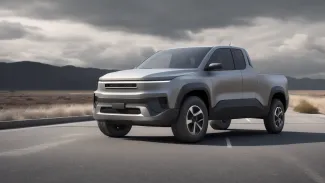
Slate Auto was never trying to build a luxury truck. From the start, the Michigan-based startup set out to make an electric pickup that ordinary working Americans could actually afford — and it has delivered something that reflects that philosophy with almost radical honesty.
The base vehicle has hand-crank windows. There is no infotainment screen, no built-in navigation, no driver assistance suite to add thousands to the sticker price. The body comes in a single gray composite finish — no paint at all. Buyers who want colour can order custom wraps. It sounds spartan, and it is. But spartan with a purpose: every stripped feature is a cost that didn't land on the buyer.
The result is a base price of $24,950 before taxes, title, registration and destination fees. The truck converts to a five-seat SUV configuration for $29,950. Those numbers are significant even without the federal EV tax credit, which no longer applies under current US policy.
The engineering choices behind the price
Slate made a pivotal decision to switch battery chemistry. The original plan called for NMC cells from SK On. Instead, the production truck uses a 65 kWh lithium iron phosphate (LFP) pack with 63 kWh of usable capacity. LFP cells cost less, tolerate more charge cycles without significant degradation, and eliminate concerns about thermal runaway — a meaningful safety advantage in a vehicle that will spend time on job sites and in extreme weather.
The powertrain is deliberately simple: a single rear motor producing 181 horsepower. That is not spectacular by modern EV standards, but it is adequate for daily work and far more than enough to move a compact truck at highway speeds. Range came in at approximately 205 miles — a meaningful upgrade from the 150-mile figure the company had cited earlier, and competitive with many budget-oriented EVs in the segment.
Bezos money, direct-to-consumer model
Slate has raised approximately $1.4 billion across three funding rounds. Investors include Bezos' family office, TWG Global, General Catalyst, and former Amazon executive Diego Piacentini. The Bezos connection is impossible to ignore: the same discipline that drove Amazon to relentlessly cut operational costs appears to be informing Slate's approach to automotive retail as much as engineering.
Rather than selling through franchise dealerships — the traditional and expensive route — Slate is going direct-to-consumer. It has formed a notable partnership with Carvana, the US online used-car giant, which could handle financing, delivery and aftermarket services. This arrangement sidesteps one of the most persistent cost layers in the American auto industry and positions Slate alongside other EV brands — including Tesla and Rivian — that have chosen to control their own sales channels.
Preorders open now, deliveries before end of 2026
Slate opened preorders on 24 June 2026, and the company says first deliveries are on track for before the end of this year. That timeline is aggressive for a startup that hasn't yet begun mass production, but Slate has had years of preparation behind a long period of near-silence and a $1.4 billion war chest to fund it.
At $24,950, the truck undercuts the Chevrolet Bolt EV (around $29,000), the Nissan Leaf, and will arrive ahead of Ford's planned budget electric pickup, which is expected to start around $30,000 in 2027. The Slate truck is not trying to compete with a Ram 1500 REV or Rivian R1T on features. It is trying to be the electric vehicle that replaces an older petrol pickup for a buyer who cannot justify spending $50,000 on a new truck.
What this means for Europe
The Slate truck is, for now, a US-only product. European regulations, crash safety standards and right-hand-drive requirements mean it will not cross the Atlantic in this form. But the engineering lesson Slate is teaching applies everywhere: a credible electric vehicle with 200-plus miles of range, real cargo utility and LFP battery technology does not have to cost $50,000. It does not even have to cost $35,000.
European carmakers have largely argued that affordable EVs require either government subsidy, volume production in China, or sacrifice of profitability. Slate argues otherwise — though it is fair to note that the company has not yet demonstrated it can build at scale and remain profitable. The first year of deliveries will answer that question more honestly than any press release.
For European regulators and policymakers watching the US market, the Slate truck is worth tracking. A sub-$25,000 electric pickup from a well-funded startup with direct-to-consumer sales could accelerate pressure on legacy manufacturers to cut costs and complexity rather than add features and raise prices.
The risk: scale and the unknown
Startups in the auto industry have a troubled track record. Fisker, Lordstown, Rivian's early years, Nikola — the list of EV companies that failed to survive the transition from prototype to mass production is long. Slate has more funding than most, a disciplined cost philosophy, and a genuinely competitive product on paper. But the company still needs to prove it can manufacture thousands of trucks without the quality problems, supply chain shocks or cost overruns that have derailed others.
The LFP switch was the right call technically. The Carvana partnership is a clever way around the dealer-network problem. The $24,950 price is real enough that preorders are now open. Whether Slate is still delivering trucks at that price in 18 months — that is the question that actually matters.
Will the Slate electric truck be available in Europe?
Not in its current form. The Slate truck is designed for the US market and does not meet European type-approval, right-hand-drive or pedestrian safety requirements. The company has not announced any European launch plans. European buyers should watch for a potential future global variant, but no timeline exists.
Why did Slate switch from NMC to LFP batteries?
LFP (lithium iron phosphate) cells are cheaper to produce, have longer cycle lives and are inherently more thermally stable than NMC (nickel manganese cobalt) cells. By switching from planned SK On NMC packs to LFP, Slate was able to lower the battery cost and pass that saving on through a lower base price — without significantly compromising range. The 65 kWh LFP pack delivers around 205 miles, up from the earlier 150-mile estimate.
Can I use the $7,500 federal EV tax credit when buying a Slate truck?
No. The federal EV tax credit that previously applied to qualifying electric vehicles is no longer available under current US policy. The $24,950 price is before taxes and fees, without any credit applied — which is itself a reflection of the current regulatory environment that Slate has had to design around.
Source: https://electrek.co/2026/06/24/slate-electric-truck-24950-price/