
Listen to this article:
Not a Modified Car — a Robotaxi
Every autonomous vehicle operating on public roads today — whether from Waymo, Cruise, or any other company — started life as a conventional car. Engineers bolted sensors to the roof, threaded cables through door panels, and crammed compute units under seats. The result worked, but it was always a compromise.
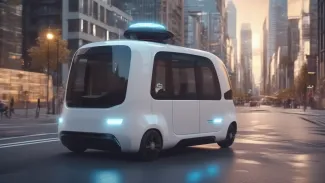
The Waymo Ojai is different. Built by Chinese EV manufacturer Zeekr and then outfitted with Waymo's autonomous hardware at the company's Arizona factory, the van-style vehicle was conceived as a rider-first platform from the first sketch. The cabin reflects this: generous legroom, three large adaptive screens for rear passengers, charging ports, cup holders, a flat floor, and a low step-in height that makes boarding natural for everyone — including wheelchair users and the elderly.
Braille markings, grab bars, and easy-to-clean interiors complete an accessibility picture that no retrofit project would have bothered with. When you design a vehicle purely for passengers from the start, you can actually think about passengers.
The 6th-Gen Driver: Fewer Sensors, Greater Capability
The Ojai runs Waymo's sixth-generation autonomous driving system, and the hardware story is remarkable. Compared to the 5th-gen Driver that currently powers Waymo's fleet of Jaguar I-PACE vehicles, the new platform cuts total component count by 42%. The camera array drops from 29 units to 13. Lidar units fall from 5 to 4. Radar is also reduced.
This is not a cost-cutting exercise at the expense of capability — it is the opposite. Years of real-world data, machine learning improvements, and sensor fusion advances mean that fewer, better-integrated sensors now outperform the sprawling hardware bundles of earlier generations. Waymo is targeting a hardware cost of under $20,000 per vehicle unit — a threshold that, if reached at scale, fundamentally changes the unit economics of running a robotaxi fleet.
Most significantly, the 6th-gen Driver unlocks something the previous system could not handle: fully autonomous operation in snowy cities. Waymo has until now largely operated in warm, dry climates — San Francisco, Phoenix, Los Angeles. The new sensor architecture and updated software opens a path to cities like Chicago, Boston, or, eventually, European capitals where winter conditions are the norm rather than the exception.
Free Rides, For Now
Ojai rides launched in San Francisco, Los Angeles, and Phoenix, with access initially free for a limited period. Waymo says it will gradually expand access to more riders and additional cities. The company's Arizona manufacturing facility is already scaling toward production of tens of thousands of units annually — a significant ramp from the current fleet of approximately 3,000 vehicles.
Following the Ojai, Waymo has confirmed it will also produce a variant based on the Hyundai IONIQ 5, giving the company a second platform and a second manufacturing partnership to hedge its production capacity.
The Numbers Behind the Ambition
Waymo's operational scale is already without parallel in the industry. The company has completed over 20 million fully autonomous trips across 11 cities, covering more than 1,400 square miles of mapped territory. Its fleet now handles 500,000 paid rides per week — a figure that would have seemed implausible just three years ago.
Investors are watching closely. In early 2026, Waymo raised $16 billion at a valuation of $126 billion — the largest single investment in autonomous vehicle history. That capital is funding exactly what the Ojai represents: the transition from proving that robotaxis work to building the infrastructure to deploy them at scale.
What This Means for Europe
Waymo does not currently operate in Europe, and European regulators have been cautious about approving fully driverless commercial operations. But the Ojai changes the calculus. A purpose-built vehicle designed for accessibility, efficiency, and easy maintenance is far easier to certify than a sensor-laden modified production car. And the 6th-gen Driver's ability to handle snow and unpredictable weather removes the most obvious technical objection to operating in northern Europe.
European cities — Amsterdam, Munich, Stockholm — are already running autonomous shuttle pilots. The gap between those trials and what Waymo is deploying in Phoenix is vast, but it is narrowing. The Ojai is a statement of intent: this is what a mature robotaxi looks like. Europe will need to decide how quickly it wants to engage with that reality.
For now, the queues form in San Francisco. But the vehicle making those rides possible was designed with a broader ambition in mind.
Will Waymo expand to Europe with the Ojai robotaxi?
Waymo has not announced European operations, but the 6th-gen Driver's ability to handle snowy and cold-weather conditions removes a key technical barrier. European cities would still require regulatory approval for fully driverless commercial services, which no country has yet granted at commercial scale.
How does Waymo's 6th-gen Driver compare to previous versions?
The 6th-gen Driver uses 42% fewer sensors than the 5th-gen system — cameras drop from 29 to 13, lidar from 5 to 4 — while adding the capability to operate autonomously in snowy cities. The hardware cost target is under $20,000 per vehicle, significantly below earlier generations.
What is Zeekr's role in building the Waymo Ojai?
Zeekr, the premium electric vehicle brand owned by Geely, manufactures the Ojai's vehicle platform. Waymo then installs its autonomous driving hardware at its Arizona factory. This partnership mirrors Waymo's forthcoming collaboration with Hyundai on an IONIQ 5-based robotaxi variant.
Source: https://electrek.co/2026/05/28/waymo-ojai-robotaxi-rides-6th-gen-driver/