52%
2026
90.5 kWh
1.75M Kč
The End of an Era: EQE Models Face Extinction
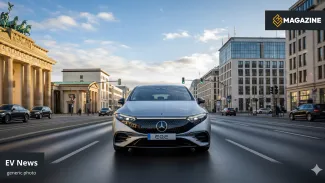
Mercedes-Benz's decision to phase out the EQE sedan and SUV by 2026 marks a significant shift in the German automaker's electric vehicle strategy. This move comes as part of what the company calls "EV lineup realignment," effectively ending production of models that debuted just three years ago in 2022.
Words like "blobby," "egg-shaped," and "just plain ugly" were used, and people likened it to a bar of soap or a melting stick of butter. The EQE's controversial styling, combined with its high price point and underwhelming market performance, contributed to its early demise.
Meet the Departing EQE: Technical Specifications
Key Features: Rear-wheel drive, 430-liter trunk capacity, 32-minute DC charging (10-80%).
Sales Struggle: Numbers Tell the Story
The EQE family's market performance has been nothing short of disappointing. The EQE sedan and SUV didn't do much better last year, selling 11,660 units compared to 19,104 units in 2023, marking a 39% decrease. This significant drop in demand forced Mercedes to reconsider its EV strategy.
US Market Exodus: Production Halt Effective September 2025
A spokesman for the brand confirmed that MB will temporarily pause production for U.S.-bound EQE and EQS starting on September 1st.
The EQE SUV drops by $12,950 to $66,100, the EQE sedan is reduced by $9,950 to $66,100 as Mercedes attempts to clear inventory.
"We are temporarily closing U.S. order banks for the EQS Sedan, EQS SUV, EQE Sedan, and EQE SUV to align with customer and market demand"
The end of federal EV tax credits on September 30th accelerated the decision to halt US-bound production.
What's Next: The Replacement Strategy
New Generation Electric Models
C-Class EQ (2026): The C-Class EQ saloon, due in 2026, will bridge the gap to the EQE saloon in terms of its technology, including options such as air suspension and rear-axle steering.
E-Class EQ (2027): However, the same spokesperson did confirm the successor model to the EQE saloon, the electric-powered E-Class EQ saloon, is under development and planned for introduction in 2027.
Technology Upgrades Redirected
Planned EQE upgrades including 800V electric architecture will now benefit the larger EQS models instead.
Advanced power electronics technology will be integrated into next-generation platforms.
Factory retooling allows Mercedes to prepare for the E-Class EQ launch in 2027.
Move away from separate EV sub-brand toward integrated electric variants of existing models.
Industry Implications: Lessons from the EQE Experiment
The shape of Mercedes-Benz's ground-up EVs is vastly dictated by the pursuit of aerodynamic efficiency to maximize EV range. Each model achieves admirable drag coefficients, but their resulting blobby styling is tough to overlook, especially at a Mercedes price point.