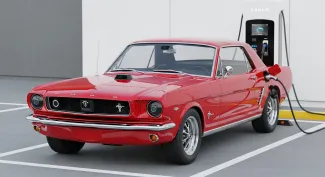
The automotive world is witnessing a fascinating intersection between heritage and high technology. While most manufacturers are focused on designing the next generation of aerodynamic electric vehicles, a group of enthusiasts is looking backward to move forward. A recent project has captured the attention of the EV community: a 1966 Ford Mustang that has been completely gutted and rebuilt using the "brains" and "brawn" of a 2024 Tesla Model 3.
A $40,000 Marriage of Eras
The project, led by Yaro Shcherbanyuk of Calimotive, is a masterclass in what enthusiasts call "restomodding"—the process of restoring a classic vehicle while modernizing its performance and technology. According to reports from Electrek and Autopostglobal, the total investment for this transformation was approximately $40,000 USD (roughly €37,000).
Shcherbanyuk began with a worn-out 1966 Mustang equipped with a straight-six engine, purchased for about $10,000. Over a period of two years, he and his team worked to replace the internal combustion engine with a modern electric drivetrain. The result is a vehicle that retains its cherry-red, classic silhouette but operates with the near-silent efficiency of a modern EV.
Technical Deep Dive: Integrating Tesla Technology
What sets this conversion apart from standard EV swaps is the integration of Tesla's proprietary technology. Most EV conversions simply replace an engine with a motor and a battery pack. However, Shcherbanyuk went much further by utilizing components from a 2024 Tesla Model 3. This includes not just the motor and battery, but also the installation of Tesla's external camera suite.
By retrofitting these cameras, the Mustang is capable of utilizing Full Self-Driving (Supervised). This is a significant technical feat. In a standard Tesla, the software is designed for a chassis specifically engineered to house those sensors. Integrating them into a 60-year-old steel frame requires complex calibration to ensure the software correctly interprets the vehicle's dimensions and movement. The driving experience, according to Shcherbanyuk, is "remarkably smooth" and feels essentially like driving a modern Tesla, albeit in a much more stylish package.
The Growing "EV Restomod" Market
This project highlights a growing trend in the automotive aftermarket. As internal combustion engines (ICE) face increasing scrutiny due to emissions regulations, classic car owners are looking for ways to keep their beloved vehicles on the road. The "EV restomod" movement offers a way to preserve automotive history without the environmental guilt or the mechanical headaches of aging petrol engines.
While companies like the UK-based Lunaz specialize in high-end, luxury EV conversions for classic Rolls-Royces and Bentleys, Shcherbanyuk’s approach represents a more accessible, albeit highly technical, path for enthusiasts. It demonstrates that the modular nature of modern EV drivetrains—where motors, inverters, and battery modules can be decoupled from the original chassis—is the key to extending the life of classic icons.
The European Perspective: Challenges and Opportunities
For European readers, this news is particularly interesting. While the US market has a massive culture of classic muscle cars, Europe has a strong tradition of classic European touring cars. However, the path to a similar conversion in the EU is much more difficult.
The primary hurdle is homologation—the process of certifying a vehicle for road use. In Europe, modifying a vehicle so fundamentally that its entire powertrain and safety systems (like autonomous driving sensors) change requires rigorous testing and documentation to meet EU safety standards. Furthermore, the cost of sourcing Tesla components and the specialized labor required for such a deep integration would likely push the price well beyond the $40,000 mark seen in the US.
Nevertheless, as battery technology becomes more standardized and "crate motors" (pre-assembled electric drivetrains) become more common, we may see a surge in European boutique shops offering similar services for classic BMWs, Mercedes-Benzes, or even vintage Fiats.
Can any classic car be converted to a Tesla-powered EV?
Technically, most cars can be converted, but it is not a "plug-and-play" process. The complexity depends on how much of the Tesla software and hardware (like FSD cameras) you wish to integrate. A simple motor swap is much easier than a full software-integrated conversion.
Is Full Self-Driving (Supervised) safe in a vintage car?
The safety of FSD depends on the vehicle's ability to react to sensor data. In a conversion, the integration of cameras and the vehicle's braking/steering systems must be perfectly calibrated. It remains a "supervised" system, meaning the driver must always be prepared to take control.
How much would such a conversion cost in Europe?
Due to higher labor costs, stricter regulatory compliance (homologation), and the cost of importing specific components, a professional conversion of this caliber in Europe would likely cost significantly more than the $40,000 USD spent on the US project.