
Listen to this article:
When a startup founded in 2022 raises over $300 million in four years, operates 60,000 electric motorcycles across six African nations, and completes 26 million battery swaps — it earns the right to build its own engineering future. That is exactly what Spiro is doing.
The Dubai-headquartered company, widely recognised as Africa's largest electric vehicle business, has confirmed the acquisition of Coexlion, an international motorcycle engineering consultancy operating from the UK Midlands and Bangalore, India. Simultaneously, Spiro announced it will establish its first African research and development centre in Kenya — a facility that will focus on designing and localising electric mobility solutions tailored to the realities of the African market.
Who is Coexlion — and why does this deal matter?
Coexlion is not a household name outside engineering circles, but its track record speaks clearly. The consultancy has contributed to more than 25 motorcycle programmes globally, spanning electric two-wheelers, chassis and frame development, battery systems, reliability engineering, and industrial design. With offices in the UK and India and a portfolio ranging from consumer scooters for ride-sharing platforms to high-performance motorcycles, the company offers exactly the deep technical DNA that a rapidly scaling EV manufacturer needs.
The acquisition "will support the development of electric motorcycles designed specifically for African road conditions, rider usage patterns and customer requirements," Spiro said in its announcement. In practice, that means engineering for unpaved and semi-urban roads, tropical climates, high daily mileage by commercial riders, and the specific ergonomics and maintenance realities of markets in Kenya, Rwanda, Uganda, Nigeria, Togo, and Benin.
The Kenya R&D centre: Africa builds its own EV future
The planned Kenyan facility will complement Spiro's existing R&D centre in Pune, India, which already employs more than 150 engineers and holds over 30 proprietary patents. The Africa hub is not a satellite office — it is conceived as a genuine engineering centre, rooted in the markets it serves.
Kenya is a strategic choice. Nairobi has emerged as one of Africa's leading technology hubs, home to a growing pool of engineering talent and a government actively promoting digital and green industrial investment. Spiro already assembles electric motorcycles in Kenya, making the country a natural base for advancing both production and research.
The move also reflects a broader trend: as global EV makers increasingly acknowledge that African roads, business models, and user needs require fundamentally different product thinking, localising engineering — not just manufacturing — becomes a competitive imperative.
Spiro's rise: from startup to continent-wide force
Founded in 2022 and led by CEO Kaushik Burman, Spiro has grown at a pace that few in the global EV industry have matched. The company began with $85 million in seed funding from the Equitane Group, backed by Gagan Gupta, and has since attracted investment from some of the world's most credible institutions.
In May 2023, Société Générale invested $63 million to accelerate expansion into Kenya and Uganda. The following year, the African Export-Import Bank provided $50 million in financing — one of the clearest signals of institutional confidence in the African EV sector. In October 2025, Spiro closed a $100 million funding round, described at the time as "the largest ever seen in electric vehicles in Africa."
The numbers behind the business are striking. As of late 2025, Spiro operates:
- 60,000+ electric motorcycles across six countries
- 1,500 battery-swapping stations — the continent's fastest-growing such network
- 26 million completed battery swaps
- Assembly plants in Kenya, Rwanda, Uganda, and Nigeria
- More than 800 million kilometres of low-carbon travel enabled
In 2024, Time magazine named Spiro to its list of the 100 Most Influential Companies in the world — recognition that placed the African EV startup alongside some of the most powerful corporations on the planet.
Battery swapping as the African model
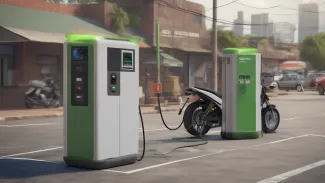
Central to Spiro's success is a business model that sidesteps one of the biggest barriers to EV adoption in emerging markets: the high upfront cost of batteries. Rather than selling riders a motorcycle with a fixed battery, Spiro's swap network allows riders — most of whom are commercial boda-boda (motorcycle taxi) operators — to exchange a depleted battery for a fully charged one at a swap station in under a minute.
This removes range anxiety, eliminates the need for home charging infrastructure, and dramatically lowers the vehicle purchase price. For a rider earning income by the kilometre, the economics are compelling: lower fuel costs compared to petrol motorcycles, consistent performance, and a pay-as-you-swap model that aligns with daily cash flow.
The Coexlion acquisition and the Kenya R&D centre directly serve this model. Better-engineered bikes mean lower maintenance costs, longer lifespan, and batteries designed to survive thousands of swap cycles in high-humidity, high-temperature conditions. These are engineering problems that require African expertise — and that is precisely what Spiro is now building.
A signal for the continent
Beyond Spiro's own growth story, this announcement carries a wider significance. For years, Africa has been framed almost exclusively as a destination market for technology developed elsewhere. The establishment of a dedicated EV R&D centre on African soil — by an African-operating company — represents a meaningful shift in that narrative.
With the continent's electric two-wheeler market projected to grow sharply through the decade, and with local players increasingly able to attract international talent and capital, Kenya could become the Shenzhen of African electric mobility: a place where products are not just assembled but conceived, engineered, and exported.
Spiro's target of deploying 2 million electric bikes across Africa by 2030 is ambitious. But with a $300 million war chest, a world-class engineering team, and now a research base on the continent it serves, that ambition looks less like a dream and more like a road map.
What is Spiro and where does it operate?
Spiro is Africa's largest electric vehicle company, founded in 2022 and headquartered in Dubai. It operates electric motorcycle fleets and battery-swapping networks in six countries: Kenya, Rwanda, Uganda, Nigeria, Togo, and Benin. As of late 2025, it runs over 60,000 electric motorcycles and 1,500 battery swap stations, with more than 26 million completed swaps.
What is battery swapping and why is it popular in Africa?
Battery swapping allows electric motorcycle riders to exchange a depleted battery for a fully charged one at a dedicated station in under a minute — without waiting to charge. In Africa, this model is popular because it eliminates the need for home charging infrastructure, reduces the upfront cost of the vehicle, and suits the economics of commercial boda-boda (motorcycle taxi) riders who earn income daily and need reliable, fast energy replenishment.
Why is Kenya chosen for Spiro's first African R&D centre?
Kenya is a natural fit because Spiro already assembles electric motorcycles there and the country is one of Africa's leading technology and innovation hubs. Nairobi has a growing pool of engineering and tech talent, a supportive government attitude toward green industry, and strong infrastructure links across East Africa — making it an ideal base for designing EV solutions tailored to African market needs.