
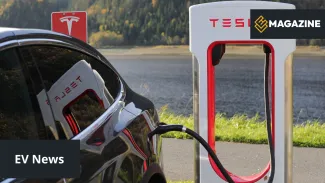
What changes for Volvo drivers
Volvo already operates its own charging service — the Volvo Public Charging Service (VPCS), run in partnership with Digital Charging Solutions — giving drivers access to over 1.2 million charge points across Europe and another 120,000 in North America, including Superchargers there. But in Europe, Tesla's network has been accessible only through Tesla's own app for non-Tesla vehicles — until now.
The integration announced today pulls Superchargers into the Volvo ecosystem proper. Drivers will locate, activate, and pay for Supercharger sessions without installing the Tesla app or creating a separate account. For anyone who has juggled four or five charging apps on a cross-border road trip, this is a genuine quality-of-life improvement.
"Volvo drivers already have access to over three million charging points globally through the Volvo app," said Alejandro Castro Pérez, Head of Energy Solutions at Volvo Cars. "Adding Tesla Superchargers in Europe means they now have even easier access to one of the most recognised fast-charging networks. As we accelerate towards full electrification, our goal is to make charging simple and effortless through a seamless ecosystem."
The integration covers all current Volvo EVs — EX30, EX40, EC40, EX60, EX90, and ES90 — all of which use the native CCS2 connector widely adopted across Europe. Plug-in hybrid models like the XC60 Recharge are excluded; their Type 2 ports cannot physically accept a DC fast-charger.
The 29-country rollout includes all major European markets: Germany, France, Norway, the United Kingdom, Sweden, Italy, Spain, plus Central and Eastern European countries including Czechia, Poland, Austria, Slovakia, Hungary, Romania, Croatia, and the Baltic states. The timing — Q4 2026 — means Volvo effectively has this ready for winter, when reliable fast-charging infrastructure matters most.
The Ionity problem
This is where things get interesting for the wider industry. Tesla Superchargers are not just abundant — they are reliably among the cheapest fast-charging options in Europe. In France, Tesla owners pay as little as €0.15/kWh; in Norway, around €0.14/kWh. Even at non-Tesla rates, Superchargers routinely undercut competing networks by 20–30%.
And here is the strategic friction: Volvo is not a shareholder in Ionity, the pan-European fast-charging joint venture backed by BMW Group, Ford, Hyundai Motor Group, Mercedes-Benz, and the Volkswagen Group (with Audi and Porsche). Those manufacturers face a real dilemma. If they integrate Superchargers into their own apps, they risk cannibalising Ionity usage — a network they collectively invested billions into building. If they don't integrate them, their customers are left with a fragmented experience: one app for Ionity, another for Tesla, and likely a few more for regional providers.
Volvo sidesteps this entirely. Without a stake in a competing charging network, the Swedish brand can make a purely customer-centric decision: take the best infrastructure available and put it in one app. It is a surprisingly rare posture in an industry where charging strategy is often tangled with legacy investments and corporate politics.
To be fair, Ionity is not standing still. The network recently began deploying 400 kW chargers and expanding aggressively. But its pricing — typically €0.55–0.79/kWh without a manufacturer subscription — makes Superchargers look like a bargain in comparison.
The bigger picture: standardisation by market force
Tesla's Supercharger network is quietly becoming the de facto standard for cross-brand fast charging in Europe — not through regulation, but through sheer reliability and competitive pricing. When Volvo, Polestar, Ford, and GM all decide to integrate Superchargers into their native apps, the pressure on networks like Ionity, Fastned, and Allego to compete on both uptime and price intensifies.
Volvo confirmed it is also preparing for the NACS (North American Charging System) standard in select Asia-Pacific markets — specifically Japan and South Korea — by 2029. This follows Volvo's 2023 commitment to adopt NACS for the US market. In Europe, CCS2 remains the mandated standard, so the connector question is settled for now. But the deeper trend is clear: OEMs are increasingly willing to work with Tesla's charging ecosystem rather than against it.
The real winner in all of this is the consumer. More accessible Superchargers mean more fast-charging options at lower prices. And when Volvo shows that integrating a competitor's charging network actually strengthens your product offering rather than weakening it, it becomes harder for Ionity's shareholders to justify keeping their customers walled off.
The question is no longer whether Superchargers are good enough. It is whether the rest of the industry can afford to ignore them.
Asia-Pacific: NACS on the horizon
Alongside the European announcement, Volvo confirmed plans to transition select models in Japan and South Korea to NACS by 2029. This is a significant signal for the APAC region, where charging standards remain fragmented — Japan has long relied on CHAdeMO, while South Korea uses CCS1. A unified NACS ecosystem could simplify charging dramatically for drivers in both markets, and Volvo's early commitment gives it a first-mover advantage among non-Tesla brands.
The exact timeline, specific models, and market rollout details will be shared later, Volvo said.
Do I need a Tesla account to charge at Superchargers with a Volvo?
No. Once the integration goes live in Q4 2026, Volvo EV owners will be able to locate, activate, and pay for Supercharger sessions entirely through the Volvo Cars app. A separate Tesla account is not required — the same model already works in North America for Volvo drivers.
Which Volvo models are supported?
All current battery-electric Volvo models with a CCS2 connector are supported: EX30, EX40, EC40, EX60, EX90, and ES90. Older models like the XC40 Recharge P8 (2021–2024) should also be compatible as they share the same Android Automotive platform, though Volvo will confirm the exact model-year list closer to launch. Plug-in hybrids with Type 2 ports are excluded — they cannot physically accept a DC fast-charger.
Will Volvo owners get discounted Supercharger rates?
Volvo has not confirmed pricing details yet. Tesla typically offers two tiers: a standard rate for all users and a discounted membership rate. Given that Volvo operates its own tariff structure through VPCS, it is likely the company will negotiate some form of preferential pricing for its customers. Specific conditions should be announced before the service launches in Q4 2026.
Source: https://www.volvocars.com/intl/media/press-releases/47059D66BF39AA8D/