
Listen to this article:
The Hum That Started It All
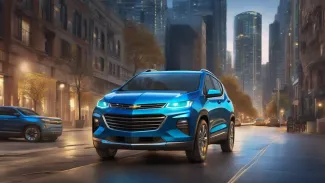
Walk a dog past a Chevrolet Blazer EV or Equinox EV at low speed and something remarkable often happens. The dog freezes. Ears rotate. The tail begins to move. It's as if the vehicle is broadcasting on a frequency that only animals can fully appreciate — and in a very real sense, it is.
General Motors didn't accidentally stumble into the business of making sounds that captivate animals. The company employs Jay Kapadia, its Creative Sound Director since 2017, a classically trained musician and electronics engineer who has devoted years to crafting what he calls "the voice of the car." His brief: make each GM brand sound distinctive, purposeful, and — for Chevrolet specifically — otherworldly.
"Sound plays an important role," Kapadia has explained. "It evokes emotions and becomes a critical component to becoming the voice of the car."
For Chevrolet, that voice is deliberately galactic. The pedestrian alert sound of vehicles like the Blazer EV and Equinox EV has been widely described as the kind of tone you'd hear docking a spacecraft — space-age whistling tones layered with subtle sonic textures. It's not accidental. It's engineered. And dogs, apparently, find it irresistible.
What the Law Requires — and What Designers Choose to Create
The reason any EV makes sound at low speeds is a matter of law, not luxury. Since July 2019 across the EU and for US models under the NHTSA's Federal Motor Vehicle Safety Standard No. 141, all new electric and hybrid vehicles must emit an acoustic warning signal — the Acoustic Vehicle Alerting System, or AVAS — when travelling below 20 km/h in Europe and 30 km/h in the United States. The rule exists to protect pedestrians, cyclists, and visually impaired people who relied for decades on engine noise to detect approaching traffic.
The regulation specifies a range: sounds must fall within frequency bands between 315 Hz and 5,000 Hz, and volume must sit between 50 and 75 decibels — about as loud as a dishwasher. Beyond those constraints, manufacturers have creative freedom. And the choices they make reveal a great deal about brand identity.
BMW and Škoda hired professional music composers. Porsche built sounds described as "emotive, sporty and powerful." The Hyundai Ioniq 5 N can simulate fighter jet sounds. And GM went galactic, creating a unified family of space-age tones for Chevrolet — sounds that, as owners in online forums describe, make the Equinox EV sound "like an alien spaceship" and the GMC Sierra EV like "the intro to a Tron reboot."
There was one notable hiccup in GM's sonic ambitions: in late 2024 and into 2025, 81,177 Chevrolet Equinox EVs were recalled because their AVAS sound wasn't loud enough at speeds up to 10 km/h — failing to meet the required minimum volume ramp that NHTSA mandates. The sound was there. It was simply too quiet for pedestrian safety standards. The fix was a software update, and the characteristic hum returned to its proper volume.
Why Dogs Hear What We Can't
Here is where biology explains what looks, from the outside, like a quirk or a joke. Dogs don't merely hear better than humans — they hear a fundamentally different version of the world.
Humans can detect frequencies up to roughly 20,000 Hz. Dogs hear up to 60,000 Hz. More critically, in the range between 3,000 and 12,000 Hz, canine hearing is significantly more sensitive than ours — capable of detecting sounds at negative decibel levels that humans simply cannot register.
Dog behaviorist Anna Webb has noted: "Dogs' hearing is four times more acute than ours. They pick up on sound frequencies from traditional engine noises that are inaudible to humans."
Electric vehicles, even beyond their AVAS systems, generate acoustic signatures that sit squarely in this canine-sensitive range. The inverter that converts battery current to drive the electric motor operates at switching frequencies typically between 4 kHz and 20 kHz. To most humans, that's either inaudible or a faint high-pitched hum. To a dog, it's a persistent, clear signal — a technological whisper that announces an EV's presence long before any human would notice it.
The AVAS frequency bands, layered on top of this motor whine, create a sonic cocktail that dogs have never encountered in the natural world. No prey animal sounds like this. No threat sounds like this. It's entirely novel — and novelty, for many dogs, triggers intense curiosity rather than fear.
The Broader Picture: EVs Are Actually Good for Dogs
The viral fascination with dogs stalking Chevy EVs through car parks is actually the tip of a more interesting iceberg. Multiple studies have found that dogs are, in general, significantly calmer in electric vehicles than in combustion-engine cars.
Škoda's research monitored heart rate changes in a cocker spaniel named Mango across three vehicle types. In an electric Škoda Elroq, Mango's resting heart rate of 80 BPM rose only to 100 BPM. In a petrol vehicle, it reached 120 BPM. In a diesel, 125 BPM. The absence of engine vibration, gear changes, and low-frequency combustion noise clearly mattered.
A CarGurus survey of over 1,500 dog-owning drivers reinforced the picture. Dog owners who had driven their pets in both EVs and combustion-engine vehicles reported that their dogs were calmer (43%), less anxious (42%), and whined less (45%) in the electric car. Dr. Scott Miller summarised the science: "The quiet mechanics, absence of gear changes, and the spacious interiors of electric cars create a soothing environment for dogs."
Even EV-specific sounds that concern some owners — the high-pitched whine during charging — are typically brief and manageable. The broader acoustic environment of an EV journey, stripped of diesel clatter and petrol rumble, is simply better for animals with sensitive hearing.
This matters for European dog owners making vehicle choices. With 41% of dog owners saying they consider their dog's comfort when selecting a vehicle, and 54% admitting they've avoided trips entirely because of their dog's car anxiety, the acoustic argument for EVs has practical weight.
The Paradox: Calm Journeys, Wild Reaction at the Kerb
There is something delightfully paradoxical about the situation. Inside an EV, travelling at motorway speeds, a dog experiences a quieter, smoother, more stress-free journey than in any combustion car. But at low speeds — precisely when the AVAS system activates — the same vehicle broadcasts a sound that can trigger intense curiosity, excitement, and in some cases obsessive behaviour.
It isn't fear. Studies are consistent on this: EVs don't cause distress in dogs. What Chevy's galactic tones appear to trigger is something closer to fascination — the canine equivalent of hearing an unfamiliar instrument for the first time. The sound doesn't fit any category a dog's ancient sensory system knows. It doesn't smell like a threat. It doesn't behave like prey. But it sounds like nothing else in the world.
Jay Kapadia, designing those sounds in GM's studio, was thinking about brand identity and human emotion. He probably wasn't thinking about a Golden Retriever in Prague pressing its nose to the window and refusing to leave. But in a world of increasingly silent streets, the spaceship hum has found an unexpected audience.
Can the EV pedestrian alert sound be turned off?
In most countries, no — or only under very specific conditions. EU regulations require the AVAS system to function continuously below 20 km/h and cannot be permanently disabled by the driver. In the US, the limit is 30 km/h. Some manufacturers allow the system to be muted when the vehicle is stationary, but the sound must activate as soon as the vehicle moves. Disabling the system entirely would breach road safety regulations.
Do all EVs have the same pedestrian alert sound, or does it vary by brand?
Every manufacturer designs its own AVAS sound profile, which is why Chevy EVs sound noticeably different from a Porsche Taycan, a BMW iX, or a Tesla. GM deliberately gave its Chevrolet brand a "galactic," space-age quality, while other makers opted for sounds resembling modified engine notes, musical tones, or nature-inspired audio. The only constant is the regulatory requirement: audible, within a specified frequency range, and scaling in volume with speed.
Should I be concerned about bringing my dog near EVs or buying one if I have a dog?
Based on available research, there is no evidence that EVs cause distress in dogs — and considerable evidence that journeys in EVs are less stressful for dogs than in combustion vehicles. The curiosity some dogs show toward EV pedestrian alert sounds is generally harmless fascination rather than anxiety. If your dog shows intense interest in EV sounds, this is likely a response to novelty, not a sign of fear. The quieter ride quality and absence of engine vibration make EVs an excellent choice for dog owners.
Source: https://insideevs.com/news/797014/dogs-and-ev-sounds-explainer/