
Listen to this article:
A Launch That Broke All Expectations
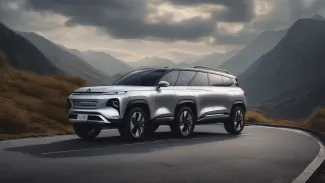
The Xpeng GX is the company's largest and most ambitious vehicle to date — a six-seat premium electric SUV measuring 5,265 mm in length with a 3,115 mm wheelbase. But what made the launch truly remarkable wasn't the engineering specs. It was the pricing strategy.
At launch, Xpeng set a limited-time starting price of 269,800 yuan (approximately $39,790 / €36,500) — a dramatic contrast to its earlier pre-sales price of 399,800 yuan. For a vehicle loaded with autonomous driving technology and premium features, the message was unmistakable: Xpeng was not playing it safe.
The market responded instantly. 24,863 firm orders were placed within the first 12 hours, with over 80% of buyers opting for the Ultra flagship BEV trim, officially priced at 359,800 yuan (349,800 yuan with a 10,000 yuan launch discount). The stampede toward the top trim has created a bottleneck that production capacity cannot yet resolve.
The Numbers Behind the Waiting List
The delivery timeline gap between trim levels tells the story clearly:
- Ultra flagship BEV: 25–29 weeks
- Other BEV variants: 5–7 weeks
- Ultra flagship EREV: 12–14 weeks
- Other extended-range variants: 4–7 weeks
For context, 29 weeks means buyers ordering the top-spec GX today won't receive their vehicle until late November or early December 2026. That's a level of demand backlog more commonly associated with limited-edition sports cars than mass-market electric SUVs.
CNEVPost reported that Deutsche Bank has revised its forecast upward, now projecting potential monthly sales of 5,000 units based on the GX's competitive positioning and technology package.
What Makes the Ultra Flagship Worth the Wait?
The Ultra flagship BEV isn't just the most expensive GX — it's genuinely differentiated. It comes with an exclusive 110 kWh battery pack delivering up to 750 km of range (WLTC cycle), a figure that places it among the longest-range electric SUVs currently on the market anywhere in the world.
The autonomous driving system is where Xpeng has concentrated its most significant engineering effort. The GX is built to L4 autonomous driving standards, featuring a pure-vision, LiDAR-free approach powered by Turing AI chips delivering up to 2,250–3,000 TOPS of computing power depending on the variant. The system uses what Xpeng calls an aviation-grade six-layer redundancy architecture, covering steering, braking, power supply, drive systems, communication, and access.
Additional standout features on the top trim include:
- Steer-by-wire chassis — eliminating the mechanical link between the steering wheel and wheels for more precise control
- AI-dimming privacy glass — electronically controlled transparency across the panoramic roof
- Auto soft-close doors on all four doors
- Six-seat independent seating configuration
The extended-range variant offers a different proposition: 430 km on battery alone and a combined range of 1,585 km when the range extender is factored in — practically eliminating range anxiety for long-distance travel.
The Competitive Battlefield
The GX enters one of China's most contested segments. It competes directly against the Li Auto L9 and AITO M9 — both of which have established strong market positions in the premium Chinese SUV space. Li Auto in particular has been extraordinarily successful with its extended-range strategy, selling hundreds of thousands of vehicles annually.
What separates the GX from these rivals is Xpeng's bet on pure-vision autonomy. While Li Auto and AITO rely on sensor fusion (combining cameras, radar, and LiDAR), Xpeng has doubled down on camera-only perception — the same philosophical approach as Tesla's FSD. Xpeng has publicly defended this stance, arguing that LiDAR is no longer necessary given the maturity of AI vision systems.
The aerodynamic profile supports this technology-forward identity. With a drag coefficient of just 0.255, the GX is exceptionally slippery for a vehicle of its size — contributing to the impressive range figures despite the large body.
What This Means for Global Markets
For now, the Xpeng GX is a China-only product. But the demand signal it's generating has wider implications. Chinese automakers have consistently used their domestic market as a proving ground before expanding internationally, and a vehicle that sells 25,000 units in 12 hours is exactly the kind of commercial validation that accelerates global rollout planning.
Xpeng is already present in Europe through its G6 and G9 models, and has a strategic technology partnership with Volkswagen Group that has produced the ID. Unyx 07. As the company's technology matures and production scales up, a European version of the GX's autonomous driving platform — even if not the GX itself — seems increasingly likely.
For European buyers watching Chinese EV development, the GX wait time phenomenon is a useful reminder: aggressive pricing combined with genuinely capable technology creates demand that outstrips supply. It's a dynamic that European automakers are still learning to navigate.
Will the Xpeng GX be available in Europe?
There is currently no official announcement of a European launch for the Xpeng GX. The vehicle is sold exclusively in China for now. However, Xpeng already sells the G6 and G9 in select European markets and has a technology partnership with Volkswagen, so future expansion of its premium lineup to Europe remains possible.
What is the range of the Xpeng GX Ultra flagship BEV?
The Ultra flagship BEV variant is equipped with an exclusive 110 kWh battery pack and delivers up to 750 km of range on the WLTC cycle — one of the longest ranges of any electric SUV currently on the market.
Why does the Xpeng GX use pure-vision autonomous driving instead of LiDAR?
Xpeng has chosen a camera-only (pure-vision) approach for its autonomous driving system, similar to Tesla's FSD philosophy. The company argues that advances in AI and computing power have made LiDAR redundant, allowing the system to rely entirely on visual data processed by Turing AI chips delivering up to 3,000 TOPS of computing power.
Source: https://cnevpost.com/2026/05/25/xpeng-gx-top-trim-wait-time-29-weeks/